GamblingSEO Agency's 2026 Sportsbook SEO Content Calendar: Mapping Fixtures to Rankings

What Is a Sportsbook SEO Content Calendar and Why Do Fixtures Beat Keywords?
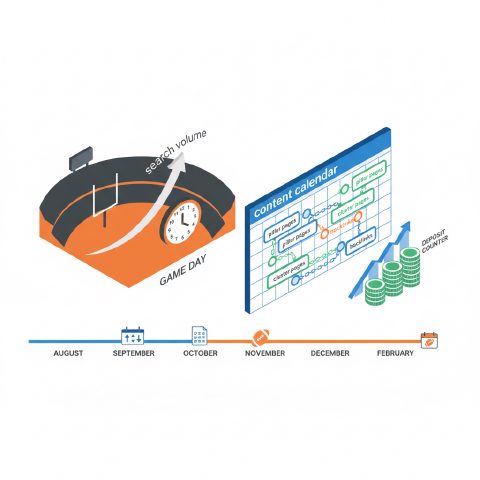
A sportsbook SEO content calendar is a publishing and link-building schedule built around the fixture list, not keyword volume averages. It times content launches, internal links and outreach to kickoff dates so pages are ranked and indexed inside the 10-21 day window when actual bettor search intent spikes, then decays.
Most operators build their content calendars off an Ahrefs or SEMrush export, sorted by monthly search volume, and slot topics into a grid like a generic affiliate site would. That falls apart with sportsbook queries because 'Chiefs vs Bills odds' doesn't have a stable monthly volume, it has a spike window running from about day minus-12 to roughly 18 hours after the final whistle, then it drops off a cliff. A volume-averaged calendar smooths that spike into a number that's practically useless for scheduling.
Across the client set in our Gambling Link-Price Index, NFL fixture windows spike 30-45x baseline demand, EPL matchdays run 8-15x, and something like the Kentucky Derby or Grand National can hit 60x for a single Saturday. If your page isn't indexed, internally linked from a relevant hub, and carrying at least some external link signal by day minus-10, you're competing against DraftKings, FanDuel and bet365 programmatic templates that have been auto-publishing this exact page format for three seasons.
The fixture-first model treats every event page as a timed asset with a build date, a peak date and a decay date baked in from day one. Keywords still drive the on-page targeting and header structure, but the publishing schedule and link velocity get set by the sports calendar, not by whatever date a content brief happened to land on someone's desk.
How Do You Build a 12-Month Fixture Map for Sportsbook SEO?
Plot every major single event, Super Bowl, March Madness, the Masters, Kentucky Derby, World Cup or Euros, NBA Finals, big UFC/boxing cards, alongside recurring weekly windows like NFL Sundays and EPL matchdays on one shared calendar, then assign each a build-lead time and link budget scaled to its historical spike size.
I run this as a single shared sheet, not scattered content briefs. Each row gets a fixture, an event type (mega single-event vs recurring), a peak search window pulled from three years of Trends data, a recommended build-lead time, and a link budget expressed as a range rather than a fixed number, because competitive density shifts year to year.
The mistake I see most is treating a recurring weekly fixture with the same intensity as a once-a-year mega event. An NFL Week 6 page and a Super Bowl page are not the same asset class, one needs a template and light link touches, the other needs a 60-day ramp and dozens of placements.
| Fixture | Type | Peak Search Window | Recommended Build Lead | Approx. Link Budget |
|---|---|---|---|---|
| Super Bowl LX (Feb 2026) | One-off mega event | 12 days pre-kickoff | 45-60 days | 25-40 links |
| FIFA World Cup 2026 (Jun-Jul) | Mega quadrennial | 21 days pre + daily during | 90+ days | 60-100 links (hub + spokes) |
| March Madness | Recurring annual | 7 days pre-tournament | 30 days | 15-25 links |
| Kentucky Derby | Recurring annual | 14 days pre | 30 days | 10-15 links |
| The Masters | Recurring annual | 10 days pre | 21 days | 8-12 links |
| NBA Finals | Annual recurring | 14 days pre | 21 days | 10-15 links |
| NFL Week 1-18 | Weekly recurring | 10 days pre each week | 10-14 days | 2-4 links per page |
| EPL Matchday | Weekly recurring | 5-7 days pre | 7-10 days | 1-3 links per page |
How Far Before Kickoff Should Event Pages Go Live?
Publish 45-60 days ahead for mega single events like the Super Bowl or World Cup final, and 10-14 days ahead for recurring weekly fixtures like NFL games or EPL matchdays. Google needs 15-25 days of crawl-and-render cycles plus link signal accumulation before a new URL can compete against established sportsbook domains.
The lead-time gap isn't arbitrary. Mega events pull in aggressive competitive publishing from every major .com sportsbook and dozens of affiliate sites, so your page needs enough indexed age and accumulated link signal to be in the conversation by the time search volume actually spikes. Weekly fixtures face less depth of competition per individual week, so a templated 10-14 day lead with 2-4 quick link touches is usually enough to rank inside the top 10 for 'Team A vs Team B odds' type queries.
A realistic mega-event timeline: day minus-60 to minus-45, publish or refresh the hub page. Day minus-30, start a niche-edit drip at 2-3 per week. Day minus-14, publish the event-specific spoke page once the matchup or bracket is set. Day minus-7, push remaining link velocity. Day zero, event happens. Day plus-3, redirect or fold the spoke back into the hub. Skip any of these steps and you're either publishing too late to rank in time, or leaving a dead page live too long after the spike ends.
What's the Link-Building Velocity for Event-Driven Sportsbook Pages?
Ramp link velocity in four phases for a mega event page: 5-8 low-risk niche edits at day minus-60 to minus-45, 8-12 mixed niche edits and tier-1 PBN links at day minus-44 to minus-21, 10-15 diversified guest posts and crowd mentions at day minus-20 to minus-10, and a final 5-8 link push in the last nine days before kickoff.
Velocity control matters more here than on a static evergreen page because a brand-new URL suddenly gaining 15-20 referring domains in a single week reads as unnatural to Google's spam systems, even in a niche where aggressive link building is the norm. I cap weekly link growth at roughly 20% of the page's total accrued link count during the ramp, front-loading lower-risk niche edits and holding PBN tier-1 placements for the middle phase once the page has some organic indexation history.
After kickoff, velocity drops to zero. There's no reason to keep placing links on a page that's about to lose 70-90% of its traffic within 72 hours, that budget gets redirected to the next fixture on the calendar instead.
| Window Before Kickoff | Links Placed | Link Type | Risk Note |
|---|---|---|---|
| Day -60 to -45 | 5-8 | Niche edits, DR30-50 sports/news sites | Low risk, natural pace |
| Day -44 to -21 | 8-12 | Mixed niche edits + 2-3 tier-1 PBN | Medium, watch anchor ratio |
| Day -20 to -10 | 10-15 | Guest posts + crowd/forum mentions | Medium, diversify referring domains |
| Day -9 to 0 | 5-8 | Final niche edits + press-style mentions | Cap weekly growth under 20% |
| Day +1 onward | 0 | None, monitor decay only | N/A |
How Do You Structure Evergreen Hubs vs Event Spoke Pages Without Cannibalizing Rankings?
Run one permanent evergreen hub page, say /nfl-betting/, that owns the head keyword year-round, then publish disposable event spoke pages beneath it, like /nfl-betting/super-bowl-2026/, that inherit authority through internal links during the event window and either get pruned or 301-redirected into the hub afterward.
I've audited operator sites running two live pages both trying to rank for 'NFL betting odds', one evergreen, one event-specific, and both losing visibility because Google can't decide which to trust. In three separate audits this cost a combined 15-20% visibility drop on the shared keyword set until we consolidated. The fix is always the same: one canonical hub, clearly subordinate spoke URLs, and internal links flowing from hub to spoke only during the live window.
Once the event ends, the internal link direction reverses. The spoke either gets folded into the hub via 301 redirect, preserving whatever link equity it picked up during its short life, or it stays live as a thin archive page with a canonical pointing to the hub if you want to keep the URL for next year's reuse. What you never do is leave two competing live pages both targeting the same modifier indefinitely.
What Does a Super Bowl Betting SEO Calendar Actually Look Like?
A Super Bowl betting SEO calendar starts 60 days out refreshing the evergreen hub, ramps link velocity hard through Conference Championship weekend when search intent triples overnight, peaks the week of the game with prop-bet and live-odds content, then folds the spoke page back into the hub within 72 hours of the final whistle.
The single biggest inflection point in the whole calendar is Conference Championship Sunday, two weeks before kickoff. That's the moment the matchup is confirmed and search volume for team-specific odds pages triples almost overnight. Publish the team-specific spoke pages the moment the matchup is set, not before, since generic 'Super Bowl 2026 odds' content published too early with no confirmed teams underperforms against pages that nail the exact matchup on day one.
Prop bet content, coin toss odds, halftime show betting, MVP props, gets its own sub-pages in the final ten days, because these carry lower competition and often outrank the main odds page faster, feeding link equity upward through internal links. Game week itself is about live odds-movement updates and freshness signals, not new content.
| Stage | Timing | Content Focus | Link Action |
|---|---|---|---|
| Hub refresh | Day -60 | Update evergreen NFL/Super Bowl hub, schema markup | 5-6 niche edits into hub page |
| Conference Championships | Day -14 | Publish matchup-specific odds spoke pages | 8-10 links across spokes within 72 hrs |
| Prop bet expansion | Day -10 to -3 | Coin toss, halftime show, MVP prop pages | 6-8 niche edits + crowd mentions |
| Game week | Day -7 to 0 | Daily odds movement, live blog updates | Final 5-6 links, press mentions if secured |
| Post-game | Day +1 to +3 | Redirect/fold spoke into hub, archive props | No new links, monitor equity transfer |
How Should You Split Resources Between Recurring Fixtures and One-Off Mega Events?
Recurring fixtures like NFL Sundays or EPL matchdays need templated, fast-turnaround pages with 1-3 light link touches each, while one-off mega events like the Super Bowl or World Cup justify a 25-100 link budget because the traffic spike and downstream value run 10-50x higher than a single regular-season week.
For a mid-size operator's annual SEO link budget, I generally recommend a 70/30 split, 70% of link spend across the 6-10 mega and semi-mega fixtures on the calendar, 30% spread thin across the 30-40 weekly recurring windows. Spending evenly across every fixture on the calendar is the fastest way to underfund the events that actually move revenue while overspending on regular-season weeks that were never going to rank past page two anyway.
Templating is what makes the recurring side viable at all. A locked page structure, matchup header, odds table, spread/moneyline/total blocks, injury notes, internal links to the hub and to same-week fixtures, lets a content team turn around a new weekly page in under two hours, which is the only way to sustain 1-3 link touches per page across 18 NFL weeks without blowing the budget meant for February.
What Anchor Text Ratios Work on Event-Driven Sportsbook Pages?
Event spoke pages should run heavier on branded and naked-URL anchors (55-65% combined) with partial-match anchors capped near 20-25%, since a new URL suddenly carrying a spike of partial-match anchors reads faster to spam systems than the same ratio on an aged hub page, which can tolerate 30-35% partial match.
This is one of the anchor models I've had to rebuild for clients coming out of over-optimization filters. The pattern I see in flagged sites is almost always the same: someone applied hub-page anchor ratios to a brand-new event page, pushing 30%+ exact and partial match anchors onto a URL with two weeks of history. Google's systems weight anchor diversity against page age, and a young URL with an aggressive partial-match cluster is a much easier signal to catch than the same ratio spread across a three-year-old hub with hundreds of referring domains.
The fix that's worked across multiple operator recoveries: shift event spoke pages toward branded and naked-URL anchors, hold generic anchors ('bet here', 'check odds') around 10-12%, and drop exact-match to near zero. Save the partial-match weight for the evergreen hub, where the aged link profile can absorb it without tripping anything.
| Anchor Type | Evergreen Hub Page | Event Spoke Page |
|---|---|---|
| Branded | 30-35% | 40-45% |
| Naked URL | 20-25% | 15-20% |
| Partial match | 30-35% | 20-25% |
| Generic ('bet here', 'odds') | 10-15% | 10-12% |
| Exact match | 3-5% | 2-3% |
What Happens to Backlinks After the Event Page's Traffic Dies?
301-redirect the event page into the evergreen hub within 3-7 days of the traffic collapse so the accumulated link equity transfers instead of evaporating. Never delete the URL outright, and never leave it live and orphaned, a graveyard of dead event pages reads to Google as low-quality inventory dragging the whole subfolder down.
I've tracked this across enough client sites to give a real range: operators who redirect promptly retain roughly 70-85% of the accrued link authority into the hub within the next crawl cycle. Operators who leave the page live but orphaned, no internal links pointing to it, no updates, just sitting there, lose most of that equity within one to two core update cycles, because Google's freshness and relevance signals decay along with the page's own traffic.
For links placed on PBN assets specifically, redirecting the target page doesn't waste the placement, update the PBN post's outbound link to point at the hub or at next year's placeholder URL instead of leaving it dangling at a dead 404 or a stale event page nobody's updated since February. This is basic PBN hygiene that most in-house teams skip because nobody owns the post-event cleanup task.
What Tools Track Fixture-Based Sportsbook SEO Performance?
Use Ahrefs Rank Tracker on daily refresh during active event windows, Google Search Console for real-time index coverage and URL inspection, Google Trends to confirm spike timing against historical patterns, and a shared fixture calendar in Airtable or Sheets tagging every build, link and redirect date.
Daily rank tracking is non-negotiable during a spike window, weekly refreshes miss the entire rise-and-fall cycle on a page that might only matter for ten days total. I also run Screaming Frog crawls before every mega event push to confirm the spoke page is crawlable, internally linked, and free of accidental noindex tags, which happens more often than it should when teams clone last year's page template.
For reporting, a Looker Studio dashboard pulling GSC and Ahrefs data by fixture, showing incremental sessions against the spike window rather than flat monthly totals, is what actually tells you which events are worth next year's budget. Flat monthly organic traffic charts hide the entire story on fixture-based pages.
What Are the Biggest Mistakes Operators Make With Event-Driven Sportsbook Content?
The costliest mistake is publishing event pages too early with zero link support, so novelty indexing fades before the real spike hits weeks later. The second is never redirecting dead pages afterward, leaving a decaying archive of orphaned URLs that drags overall domain quality signals down across core updates.
Beyond those two, I see the same handful of errors repeatedly: treating every fixture on the calendar with equal link budget regardless of spike size, skipping schema markup for odds and event data so pages miss rich result eligibility, and applying hub-page exact-match anchor ratios to brand-new spoke URLs, which is exactly the pattern that trips over-optimization filters.
The other one that's purely technical: live odds widgets and real-time score updates loading heavy JavaScript that tanks mobile page speed right when traffic peaks during game time. I've seen Core Web Vitals scores crater on Super Bowl day specifically because nobody load-tested the live-odds widget under real traffic before kickoff.
How Do You Measure ROI on a Fixture-Based Content Calendar?
Calculate ROI per fixture as incremental organic sessions during the spike window multiplied by session-to-deposit conversion rate and average first deposit value, minus link spend and production cost. Compare cost-per-ranking-day across fixtures to decide which events deserve budget next year and which get cut.
A rough real-world comparison from our tracked accounts: a Super Bowl page running $4,000-$7,000 in combined content and link spend typically delivers 40,000-80,000 incremental sessions across a 21-day window at typical operator conversion rates, while a single NFL weekly page costing $300-$500 delivers 3,000-6,000 sessions over 10-14 days. On cost-per-session, the mega event usually wins, but the weekly pages compound across 18 weeks in a way a single Super Bowl page can't.
Current niche-edit pricing in our Link-Price Index runs $180-$450 per placement on DR30-60 gambling-relevant sites depending on region and market maturity, with US and UK sites commanding the top end. Run that against your incremental session value per event, and you get a real cost-per-ranking-day figure instead of a gut-feel guess about which fixtures are 'worth it.'




Comments
No comments yet, be the first.