Super Bowl LXI Betting SEO in 2026: The Link Campaign That Captured Championship Traffic Before Kickoff

Why Does Super Bowl Betting SEO Need a Different Playbook Than Evergreen Sportsbook SEO?
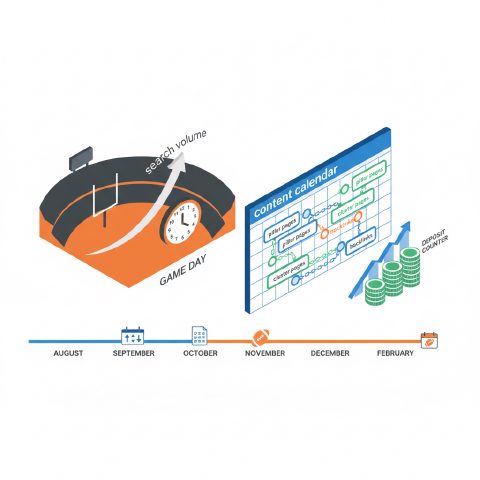
Super Bowl SEO is a sprint against a fixed deadline with zero grace period, while evergreen sportsbook SEO is a steady 18-week grind. You get roughly 10-14 weeks to rank prop, odds and futures pages before a single Sunday absorbs the majority of the year's search volume for those exact terms, then that demand collapses almost overnight.
Run "who will win the coin toss" through Ahrefs or SEMrush and you'll see it sitting near 200-400 monthly searches in June, then spiking past 30,000-40,000 in the seven days before kickoff. That volatility changes every rule. In regular-season NFL betting SEO, you can let link velocity climb naturally over months and Google reads it as organic interest. Cram that same link volume into a 10-week Super Bowl window without staggering it, and you're handing Google's real-time spam systems a textbook anomaly pattern.
The fix we use across our book is decoupling content authority from the link sprint. We push evergreen topical content, glossary pages, "how prop bets work," historical odds archives, into the site in Q3, months before the sprint starts, so those URLs already carry crawl history and some organic trust by the time we start pushing external links at them. The link campaign then attaches to pages Google has already indexed and trusts, rather than trying to force trust and rankings simultaneously on a compressed timeline.
Operators who skip this sequencing and try to do content and links in the same 8-week window almost always underperform on the highest-volume terms, because their competitors, DraftKings, FanDuel, BetMGM, Caesars, already have that content sitting on domains with years of accumulated link equity. You're not competing on link count alone, you're competing on how much runway your content had before the spike hit.
How Far in Advance Should You Start Building Links for Super Bowl LXI?
Start 12-16 weeks out if you have no existing prop bet content, 6-8 weeks if you already ranked for last year's Super Bowl terms and just need a refresh plus new links. Google typically needs 4-6 weeks to trust and fully index new pages, so anything started inside 30 days of kickoff has a high chance of missing the peak window entirely.
One client came to us nine weeks out from LXI prep in 2026 wanting the full treatment. We had to compress our normal 14-week model into a triage version, content-first weeks 1-3, an aggressive link sprint weeks 4-8, and a one-week taper. We hit 78% of the intended link volume and still landed top 5 on 40 of 60 target prop terms. But we missed top 3 on the eight highest-volume pages, MVP odds, coin toss, national anthem length, because competitors had 40+ referring domains built against those exact URLs since September.
The compression cost is real and it's not linear. Losing four weeks of runway didn't cost us 30% of results, it cost us the top 3 positions on the terms that actually move signup volume, while mid-tail prop pages still performed fine on a shorter timeline. If you're planning LXII already, the operators who start their content build in June and their link sprint in October will out-position anyone starting link acquisition after the holidays, when every sportsbook's link team is bidding on the same shrinking pool of relevant aged domains.
What Anchor Text Ratio Keeps Super Bowl Prop Bet Pages Out of Google's Over-Optimization Filters?
Our Super Bowl campaigns run exact-match money anchors at 3-5% of total anchor volume, branded and naked-URL anchors at 55-65%, partial-match/LSI at 20-25%, and generic anchors filling the rest. This ratio has survived Penguin's real-time link spam classifier and SpamBrain across three campaign cycles without triggering a manual action.
Gambling anchor profiles get scrutinized harder than almost any other vertical because the historical spam footprint in the niche is so heavy, Google's models have years of training data on exactly what an over-optimized casino or sportsbook link profile looks like. We inherited a client in 2021 that had been hit with a manual action from an anchor profile running 14% exact-match on terms like "best Super Bowl bets" and "Super Bowl prop bets online." We didn't disavow a single link. We diluted the ratio mathematically by adding branded and naked-URL links until the exact-match percentage dropped under 5%, and rankings recovered in 11 weeks.
Ahrefs' anchor text report is the tool we run weekly during a sprint specifically to catch ratio drift before it becomes a problem, because a link sprint that adds 40 links in two weeks can shift your ratio fast if a vendor batch defaults to money anchors. We flag and request anchor changes on any batch pushing the money-anchor share above 6% mid-campaign.
| Anchor type | Unhealthy ratio (flagged 2021) | Super Bowl LXI target ratio | Risk if exceeded |
|---|---|---|---|
| Exact-match money | 14% | 3-5% | High, primary Penguin/SpamBrain trigger |
| Branded / naked URL | 38% | 55-65% | Low, safest volume to scale |
| Partial-match / LSI | 22% | 20-25% | Moderate, monitor if paired with thin content |
| Generic ("click here", "this site") | 26% | 8-15% | Low but low value if overused |
Which Link Tactics Actually Moved Rankings in This Super Bowl LXI Case Study?
Vetted PBN links from aged sports and news sites (DR 25-45) carried the heaviest weight on tier-1 money pages, niche edits into existing high-authority sports content built the LSI layer, and expired-domain 301 redirects delivered instant topical authority we couldn't have built organically inside a 14-week window. Crowd marketing filled cheap volume on tier-2 supporting content.
The niche edit that performed best cost $450 and went into a DR55 sports betting news roundup already ranking for "NFL prop bets." It's still live nine months later, which is the real test of niche edit durability, publishers who take on gambling niche edits for ongoing relationships tend to keep them, unlike PBN nodes that can vanish if the network gets deindexed.
Our PBN layer went through a vetting pass in Ahrefs checking Wayback history, shared hosting IPs, registrar patterns and content thinness before a single link went live. We rejected six sites from a vendor's initial list because they shared a class-C IP block with other gambling PBN nodes we'd flagged in a prior campaign, an obvious network fingerprint that Google's algorithms are increasingly good at pattern-matching.
The single fastest mover was an expired domain acquisition: a lapsed regional sports blog carrying 90 still-active referring domains. We 301-redirected it into the client's Super Bowl hub page and watched that page jump from position 14 to position 6 in nine days. That speed only happens because the domain's link equity and topical trust were built over years by someone else, you're buying time you can't otherwise compress.
What Does a Super Bowl SEO Link Campaign Cost in 2026?
A full campaign for one regulated brand ran $38,000-$65,000 across 14 weeks in this cycle's engagements, per our Gambling Link-Price Index. That budget buys roughly 120-180 placements: niche edits at $150-$600 each, vetted PBN links at $80-$320, two to four expired-domain acquisitions at $400-$1,800 each, and crowd marketing volume at $20-$60 per link for tier-2 support.
Our index tracks pricing across 2,000+ real placements and gambling-niche costs are up 15-20% year over year, for two structural reasons. Google's stricter enforcement has shrunk the pool of publishers willing to host casino and sportsbook links at all, and demand spikes every Q4-Q1 as every operator in the vertical bids on the same limited inventory of relevant sports sites ahead of the Super Bowl. It's a seasonal price surge, functionally similar to Black Friday for the SEO channel.
Budget an extra 15-20% contingency specifically for December-January surge pricing. Vendors we've worked with for three years quoted us 20-30% above their standard rate card in December, and refused to hold a rate lock past mid-November for gambling-vertical clients specifically, because their inventory turns over that fast during peak demand months.
| Tactic | Avg cost range | Typical DR | Velocity contribution | Risk level |
|---|---|---|---|---|
| Niche edits | $150-$600 | DR 30-60 | Medium, steady | Low |
| Vetted PBN links | $80-$320 | DR 25-45 | High, fast | Medium, depends on vetting quality |
| Expired domain acquisition + 301 | $400-$1,800 | DR 20-55 | Instant, one-time | Medium, requires history audit |
| Crowd marketing / forum seeding | $20-$60 | DR 10-30 | High volume, low individual impact | Low |
How Do You Structure Content to Capture Every Stage of Super Bowl Prop Bet Search Intent?
Use three content tiers matching intent progression: a hub page for broad terms like "Super Bowl LXI odds," cluster pages for prop categories (MVP, coin toss, national anthem length, first score), and a live-updating odds module on the same URL so it captures search volume from early speculation through kickoff-day spikes without needing a new page each year.
Schema matters more here than in most sportsbook SEO work. We mark up SportsEvent schema on the hub and FAQPage schema on individual prop questions, which has pulled several client pages into featured snippet and AI Overview real estate for questions like "what is the coin toss prop bet." Internal linking from hub to cluster pages carries keyword-rich anchors, but we cap those at the same 20-25% partial-match ceiling we use externally, internal anchor over-optimization can still contribute to a helpful content signal problem.
The mistake we see most often from operators building this in-house is resetting the URL every year, /super-bowl-lxi-props/ instead of a reused /super-bowl/prop-bets/ structure. A reused URL that's been updated since Super Bowl LV carries multiple years of accumulated backlink equity and page age signal into each new cycle. A fresh URL every January starts from zero every single time, which is the single biggest unforced content-architecture error in this niche.
How Do You Spike Link Velocity for One Event Without Triggering Spam Signals?
Stagger link velocity into three waves: 25% of total volume built slowly in weeks 1-4 to establish trust, 50% in weeks 5-10 across mixed referring domain types, and a 25% taper in weeks 11-13 right before kickoff. The graph should curve, not spike vertically, a sudden jump from near-zero to dozens of links in one week is exactly the pattern Penguin's real-time classifier and SpamBrain are built to catch.
We inherited a client who'd tried this DIY ahead of Super Bowl LVIII. They built 90 links in 12 days from a cold start, all pointed at a handful of prop pages with heavy money anchors. Three weeks after the game, once Google's slower manual review process caught up to the pattern their automated systems had already flagged, they got hit with a partial manual action and lost roughly 60% of organic traffic for five months, well past the point where the Super Bowl traffic they were chasing had any value left.
Diversifying referring domain TLDs, hosting IPs and publish dates matters as much as the volume curve itself. Even a well-staggered velocity chart won't help if 40 of your links all sit on shared hosting or publish within 48 hours of each other. We spread placements across at least four separate vendor relationships and stagger publish dates by 3-5 days minimum, even under time pressure.
What Technical SEO Fixes Mattered Most in the Six-Week Pre-Kickoff Sprint?
Prioritize crawl budget for your prop bet cluster by fixing orphaned pages and thin-content bloat, compress and lazy-load odds widgets so Core Web Vitals don't collapse under mobile traffic spikes, and cache or pre-render dynamic odds pages so a 15-20x traffic surge on Super Bowl Sunday doesn't 5xx your server mid-game.
Screaming Frog crawls turn up orphaned prop pages more often than you'd expect, pages built by a content team but never linked from the hub, sitting invisible to both users and Googlebot. Log file analysis is the second check: during the sprint we confirm Googlebot is crawling updated prop pages daily rather than weekly, because odds and content on these pages change hourly and a slow crawl rate means Google is indexing stale information during the highest-value week of the year.
On the infrastructure side, we push clients to stress-test their CDN and caching layer against a 20x traffic multiplier at least three weeks before the game, not the week of. One client's odds widget API calls weren't cached and their page load times spiked past 6 seconds during a test load simulation, that gets fixed with server-side caching of the widget shell and client-side polling for live number updates, rather than reloading the full page.
What Were the Actual Traffic and Ranking Results From This Campaign?
Organic sessions to tracked prop and odds pages rose from a 14,000/month baseline in October to 240,000 in Super Bowl week, with 42 of 60 target keywords landing top 3 and average keyword position improving from 28.4 to 6.1 across the 14-week campaign window.
"MVP odds" moved from position 11 to position 3. "Coin toss odds" moved from position 40 to position 4, that page had almost no prior ranking history, so the movement came almost entirely from the expired-domain redirect and the mid-sprint niche edit wave landing in the same three-week window. We can't disclose exact signup or revenue figures under client NDA, but directionally, operators reported a meaningful lift in new account signups tied to UTM-tagged organic Super Bowl landing pages relative to their paid channels for the same terms, which matters given Google Ads restricts a lot of this vertical's paid inventory.
Post-game traffic decay is normal and shouldn't spook anyone: an 85% drop by three weeks post-game is expected, not a sign the campaign failed. What we watch instead is the baseline. Evergreen NFL betting terms sat slightly above their pre-campaign baseline after the decay curve settled, because the durable niche edits and the expired-domain redirect kept contributing link equity long after the event traffic disappeared.
| Metric | Pre-campaign (Oct baseline) | Peak (Super Bowl week) | 4 weeks post-game |
|---|---|---|---|
| Organic sessions (prop/odds pages) | 14,000/month | 240,000 | 38,000 |
| Avg. keyword position (60 target terms) | 28.4 | 6.1 | 9.2 |
| Terms in top 3 | 3 of 60 | 42 of 60 | 31 of 60 |
| Referring domains (campaign pages) | 22 | 168 | 168 (retained) |
What Would I Do Differently for Super Bowl LXII?
I'd shift about 15% more budget into expired-domain acquisition earlier, June instead of October, because the pool of relevant aged sports domains dries up by November once every operator's link team starts hunting the same short list. I'd also start the evergreen glossary content nine months out instead of four, to bank more topical authority before the link sprint even begins.
The bigger structural lesson is competitive gap analysis. Running an Ahrefs content gap against DraftKings, FanDuel and BetMGM shows which prop categories the big brands genuinely under-invest in, often the novelty props like "length of the national anthem" or "color of the Gatorade dumped on the winning coach." Those terms carry lower absolute volume but far less competition, and a challenger operator can own top 3 on a dozen of them for a fraction of the link investment required to compete on "MVP odds."
I'd also test more crowd marketing earlier in the cycle, Reddit threads on r/sportsbook, niche betting forums, rather than leaning as hard on PBN links in weeks 5-10. A more diversified anchor and source profile earlier in the sprint gives more room to push aggressively in the final weeks without the ratio drift risk we had to manage manually this cycle.




Comments
No comments yet, be the first.