Sportsbook SEO for the 2026 NFL Season: GamblingSEO.agency's Link-Price Playbook

What makes sportsbook SEO different from casino or affiliate SEO?
Sportsbook SEO runs on a compressed, recurring calendar instead of evergreen content. Search volume for terms like 'NFL week 5 odds' spikes and dies within days, link opportunities cluster around news cycles, and Google treats betting-line pages as YMYL content requiring stronger E-E-A-T signals than a typical slots review site.
Casino SEO is mostly evergreen, a 'best online slots 2026' page can rank for a year with minor updates. Sportsbook content decays fast. A page targeting 'Chiefs vs Bills odds' is dead volume the Monday after the game. That means your content calendar has to be production-line efficient: templated odds pages, automated line-update feeds via API, and editorial around 18 weeks of regular season plus playoffs, not a handful of static pillar pages.
Link building follows the same rhythm. Sports journalists and bettors link to fresh, timely content, injury reports, line movement analysis, sharp money tracking, far more readily than to a static 'how sports betting works' guide. I've placed over 300 sportsbook links in the past two NFL seasons through our index, and the acceptance rate on timely content (power rankings, week-by-week previews) runs 3-4x higher than on evergreen pages pitched to the same sites.
Google also scrutinizes betting-line accuracy and licensing disclosure harder than it does casino bonus claims, because moneyline and spread content sits closer to financial advice in its YMYL classification. Author bios, licensing badges (state gaming commission numbers for regulated operators, or clear jurisdiction disclosure for offshore books), and citation of official league injury reports all matter more here than on a typical iGaming review page.
How do you build a sports betting content calendar for the 2026 NFL season?
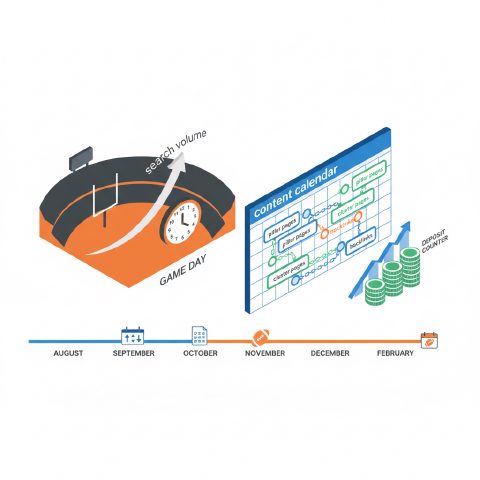
Build the calendar backward from the September 2026 kickoff, mapping 18 regular-season weeks, bye weeks, Thanksgiving and Christmas slates, and the postseason through the Super Bowl. Each week needs odds pages, injury-driven line-move posts, and one link-worthy asset, a data study, power rankings, or sharp-money tracker.
Start the calendar in February, right after the previous Super Bowl. That's when you draft team-by-team preview templates, set up your odds-feed integration (most operators pull from a provider like Sportradar or their own trading desk), and lock outreach targets for the season. By April, once the schedule releases, you slot exact publish dates for each week's preview and recap content, plus draft/trade-driven news hooks through August training camp.
The weekly cadence during the season looks like this: Monday recap and 'what we learned' analysis, Wednesday injury report update with line movement commentary, Friday full-slate preview with picks, and Sunday/Monday live odds pages. That's 4 core content pieces per week for 18 weeks, roughly 72 timed assets, plus playoff and Super Bowl content in January-February 2027.
The link-worthy layer sits on top of that grind. One data-driven asset per month, 'which teams beat the spread most as home underdogs since 2015,' 'public betting percentage vs closing line value by division', is what earns unlinked mentions and outreach wins on sites like Awful Announcing, Sports Illustrated's betting vertical, or local sports-radio blogs. Recap and odds pages rarely get organic links; they exist for search volume capture and internal link equity distribution.
What does it actually cost to build links for a sportsbook site in 2026?
Our Link-Price Index shows sportsbook niche edits on DR40-60 sports media sites running $250-$650 per placement, guest posts on the same tier at $400-$900, and digital-PR hits during NFL season spiking 30-50% higher than off-season due to journalist demand. PBN links, where usable, run $120-$350 depending on domain quality.
Pricing moves with the calendar in this niche more than in any other vertical we track. A niche edit on a mid-authority sports blog that costs $300 in June can run $450-$550 in September when every sportsbook affiliate and operator is fighting for the same NFL-adjacent inventory. Budget for that seasonal markup or lock annual retainer rates with your link vendors before July.
Digital PR is where the real cost swings show up. A data-driven pitch, say, an analysis of home-underdog ATS records, placed through HARO-style journalist outreach or a direct pitch to a betting editor can land free if the data is genuinely newsworthy, or run $800-$2,500 through a paid PR agency guaranteeing placement on outlets like Awful Announcing, The Ringer's gambling vertical, or regional sports-radio sites. I've seen operators pay $3,000+ for a single Yahoo Sports or CBS Sports contributor mention during peak season, expensive, but those links carry real topical relevance weight that a generic DR70 niche edit doesn't.
PBN links still work in this vertical if the domains are properly vetted, real Wayback Machine history, clean backlink profile in Ahrefs, no prior gambling or PBN footprint, and traffic that didn't come from a link network. Expect $120-$350 per placement on a well-run private network, but budget for churn: gambling PBNs get deindexed at a higher rate than PBNs in other verticals because Google's spam team actively hunts betting-related link networks after every core update.
| Link type | Typical DR range | Off-season cost | In-season (Aug-Feb) cost | Risk level |
|---|---|---|---|---|
| Niche edit (sports media) | DR 40-60 | $250-$450 | $350-$650 | Low-Medium |
| Guest post (sports blog) | DR 30-55 | $300-$600 | $400-$900 | Low |
| Digital PR / journalist pitch | DR 60-90 | $500-$1,500 | $800-$2,500 | Low |
| Vetted PBN placement | DR 25-45 | $120-$300 | $150-$350 | Medium-High |
| Forum/crowd marketing seed | DR 15-35 | $20-$60 each | $25-$75 each | Medium |
How many backlinks does it actually take to rank for NFL betting keywords?
Ranking a mid-tail term like 'NFL week 6 odds and picks' typically needs 15-30 referring domains at DR30+; a head term like 'best NFL betting sites' needs 80-150+ referring domains at DR40+ with sustained content freshness. Volume matters less than topical relevance and recency of the linking page.
I pull competitor link data in Ahrefs before quoting any sportsbook client, and the pattern holds every season: the top 3 ranking pages for volatile weekly terms rarely have huge link counts, because Google leans on freshness and content-update signals more than raw authority for time-sensitive queries. What separates the #1 from #4 spot on 'NFL odds week 12' is often update frequency and internal linking from your live scores hub, not backlinks.
Head terms are a different fight entirely. 'Best NFL betting sites 2026' or 'NFL betting sites USA' sit in front of DraftKings, FanDuel, BetMGM and legacy affiliate sites with thousands of referring domains built over a decade. A challenger book realistically needs 80-150 referring domains from DR40+ sports, news, and finance-adjacent sites, sustained link velocity of 15-25 new domains a month for 6+ months, and a content depth that matches or beats what's already ranking, not just more links thrown at a thin page.
Don't confuse total backlinks with referring domains here. I see operators buy 200 links from 40 domains and wonder why nothing moves, Google's link graph values domain diversity far more than raw count once you're past roughly 3-5 links per domain. Spread the budget wide before you go deep on any single source.
What anchor text ratio keeps a sportsbook out of Google's over-optimization filters?
Keep branded and naked-URL anchors at 65-75% of your total profile, partial-match/generic anchors at 15-25%, and exact-match anchors under 5%. Sportsbooks that push exact-match anchors like 'best NFL betting site' above 8-10% are the profiles I most often see hit by algorithmic devaluation after a core update.
Sports betting is one of the most anchor-text-scrutinized niches we manage, alongside payday loans and CBD. Competitive pressure pushes agencies toward exact-match anchors because the ranking lift when it works is real, but the failure mode is common, and it's usually a slow ranking bleed starting 60-90 days after a spike in exact-match link velocity, not an instant manual action.
My model for sportsbook clients: 40-45% branded anchors (brand name, brand + 'sportsbook'), 20-25% naked URL or 'click here'/'this site' generic anchors, 20-25% partial-match ('NFL odds tracker,' 'this week's betting lines'), and 3-5% exact-match maximum, reserved for your strongest, most naturally-earned links, the digital PR hits and genuine editorial mentions, never the niche edits or PBN tier.
I've pulled two operator sites out of what looked like Penguin-era anchor devaluation in the last 18 months by diluting exact-match ratio from 12-14% down to under 5% over a 4-month period, layering in branded and generic anchors on fresh niche edits rather than disavowing everything. Disavow is a last resort for genuinely toxic links, not a fix for over-optimized-but-legitimate anchors, mass disavowing healthy links just erases equity you paid for.
| Anchor type | Target % | Example | Where to place it |
|---|---|---|---|
| Branded | 40-45% | "BetXYZ", "BetXYZ Sportsbook" | All tiers |
| Naked URL / generic | 20-25% | "betxyz.com", "this site" | Niche edits, PBN |
| Partial match | 20-25% | "NFL odds tracker at BetXYZ" | Guest posts, PR |
| Exact match | 3-5% | "best NFL betting sites" | Digital PR only |
| LSI/related | 5-10% | "point spread analysis tool" | Editorial mentions |
PBNs, niche edits or digital PR, which link tactic works best for sportsbooks heading into 2026?
Niche edits deliver the best cost-per-ranking-impact for mid-tail NFL terms right now, fast, topically relevant, moderate risk. Digital PR builds the domain authority ceiling needed for head terms but costs 2-3x more. PBNs still move rankings fast but carry the highest deindexation risk in a niche Google actively targets after core updates.
I run all three concurrently for most sportsbook clients, weighted by campaign phase. In the first 90 days of a new site or new state launch, niche edits do the heavy lifting, they're fast to place (1-2 weeks turnaround with a vetted vendor list), cheap enough to buy volume, and topically relevant if you're placing on actual sports and betting content sites rather than generic PBN filler.
Digital PR becomes essential once you're competing for head terms against DraftKings-tier competitors. A well-pitched data story lands you links from DR70-90 news sites that niche edits simply can't access at any price, most sports editors won't run a sponsored or paid link disclosure on a straight betting-odds link, but they will link naturally to a genuinely interesting stat pulled from your trading data. Budget PR at 25-35% of total link spend for any operator serious about head-term rankings.
PBNs are the tool I'm most candid about the risk on. They still work, a well-vetted network can push a page 10-15 positions in 4-6 weeks when nothing else moves that fast. But gambling PBNs get hunted harder than PBNs in other verticals; Google's spam team has specific patterns they watch for in betting link networks post-core-update, and I've seen entire networks deindexed within 72 hours of a spam update rollout. Use PBNs for tier-2 support links pointing at your niche edits and guest posts, never as the direct link to a money page you can't afford to lose visibility on.
How should you structure a sportsbook site for NFL team and player pages?
Build a three-tier architecture: a sports hub (/nfl/), team hub pages (/nfl/chiefs/) with permanent URLs that get updated weekly, and dated week-specific odds pages (/nfl/chiefs/week-5-odds/) that internally link back up. This keeps link equity flowing to evergreen hub pages while dated pages capture long-tail seasonal volume.
The mistake I see most often is operators publishing a new URL every week for the same team matchup content and letting old URLs go stale or get deleted, that torches accumulated link equity and creates thin, orphaned pages Google eventually stops crawling. Instead, treat team hub pages as permanent assets that get refreshed weekly (not recreated), and use dated sub-pages only for genuinely week-specific content like a single game's odds and injury report.
Internal linking should flow strictly upward: dated week pages link to the team hub, team hubs link to the sports hub, and the sports hub links to your top 5-8 highest-value pages (state landing pages, best-bets hub, live odds page). This concentrates PageRank on the pages actually converting bettors rather than diluting it across 272 individual weekly game pages that each get three weeks of search demand and then die.
Run a Screaming Frog crawl monthly during the season specifically checking for orphaned pages and broken internal links, sportsbook sites generate URL sprawl fast with automated odds feeds, and I've found operators with 400+ orphaned pages from a previous season still sitting in their sitemap, diluting crawl budget that should go toward this week's content.
What's the right link velocity for a new sportsbook launching before NFL kickoff?
Ramp from 8-12 new referring domains a month in the pre-season phase (February-July) to 25-40 a month during August-September launch push, then hold steady at 15-25 through the season. Spiking straight to 40+ domains a month from a cold start is the single fastest way to trigger a manual review on a new domain.
New domains get watched closely by Google's automated spam systems in their first 6-12 months regardless of vertical, and gambling domains get extra scrutiny on top of that baseline. I set velocity curves, not flat monthly targets, because a sudden acceleration is a stronger spam signal than the absolute volume. Going from 10 to 45 referring domains in a single month reads very differently to Google's systems than a gradual climb from 10 to 20 to 30 over a quarter, even if the total link count ends up similar.
The pre-season phase should focus on foundational trust signals: state licensing citations, sports directory listings, genuine editorial mentions from betting comparison sites, and a handful of niche edits to establish topical relevance early. This is cheap link equity and it's the safest phase to move fast in, because you're building toward launch rather than trying to outrank an established competitor immediately.
August through the first month of the season is where you push hardest, this is when betting search volume triples and competitor content freshness resets, so it's the highest-leverage window for aggressive niche edit and PR volume. After that initial push, settle into a sustainable 15-25 domains a month through the rest of the season; anything higher sustained for months without a clear content or PR justification starts looking unnatural in Ahrefs' link velocity charts, which is exactly what Google's systems are modeling too.
| Phase | Months | New referring domains/month | Primary tactic |
|---|---|---|---|
| Foundation | Feb-Apr 2026 | 8-12 | Directories, citations, editorial |
| Build | May-Jul 2026 | 12-20 | Niche edits, guest posts |
| Launch push | Aug-Sep 2026 | 25-40 | Digital PR, niche edits, PBN tier-2 |
| Season hold | Oct 2026-Jan 2027 | 15-25 | Mixed, timely content-led |
| Playoffs/Super Bowl | Jan-Feb 2027 | 20-30 | Digital PR spike |
Does US regulated sportsbook SEO need a different link strategy than offshore books?
Yes. Regulated US operators need state-specific citations, .gov and gaming-commission-adjacent link opportunities, and stricter anchor discipline because they're higher-profile manual action targets. Offshore books lean harder on PBNs and forum crowd marketing since regulated media outlets often won't link to unlicensed operators at all.
Regulated operators in states like New Jersey, Pennsylvania, Michigan or Ohio get access to link opportunities offshore books never see: state gaming association directories, local news coverage of licensing announcements, partnership press releases with pro sports teams (the NFL's team-level sportsbook partnerships open real editorial doors), and .edu sports program mentions. These carry outsized trust value and should be prioritized even when they're harder to land than a $300 niche edit.
Offshore and crypto-friendly sportsbooks face the opposite problem, most mainstream sports media won't link to an unlicensed operator under any circumstances, no matter how good the pitch or the data. That pushes offshore link strategy toward forum seeding on betting communities, crowd marketing on Reddit-adjacent spaces, PBNs, and niche edits on sites with looser editorial standards. It's a smaller, riskier link inventory, which is exactly why offshore sportsbook links command a premium in our index, expect 20-30% higher pricing than an equivalent regulated-market placement.
The other real difference is manual action exposure. A regulated operator with a state license has far more to lose from a Google manual action or a spam update hit, real revenue, real compliance obligations, real brand exposure. I run tighter anchor ratios and slower velocity for licensed clients specifically because the downside of getting caught is a business problem, not just a ranking problem.
What technical SEO problems most often tank sportsbook rankings during the season?
Odds-feed pages with duplicate or near-duplicate content across dozens of matchups, slow Core Web Vitals scores from heavy live-odds widgets, and geo-redirect chains for state-by-state licensing that confuse Googlebot are the three most common technical failures I see cost operators rankings mid-season.
Automated odds feeds generate hundreds of near-identical pages fast, same template, same boilerplate copy, just the teams and numbers swapped. Google's helpful content systems increasingly flag this pattern as thin/programmatic content unless each page has genuinely unique analysis layered in. Fix: require a minimum of 150-200 words of unique matchup analysis per page beyond the templated odds table, and canonicalize or noindex truly duplicate variants (mobile app deep-link pages, print versions).
Core Web Vitals suffer badly on sportsbook sites because live odds widgets, in-play score trackers and chat/support widgets all load render-blocking scripts. I've measured LCP scores over 4 seconds on odds pages loaded with third-party widgets, that's enough to suppress mobile rankings meaningfully during exactly the traffic spike windows (Sunday mornings, Monday night) that matter most. Lazy-load anything below the fold, defer non-critical widget scripts, and self-host odds data via API rather than embedding a third-party iframe where possible.
Geo-redirects are the quiet killer for multi-state regulated operators. If a user in Pennsylvania hits your Ohio state page and gets redirected, and Googlebot (crawling from a generic IP) gets caught in that same redirect chain, you can end up with entire state pages deindexed because Google can't reliably crawl and index content it keeps getting bounced away from. Use IP-based geo-detection with a clean fallback that still serves crawlable, indexable state pages to bots, verified through GSC's URL inspection tool on each state landing page monthly.
How long does it realistically take to rank a betting site before the 2026 season?
Mid-tail seasonal terms can rank in 3-4 months with consistent content and 10-15 link placements. Head terms like 'best NFL betting sites' realistically need 8-12 months of sustained link building and content depth. Start any 2026-season campaign no later than February-March 2026 to be competitive by kickoff.
I set expectations bluntly with new clients: if you're starting a link and content campaign in July for a September launch, you'll rank for long-tail terms with low competition, but you won't touch head terms held by DraftKings, FanDuel or BetMGM affiliate content that's had years of accumulated authority. Those sites aren't beatable on a 2-month sprint regardless of budget.
The realistic timeline for a serious challenger: months 1-3 for technical foundation, site architecture, and initial link velocity ramp; months 3-6 for mid-tail terms (specific team odds pages, state-plus-sport terms like 'Ohio NFL betting') to start climbing into page 1-2; months 6-12 for genuine head-term competitiveness assuming sustained 15-25 referring domains a month and a content calendar that doesn't skip weeks.
The seasonal nature of this niche actually helps timeline planning in one way, you get a natural reset every year. A campaign that starts strong in February 2026 and builds through the season has a real shot at ranking well for the 2026 playoffs and carries momentum into the 2027 season, compounding rather than starting from zero. Operators who treat this as a one-off pre-season sprint rather than a year-round program are the ones I see losing rankings every single off-season and rebuilding from scratch.
What content types earn the most natural links in sports betting right now?
Original data studies (ATS trends, closing line value analysis), sharp-money and public-betting tracking tools, and expert pick-tracking transparency pages earn the most unsolicited links and press mentions. Generic 'how to bet on NFL' explainer content almost never earns links, it's search-volume capture only.
Journalists and sports bloggers link to numbers they can't easily generate themselves. A proprietary data cut, home dogs since 2018, weather impact on totals, referee crew tendencies against the spread, gets cited because it's genuinely new information, not a rehash of what's already on Action Network or Covers.com. I've had single data studies earn 15-20 organic referring domains in a month with zero outreach spend, just because the numbers were pitch-worthy and shared through r/sportsbook and betting Twitter/X first.
Live tools beat static articles for link earning. A public-betting-percentage tracker or a closing-line-value calculator gets bookmarked and referenced repeatedly across a season rather than linked once and forgotten, that's the kind of asset that keeps accumulating referring domains for months after launch with no additional promotion.
Transparency-driven content, publicly tracked pick records, verified with timestamps, updated weekly, builds the kind of trust-based linking that betting-adjacent sites and forums do naturally, because bettors actively seek out verifiable track records and link to them when recommending sources. Generic explainer content ('how does a point spread work') still belongs on the site for top-of-funnel search volume and internal linking value, but budget zero expectation of it earning external links, that's not its job.




Comments
No comments yet, be the first.