Super Bowl Betting SEO 2026: The Deposit-First Playbook for NFL Playoff Traffic
Why Does Super Bowl Betting SEO Need a Different Playbook Than Evergreen Sportsbook SEO?
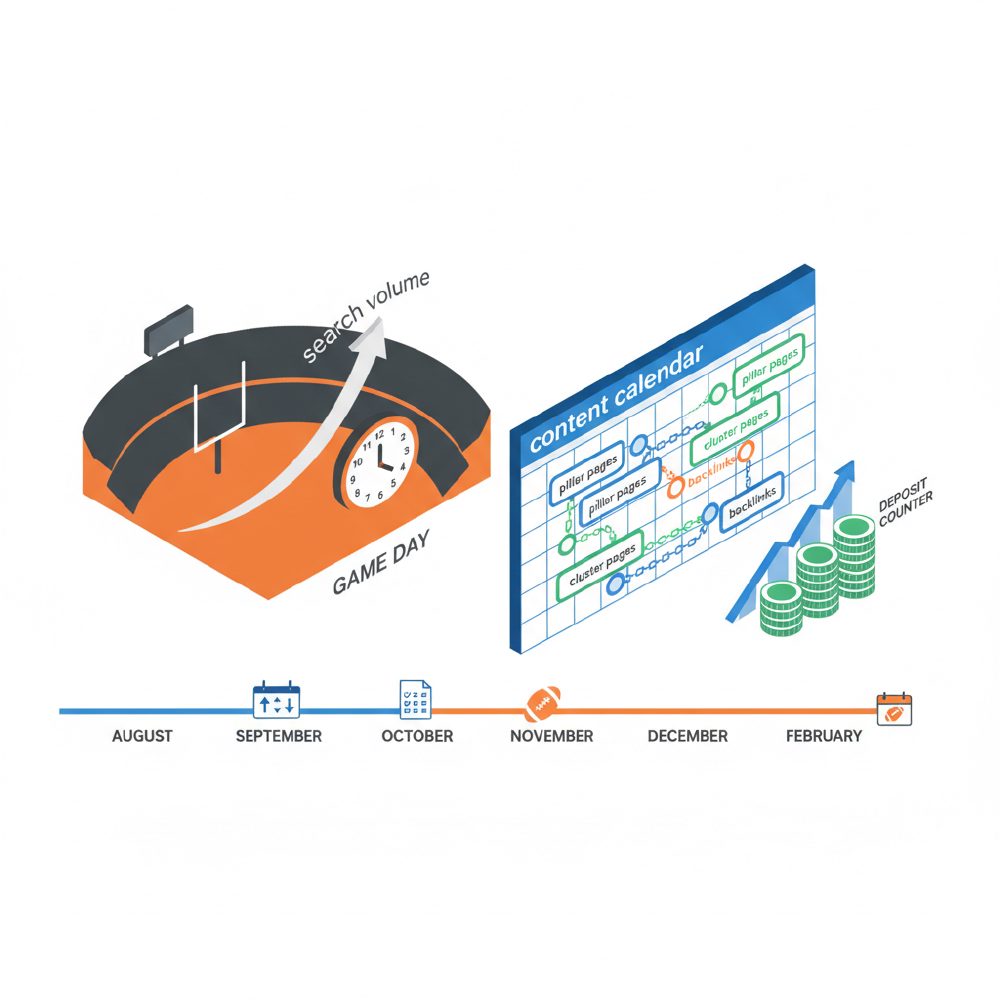
Super Bowl search behaves like a flash sale, not steady demand. Terms like "Super Bowl LX odds" or "prop bets 2026" go from a few thousand monthly searches in October to hundreds of thousands the week of the game, then fall off a cliff within days. You can't build page authority in a 10-day window, so the ranking work has to happen months earlier.
I pull Google Trends and Ahrefs volume data on every Super Bowl campaign I run, and the curve is almost identical year over year: flat through the regular season, a modest bump at the conference championships, then a vertical spike in the seven to ten days before kickoff that outpaces Black Friday retail terms in relative growth. The problem is that Google needs weeks of crawl history, backlink accumulation, and engagement signals to trust a page enough to rank it during that spike. If you're publishing your Super Bowl content in late January, you're not competing, you're spectating.
The competitive set makes this worse. DraftKings, FanDuel, BetMGM and Caesars sit on DR85-95 domains with in-house content teams and existing topical authority on every NFL query imaginable. A mid-tier or offshore operator isn't beating them on "Super Bowl odds" head-on in six weeks. The realistic play is long-tail: same-game parlay combinations, state-specific legal betting pages ("Super Bowl betting Ohio"), prop bet guides for specific players, and crypto-deposit angles the majors don't bother targeting.
This is also why I treat Super Bowl SEO as a distinct budget line from evergreen sportsbook SEO, not a subset of it. Evergreen work, bonus pages, sportsbook review content, deposit-method guides, earns links and authority steadily all year. Super Bowl content needs a compressed, front-loaded push where 70% of the link budget lands in the 90 days before the game, timed so the authority is already banked when search volume arrives.
When Should Operators Start Building NFL Playoff and Super Bowl Content for 2026?
Start seeding your Super Bowl 2026 hub page in August 2025, right after the NFL schedule release, then build links steadily through the regular season. By the time conference championships hit in mid-January, the page should already have four to five months of crawl history and backlink equity instead of starting cold.
Operators consistently make the same mistake: they wait until the conference championship games to think about Super Bowl content, because that's when the emotional urgency hits. By then you're 10-14 days out and trying to out-rank pages that have been live since summer. The fix is a phased calendar tied to the NFL schedule, not the news cycle.
I run this in four phases with clients, and the phase names matter less than the discipline of not skipping the early ones because they feel low-urgency. Phase one is the quiet build, publish the evergreen hub, get it indexed, start a modest link drip. Phase two is the authority phase through the regular season. Phase three is the playoff acceleration once brackets are real. Phase four is the 10-day sprint where content updates hourly and PR outreach peaks.
| Phase | Timing | Primary action | Link tactic |
|---|---|---|---|
| Seed | Aug-Sep 2025 | Publish/refresh evergreen Super Bowl hub + state legality pages | 3-5 niche edits/month, low velocity |
| Build | Oct-Nov 2025 | Publish prop bet & futures cluster pages, internal link to hub | Digital PR data study, 5-8 links/month |
| Accelerate | Dec 2025-early Jan 2026 | Wildcard/playoff bracket content, add FAQ schema | 10-15 niche edits + crowd marketing/month |
| Sprint | Late Jan-Feb 8 2026 | Live odds updates, prop drops, expert picks | 20-30 links/month, HARO + sports journalist pitches |
How Should You Structure Content Architecture for Super Bowl and Playoff Betting Pages?
Use one permanent hub URL you update and re-optimize every year, never a fresh /super-bowl-2026-odds/ page. Build cluster pages for props, futures, state legality and betting guides that all link back to the hub, and layer in Event and FAQ schema so both Google and AI answer engines can parse the page fast.
The single biggest architectural mistake I see: operators publish a new URL for every Super Bowl (/super-bowl-59-odds/, then /super-bowl-60-odds/) and let the old one 301 or die. That throws away every backlink the previous page earned. Keep the slug evergreen, something like /super-bowl-odds/, and update the content, the year references, and the schema in place. Google already trusts that URL's crawl history; you're compounding equity instead of restarting it.
Around that hub, build a cluster: player prop pages ("who will score the first touchdown"), futures pages ("Super Bowl winner odds" published in September), state-specific legal betting pages for regulated US markets, and a same-game parlay guide. Every cluster page links up to the hub with descriptive anchor text, and the hub links back down. This hub-and-spoke model spreads long-tail capture across dozens of lower-competition queries while consolidating authority on the one page that has to rank for the head term.
Freshness signals matter more here than almost anywhere else in gambling SEO. Add visible "last updated" timestamps, push odds movement updates daily during game week, and implement Event schema plus FAQ schema so the page qualifies for rich results and gets pulled into AI Overviews. I've seen hub pages with proper schema hold position during the volatility spike while competitor pages without it get bounced by fresher-looking news content.
What Link Building Tactics Actually Move Rankings Before the Super Bowl Search Spike?
Niche edits and digital PR do the heavy lifting in the 60-90 day window because they're fast to deploy and pass topical relevance. Layer in a tiered structure, moderate-authority niche edits pointing at the money page, with a second tier of expired-domain or stacked links feeding those, and ramp velocity from 5-10 links a month to 20-30 as kickoff approaches.
Niche edits, paying to insert a contextual link into an existing sports or betting article, are the workhorse here. Expect $150-400 per placement on DR30-60 sites depending on niche and market, and a two-to-four-week turnaround from outreach to live link. They're fast enough to fit inside the accelerate and sprint phases when guest posting and PR take too long.
Digital PR earns the bigger, harder-to-replicate links. Build a linkable asset, "we analyzed 15 years of Super Bowl prop bet outcomes" or "which conference has covered the spread more often since 2010", and pitch it to sports and betting journalists in November and December, before every other operator is pitching the same angle in January. A solid data study campaign realistically lands 15-30 links from DR40+ sites over six weeks.
For velocity, I run a tiered structure: Tier 1 links go direct to the money page from real niche edits and guest content. Tier 2, stacked links or curated expired domains with clean backlink history, checked in Ahrefs for spammy anchor patterns before acquisition, points at those Tier 1 assets, not at the client domain directly. That keeps the risk layer off the primary site. I'll be direct about the risk: PBNs on your own domain during a high-visibility event like the Super Bowl are a bad trade, if Google runs a spam update mid-campaign (they've hit gambling-adjacent sites hard in past March and August updates), you lose the whole event window along with the domain's trust. Keep anchor text mostly branded or naked URL, cap exact-match anchors under 10%, and don't let link velocity outpace what a genuinely trending topic would organically attract, 20-30 links a month in January looks natural for Super Bowl content; the same velocity in June would look manufactured.
How Do You Scale Programmatic Odds and Prop Content Without Triggering a Spam Update Penalty?
Google's March 2024 spam update explicitly named scaled content abuse, and templated player-prop and matchup pages were hit hard, some sites lost 60-90% of visibility overnight. Programmatic pages survive if each one carries a genuine editorial layer: unique analysis, injury context, and a live data feed, not just keyword permutations of team names.
The temptation with prop and odds content is obvious, generate a page for every team matchup, every player prop, every parlay combination, and let volume do the work. That model worked fine through 2022. It doesn't anymore. Google's scaled content abuse policy targets exactly this pattern: many pages, minimal unique value, generated to capture search traffic rather than serve a specific need.
My rule with clients: for every ten templated pages, there needs to be a real human editorial signal, a written take referencing that week's injury report, a specific betting trend ("the Chiefs are 8-2 ATS as road favorites since 2022"), or a cited historical stat, not just the odds number swapped in a template. Pages that fail this bar get noindexed and consolidated into the parent hub with a dynamic odds widget instead of a standalone URL.
Rendering matters too. A lot of odds data loads through third-party JS widgets that Googlebot can't always parse on the first crawl. I run every prop and odds page through Screaming Frog's JS rendering mode before launch to confirm the actual numbers are visible in the rendered DOM, and I push for a server-side rendered fallback with the current line embedded as plain text plus structured data. If the widget fails and Google only sees a blank div, the page reads as thin regardless of how much unique commentary sits around it.
SEO vs PPC for Super Bowl Betting Traffic: Where Should the Budget Actually Go?
For offshore and crypto operators, this isn't really a choice, Google Ads' gambling certification excludes almost everyone outside a handful of licensed US states, so SEO is the only scalable digital acquisition channel available for Super Bowl volume. For licensed US operators who can run PPC, CPCs on core terms hit $15-40 during game week, making organic traffic dramatically cheaper per deposit once authority exists.
Google Ads requires gambling certification tied to specific state licenses (currently a short list including NJ, PA, MI, and a handful of others), and it applies market by market. Offshore books, most crypto casinos, and sweepstakes operators outside the certified list simply can't buy Google or Meta ads for Super Bowl terms, full stop. That reality alone should settle most budget debates for this vertical: if paid isn't an option, every dollar goes to organic, PR, and affiliate placement instead.
For the operators who are certified and can run PPC, Super Bowl week is brutal on cost. I've watched CPCs on "Super Bowl odds" and "Super Bowl props" style terms climb into the $15-40 range in competitive states as the majors bid aggressively for a single week of volume, then drop back to $3-6 the rest of the year. That spike compresses ROI hard unless conversion rate and average deposit size are unusually strong.
| Factor | SEO | PPC |
|---|---|---|
| Eligibility | Open to offshore, crypto and licensed operators alike | Requires state-by-state Google Ads gambling certification |
| Cost curve during game week | Sunk cost already spent months earlier; near-zero marginal cost | $15-40 CPC spikes on core terms in competitive states |
| Time to results | 60-180 days lead time required | Live within 24-48 hours of campaign launch |
| Durability | Rankings persist for future playoff cycles if maintained | Traffic stops the moment spend stops |
| Compliance exposure | Manual actions, spam updates | Ad account suspension, certification revocation |
What Technical SEO Issues Kill Super Bowl Traffic Spikes Right When You Need Rankings Most?
Crawl budget, server capacity, and JS-rendered odds widgets are the three technical failures I see most often during game week. Traffic can jump 10-50x on Super Bowl Sunday alone, and if the server slows or Googlebot can't recrawl fast enough to see updated lines, you lose both users and the freshness signal that's keeping you competitive.
Crawl frequency has to increase during the sprint phase, because odds shift multiple times a day and stale numbers on the page hurt both trust and conversion. I pull log files through Screaming Frog's log analyzer in the two weeks before the game to confirm Googlebot is actually hitting the money pages hourly, not just once a day, if it isn't, internal linking or XML sitemap priority needs adjustment.
Server load is the other failure mode. A page ranking well for "Super Bowl prop bets" can pull 10-50x normal traffic on game day. If you're not on a CDN with proper caching (Cloudflare or similar) and your Core Web Vitals aren't holding under load, pages slow past a 2.5-second LCP, bounce rate spikes, and you lose both the conversion and the engagement signal Google reads on subsequent crawls.
Finally, check how odds actually render. A lot of operators pull live lines through a third-party API loaded via iframe or client-side JS. If that widget fails to load, which happens under high traffic load more than people expect, Googlebot and users alike see a blank space where the actual betting line should be. I push for server-rendered fallback text with the current line hard-coded and refreshed on a cron job, so the page degrades gracefully instead of going blank.
How Does Answer Engine Optimization Change for Super Bowl Betting Queries?
AI answer engines like Google's AI Overviews and Perplexity increasingly surface direct answers to "who's favored to win the Super Bowl" without a click, and they favor pages with explicit, timestamped facts, sourced odds, and named author credentials over generic content. Getting cited requires structured, dated data, not just ranking on page one.
I don't have a confirmed ranking-factor list for AI Overviews, nobody outside Google does, but pattern-matching across client accounts shows a clear preference for pages that state facts plainly and attribute them: "As of January 20, 2026, the Chiefs are -2.5 favorites per DraftKings" gets pulled into summary boxes far more often than vague prose like "the Chiefs are expected to be favored."
The practical response is threefold. First, add FAQ schema targeting the exact natural-language questions bettors type into AI chat interfaces, "who is favored in the Super Bowl," "what's the over/under for the Super Bowl." Second, put a named byline with real credentials (an in-house oddsmaker or analyst, not "Admin") on every odds and prediction page, E-E-A-T signals seem to carry extra weight when AI systems decide which source to cite as ground truth. Third, keep the canonical hub page as the single source of truth rather than fragmenting the same information across ten thin pages; AI engines appear to favor the page that's been maintained and updated over one that's been abandoned after a single publish.
How Should Operators Measure ROI on Super Bowl SEO, Deposits vs Rankings?
Rank tracking tells you whether the campaign is working; it doesn't tell you whether it's profitable. Measure ROI on first-time depositors and CPA from organic landing pages using UTM-tagged promo codes or affiliate postbacks tied to CRM data, and compare that CPA directly against your PPC or affiliate cost for the same period.
Gambling CPA benchmarks run roughly $150-400 per first-time depositor depending on vertical and market, sportsbook tends to run cheaper than casino, crypto tends to run cheaper than fiat in less regulated markets. The number only means anything if you can actually attribute an FTD back to an organic Super Bowl landing page, which most operators can't do well because their tracking stops at the GA4 session level.
The fix is a seeded promo code or unique landing path that flows into CRM or affiliate postback data, so a deposit can be traced back to the exact page and campaign that drove it. I run this with clients as a straightforward comparison: if the Super Bowl content push cost $8,000 in content and links and produced 120 FTDs, that's roughly $67 in content spend per FTD before accounting for the ongoing value of the ranking, often several multiples cheaper than the $200-350 CPA operators see bidding on the same terms via PPC during peak week.
Rank position without conversion tracking is a vanity metric in this vertical. I've had clients sitting at #2 for a head term converting at under 1% because the CTA was buried below three paragraphs of history and trivia, while a competitor's #6 page converted at 4% with the deposit bonus and operator logo above the fold. Fix the page before you chase the next position.
What Content Types Convert Best During Peak NFL Playoff and Super Bowl Search?
Odds comparison and futures pages convert highest because they capture bettors already in decision mode, comparing books at the moment they're ready to deposit. Educational "how does betting work" content ranks well and builds topical authority but converts at a fraction of the rate, treat it as top-of-funnel support, not a revenue driver.
Not all Super Bowl traffic is equal, and treating a top-of-funnel explainer the same as a bottom-of-funnel odds page in your reporting will make your whole campaign look worse than it is. I segment content by where the searcher sits in the deposit decision, and budget conversion elements, bonus codes, deposit CTAs, operator comparison tables, accordingly.
Futures pages ("Super Bowl winner odds") published early in the season carry a long tail of consistent, high-intent traffic for months before the game, which makes them some of the best-performing assets in the whole cluster relative to effort spent.
| Content type | Search intent | Typical conversion behavior | Example query |
|---|---|---|---|
| Odds comparison hub | Transactional, bottom-funnel | Highest, visitor is book-shopping now | Super Bowl odds |
| Futures/win totals | Commercial, early season | High, long tail from Sept-Feb | Super Bowl winner odds 2026 |
| Prop bet guides | Commercial | High during game week only | first touchdown scorer prop |
| Same-game parlay guides | Commercial | Medium-high, appeals to engaged bettors | best Super Bowl parlay bets |
| Educational/how-to | Informational, top-funnel | Low direct, supports topical authority | how does Super Bowl betting work |
| State legality pages | Local commercial | Medium, filters qualified US traffic | is Super Bowl betting legal in Texas |
How Do You Retain Rankings and Traffic After the Super Bowl Ends?
Don't let the hub page go dark. Repurpose it into NFL offseason content, draft coverage, free agency odds, next season's win totals, to keep the URL active and the internal link structure intact, then restart the seed phase for next year's Super Bowl within 30 days. Letting the page die and rebuilding from zero costs three to four times more than maintaining it.
Traffic on a single-event page drops 90%+ within a week of the Super Bowl ending, that part is unavoidable and not a sign anything went wrong. What is avoidable is losing the page's authority along with the traffic. Operators who build a fresh URL every year effectively reset to zero every February, then wonder why the same competitors outrank them every January.
Instead, shift the hub's content focus in late February to NFL offseason angles, draft order and betting props, free agency movement, early next-season win totals, while keeping the URL, the internal links, and the accumulated backlinks exactly where they are. Drop link velocity back to a maintenance trickle of 2-4 links a month through the offseason rather than stopping outreach entirely; a dead link profile signals abandonment as clearly as a dead page does.
By August, when the new NFL schedule drops, the page and its backlink profile already have a full year of trust behind it, and the seed phase for the next Super Bowl starts from a position of strength instead of zero. This is the single highest-leverage habit separating operators who compound rankings year over year from operators who rebuild the same climb every single January.





Comments
No comments yet, be the first.