Penalty Recovery
How to diagnose a gambling site Google penalty, tell a manual action from a core update, and build a real recovery timeline.

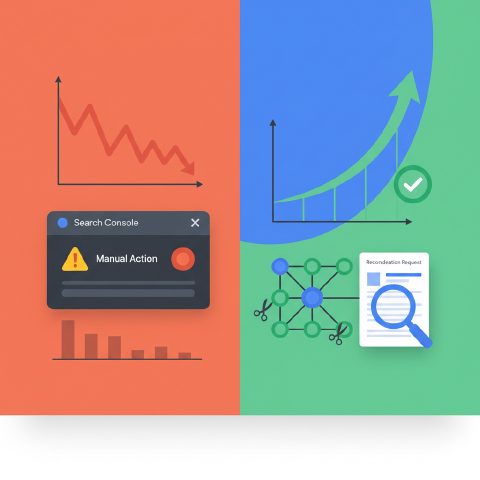
The first step in recovering a gambling site's traffic is figuring out whether you're dealing with a manual action or an algorithmic core-update demotion, because they require completely different fixes. The single biggest mistake operators make is treating one like the other. Teams routinely disavow links and file reconsideration requests to fix what's actually a core-update quality reassessment. That does nothing, burns two or three months, and leaves the actual problem untouched. Check Google Search Console's Security and Manual Actions report first. If it's empty, you're not dealing with a manual action, full stop, no matter how sudden or severe the drop looks, and the entire remediation plan needs to start from a different diagnosis.
Manual-action patterns and remediation paths
Manual actions on gambling sites cluster around a few known patterns: unnatural links to or from the site, thin content and doorway pages, cloaking and sneaky redirects, and, since September 2024, site reputation abuse, where third-party or parasite content published under your domain's authority gets flagged directly. Each has a specific remediation path, and Google checks that the fix is real before granting reconsideration. An unnatural-links action needs a full backlink audit, a disavow file targeting the toxic sources, and a reconsideration request that documents exactly what was removed or disavowed and why. A cloaking or doorway action needs the offending pattern removed site-wide before you even file. Google re-flags partial fixes fast, and a second failed reconsideration round makes the third much harder to win. Budget weeks per review cycle, sometimes multiple cycles before it clears.
Diagnosing a core-update collapse
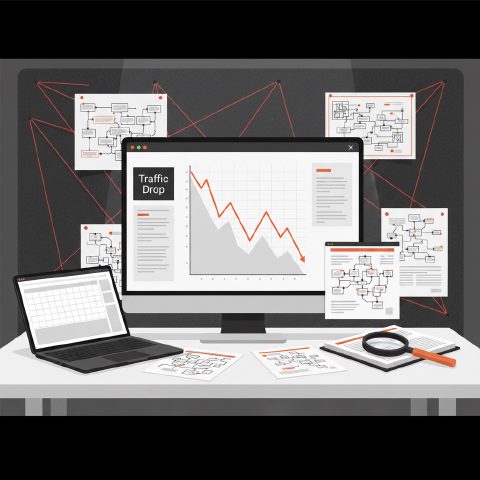
Core-update collapses look different. No manual action notice appears anywhere in GSC, and traffic drops 30 to 70 percent essentially overnight, correlated tightly with one of Google's confirmed rollout dates rather than anything you changed on your end. Gambling content sits close enough to YMYL territory that E-E-A-T weighting hits it especially hard in helpful-content and spam-focused updates. Diagnosis starts with correlating the drop date against Google's published rollout windows, then breaking the GSC performance report down by page and query to see whether the hit is site-wide or concentrated in specific templates. Geo-doorway pages and thin programmatic pages are usually the first to fall, and if that's where the damage concentrates, that's the actual root cause, not the site as a whole. There's no reconsideration request for a core update. The fix is rebuilding the flagged content pattern and waiting for the next assessment.
When disavowing is actually warranted
Disavow only when it's actually warranted: a confirmed unnatural-links manual action, or a clear negative-SEO attack pattern showing a sudden spike of spammy inbound links you never built, visible in Ahrefs or GSC's links report as an anomalous burst from low-quality domains. Export the full backlink profile and flag by pattern rather than domain by domain. Whole PBN networks, link-farm TLD clusters, and expired-domain redirect chains usually share fingerprints once you sort by referring-domain quality metrics. Submit at the domain level for anything clearly toxic. The mistake that makes recovery slower, not faster, is panic-disavowing legitimate links along with the bad ones, which can suppress rankings further on top of whatever caused the original problem. It's a mistake we see constantly from teams trying to self-recover without an actual link audit first.
Setting realistic recovery timelines
Manual action reconsideration typically clears in weeks to a couple of months per review cycle, sometimes needing multiple rounds if the first fix wasn't thorough enough. Core-update recovery has no guaranteed timeline at all. Sometimes a site recovers at the next core update three to four months later if the underlying quality issue actually got fixed, sometimes it doesn't fully recover and needs a longer rebuild of genuinely differentiated content and trust signals before Google's systems re-extend trust. Set that expectation with operators honestly up front. Promising an exact recovery date on a core-update hit is a promise that gets broken, and it damages the agency relationship worse than the slow recovery itself does.
Pairing cleanup with forward progress
Recovery work should run alongside a forward content and link program, never instead of it, because a demoted or penalized site needs new positive trust signals to convince Google's systems to re-trust it. Cleanup alone proves you stopped doing the bad thing. It doesn't prove you're now doing something worth ranking. The sites that come back fastest pair remediation with a genuine quality push on the templates or pages that got flagged, not the ones that just wait quietly for the next core update and hope. Track progress in GSC on a weekly basis rather than daily, since day-to-day fluctuation on a penalized site is mostly noise that leads nowhere useful, and report movement to stakeholders as a four to six week trend line instead of a single-day spike that rarely means what it looks like it means.

Written by Kai Renner, Crypto-Gambling SEO Lead
Explore our insights
 analysis
The 2026 Google Update Retrospective: Every Hit to Gambling Sites
Dane Whitfield walks through every core, spam, and site-reputation-abuse wave that hit casino, sportsbook, and affiliate domains in 2026, and lays out the exact diagnostic steps and recovery timelines operators used to claw back rankings.
 landing
Google Gambling Penalty Recovery: Step-by-Step for Operators
A step-by-step gambling penalty recovery framework from an operator-side SEO who's rebuilt casino and sportsbook rankings after manual actions and algorithmic hits, built to restore deposits, not just traffic charts.
Free: iGaming SEO & AEO playbook
Get our latest search & AI-visibility playbook by email, no spam.