Tennis Betting SEO in 2026: The Grand Slam Content Calendar That Actually Ranks
Why doesn't a generic sports betting SEO playbook work for tennis?
Tennis traffic lives in four explosive windows instead of a steady weekly rhythm. Search demand for a Slam can jump 400-600% in the two weeks before the draw, then crash back to baseline within days of the final. A football-style weekly content cadence leaves pages indexing too late to catch the spike.
Run a Google Trends overlay of "wimbledon odds" against "premier league odds" and the shape tells you everything. The Premier League query holds a relatively flat band across 38 weeks with small bumps on derby weekends. Wimbledon's query volume looks like a spike on a cardiogram, flat for ten months, then a vertical climb starting roughly three weeks out, peaking during the first round, and falling off a cliff by the final Sunday. The same pattern repeats for the Australian Open, Roland-Garros and the US Open, just with different magnitudes depending on market (the Australian Open skews harder in APAC and UK books; the US Open skews harder domestically in the US).
This matters for timing, not just content type. A page published the Monday a Slam starts has almost no chance of ranking inside the window that actually converts traffic, because Google needs time to crawl, index and start trusting signals, even on an established domain that's typically 5-10 days minimum, often longer if the URL is new. We've watched operator sites publish "US Open outright winner odds" pages on day one of the tournament and get first meaningful impressions on day nine, by which point the semifinals are already locked in and half the search demand has moved on.
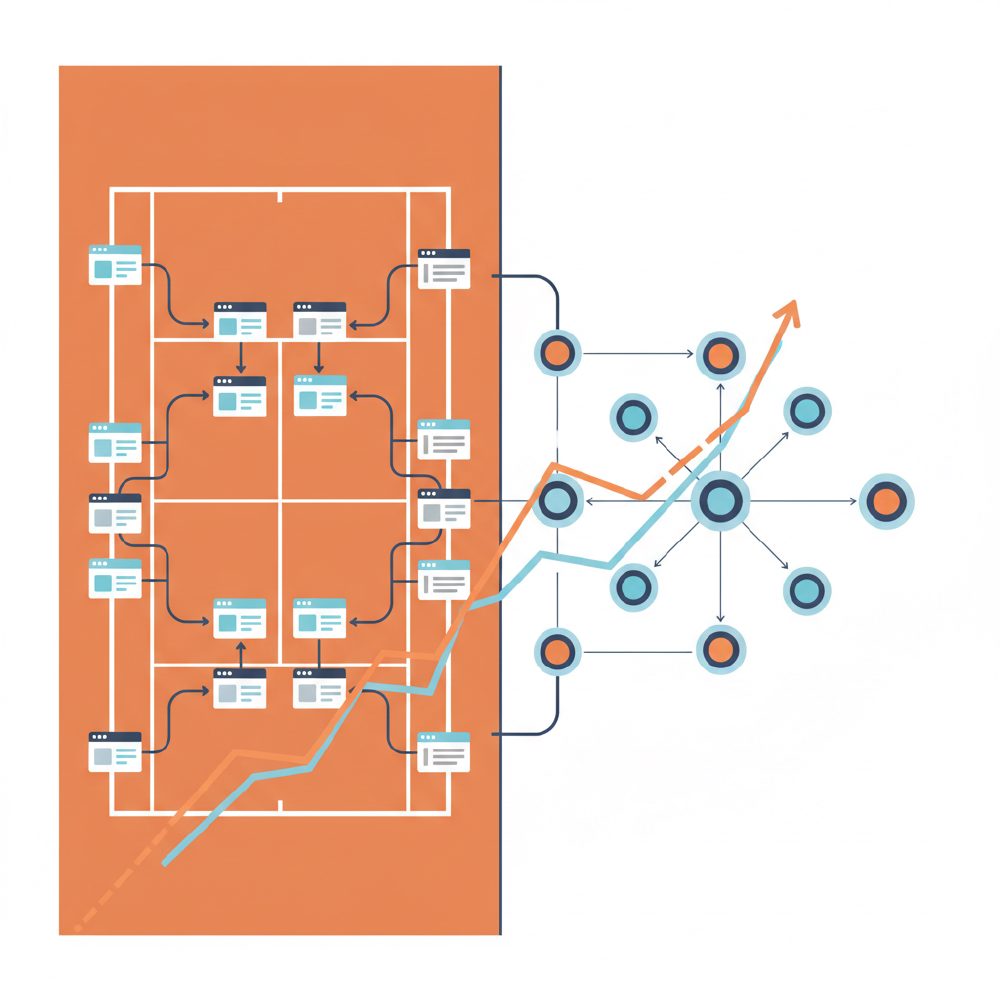
The fix isn't exotic, it's sequencing. Pages need to exist, be internally linked, and have at least one round of external link signals landed before the demand curve starts climbing. That's the whole premise behind treating tennis as four separate sprints rather than one continuous sports vertical, and it's the single biggest difference between agencies that treat tennis like an afterthought inside a bigger sportsbook SEO account and the ones who actually move the needle on it.
How do you build a 2026 Grand Slam content calendar that catches each spike?
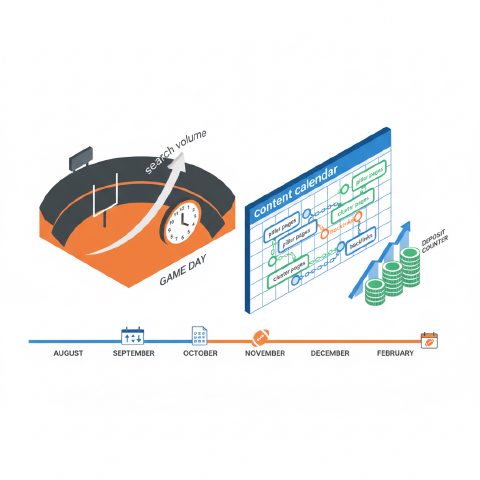
Lock four sprints to the 2026 Slam dates, Australian Open (mid-to-late January), Roland-Garros (late May), Wimbledon (late June-mid July), US Open (late August-mid September), and work backward 8-10 weeks for publishing, outreach and indexing. Confirm exact dates against the ITF and Slam organizer calendars once released, since they shift by a few days year to year.
Each sprint has the same five-page skeleton, repeated with fresh year-stamped content: a tournament hub ("Wimbledon 2026 Betting Odds"), an outright winner page per tour (men's and women's split, never combined), a draw-reveal page published the day the bracket drops, a set of player prop/futures pages for the 8-12 commercially relevant names, and a live-updating odds page that goes active on day one and gets refreshed through the fortnight. The hub and outright pages are the ones that need the 8-10 week head start, they're the pages carrying the search volume before the draw even exists.
We build the publishing schedule backward from the tournament start date. For a Slam starting on day X: hub page and outright pages go live at X-minus-70 days with a skeleton structure and historical data (past five champions, odds movement history, surface stats), then get expanded with current-season form around X-minus-21. Draw-reveal pages publish the moment the official draw drops, usually 48-72 hours before day one, these need to be templated in advance so they can go live within an hour of the draw announcement, because that's a 24-48 hour window where search volume for "[player] odds" terms is red hot and largely uncontested.
The mistake we see most often is operators treating the hub page as a one-time asset that gets a year-number swap ("Wimbledon 2025" to "Wimbledon 2026") with nothing else touched. Google's helpful content systems and the broader core update pattern since 2023 reward pages that show actual freshness signals, updated odds tables, new internal links to current-season player pages, updated FAQ content reflecting the current field. A lazy year-swap on a thin page is exactly the kind of content Google's systems have gotten better at discounting.
Which tennis betting keywords actually drive qualified traffic, not just volume?
Tournament-specific outright and "odds" terms carry the highest volume but also the most seasonal competition; player-vs-player matchup queries and surface-specific long-tails convert better with less fight. The highest-value mid-funnel terms combine a player name, tournament, and betting intent, these rarely show accurate volume in Ahrefs or SEMrush because they spike too fast for the tools to capture mid-cycle.
We split tennis keyword targets into three tiers by intent and competition. Tier one is tournament-head terms, "wimbledon odds," "us open tennis betting," "french open outright winner", high volume (reported 5K-20K monthly in tools, though actual peak-week search volume runs multiples higher than the 12-month average these tools show), high competition from sportsbooks' own domains plus media outlets like Tennis.com and the BBC. Tier two is player/matchup terms, "djokovic vs alcaraz odds," "sabalenka outright wimbledon", lower reported volume but far less competition because they only exist for a few days and most publishers don't bother templating for them. Tier three is surface and format long-tails, "best grass court betting strategy," "clay court upset odds atp", low volume, low competition, and genuinely useful for building topical authority ahead of the spike.
The practical allocation we run for operator sites: 20% of new tennis content targets tier-one terms (these need the strongest internal linking and external link support), 50% targets tier-two matchup and player pages (volume by count makes up for individual query size), and 30% targets tier-three surface/strategy content that mostly exists to support internal linking and demonstrate depth to Google's systems rather than to rank standalone.
| Tier | Example query | Relative volume | Competition level | Best page type |
|---|---|---|---|---|
| 1, Tournament head | wimbledon betting odds | High (seasonal spike) | Very high, media + sportsbook domains | Tournament hub page |
| 2, Matchup/player | alcaraz vs sinner odds | Medium, short-lived | Low-medium, few sites template for it | Prop/matchup page |
| 3, Surface/strategy | clay court upset betting strategy | Low, stable | Low | Evergreen strategy content |
| 2b, Outright futures | wta french open outright winner | Medium | Medium-high | Futures/outright page |
What makes Wimbledon betting SEO different from the other three Slams?
Wimbledon carries the heaviest media competition of any Slam, the BBC, Sky Sports and UK tabloids all publish betting-adjacent content with domain authority most operator sites can't match directly. Grass-court volatility also drives a distinct query set around upsets and retirements that doesn't exist for hard-court or clay events.
Ranking against Tennis.com, the BBC and the Telegraph for "wimbledon odds" on a pure domain-authority basis is a losing fight for most operator sites, those outlets often sit in the DR 80-93 range with decades of backlinks. The angle that works is going narrower than they bother to: BBC isn't going to publish a page dedicated to "best bet on grass-court first-round upsets" or a live-updating odds tracker tied to a specific match number on Centre Court. That specificity is where operator content can out-rank media sites even on a DR 35-50 domain, because the publishers simply aren't targeting it.
Grass also changes the content itself, not just the keywords. Rain delays and retirements are a bigger part of Wimbledon's betting narrative than any other Slam, the tournament has no retractable roof over every court, and grass's low bounce punishes big servers differently than clay or hard courts. Content that addresses this directly (in-play betting adjustments during rain delays, server-vs-grinder matchup analysis) pulls in a segment of search intent that's genuinely underserved, since most tennis betting content gets templated once across all four Slams without accounting for surface.
One more wrinkle worth flagging for UK-facing campaigns: Wimbledon betting content touching UK audiences needs to respect ASA and Gambling Commission advertising rules around responsible gambling messaging even on informational pages, which the French Open and US Open content aimed at non-UK audiences won't need in the same form. If your operator serves multiple regulated markets, don't template the compliance footer across all four Slam hubs, it needs to be market-specific.
How should ATP and WTA betting content be structured outside the four Slams?
Build ATP and WTA as entirely separate content silos, not a shared "tennis" hub, because ranking factors, player pools and search intent diverge once you're past Slam-level traffic. Weekly tour events (250s, 500s, Masters 1000s, WTA 1000s) supply a steady 15-20% of peak Slam traffic and are what keeps a tennis section crawled and trusted between majors.""
Most operator sites we audit have a single "/tennis/" directory dumping ATP and WTA content together with no clear hierarchy. That flattens internal linking signals and makes it harder for Google to understand which pages are authoritative for which tour. We rebuild this as two parallel silos, /tennis/atp/ and /tennis/wta/, each with its own ranking hub, tournament calendar page, and player directory, cross-linked only at the top-level tennis hub.
The weekly tour events matter more than most operators assume. A Masters 1000 event like Indian Wells or the Madrid Open generates real, repeatable search volume every year, and because fewer competitors bother building dedicated pages for non-Slam events, the competition is softer. We've seen ATP Masters 1000 outright pages reach page-one rankings within 4-6 weeks of publishing with just 3-5 niche edits, versus the 10-14 links and 10-12 weeks typically needed to move a Slam hub page in a competitive niche.
The other reason to keep weekly tour content running: crawl frequency. Googlebot visits sites more often when there's a steady publishing cadence rather than four bursts a year followed by silence. A tennis section that only publishes around Slams tends to get recrawled on a slower cycle, which delays indexing right when you need speed most, during the Slam sprint itself.
What anchor text ratio keeps tennis odds pages out of an over-optimization filter?
Keep branded and naked-URL anchors at 60-65% of the total profile, partial-match anchors ("tennis betting guide," "wimbledon odds comparison") at 20-25%, and exact-match anchors ("tennis betting seo," "wimbledon odds") under 10%. Generic anchors ("click here," "read more") fill the remainder and actually help the profile look natural.
Tennis odds pages get hit by over-optimization penalties more often than other sports verticals for a simple reason, because content gets templated across four tournaments a year with near-identical page structures, link builders tend to reuse the same anchor phrases ("wimbledon betting odds," "us open betting odds") across dozens of pages, which creates an anchor profile that's unnaturally concentrated on a handful of exact-match phrases. We've pulled three separate operator domains out of what looked like a Penguin-style devaluation in the last two years, and in every case the root cause was anchor concentration above 18-20% on a single exact-match phrase.
The model we run assigns anchor type at the link-building brief stage, before outreach even starts, not after the fact. For every ten links built to a Slam hub page, roughly six carry the brand name or the bare URL, two carry a partial match phrase that includes the brand or a softened variant of the target keyword, one carries a true exact-match anchor, and one carries something generic or a long-tail natural phrase a real editor would actually write. This ratio holds whether the link sits on a PBN post, a niche edit, or an organic crowd mention.
Recovery timelines matter here too. When we've corrected an over-optimized anchor profile by diluting it with branded and generic links, rankings typically start recovering within 3-6 weeks for pages that had lost position but weren't hit with a manual action. Pages with an actual manual action for unnatural links take longer and need a disavow file submitted through Search Console alongside the dilution work, budget 8-12 weeks for full recovery in that case.
| Anchor type | Target % of profile | Example |
|---|---|---|
| Branded / naked URL | 60-65% | "BetBrand," "betbrand.com" |
| Partial match | 20-25% | "tennis betting guide at BetBrand" |
| Exact match | Under 10% | "wimbledon betting odds" |
| Generic / natural | 10-15% | "this page," "more on grass-court odds" |
Which link-building tactics actually move tennis betting pages, and which ones burn the domain?
Niche edits on established tennis and racquet-sports publisher sites carry the best risk-to-reward ratio right now, averaging $90-$260 per placement in our index. Vetted PBNs still work for lower-tier ATP/WTA pages but carry real deindexing risk on Slam hub pages where scrutiny is higher; expired-domain rebuilds in the tennis niche are scarce and overpriced relative to their authority.
Niche edits are our default recommendation for tennis betting link campaigns in 2026. Tennis has a healthy ecosystem of mid-authority publisher sites, regional tennis news blogs, racquet and equipment review sites, junior/college tennis coverage, that accept contextual link insertions into existing articles for a fee. These sites typically sit in the DR 25-55 range, get genuine organic traffic (so the link passes real referral value, not just link equity), and don't scream "paid placement" to a manual reviewer the way a brand-new guest post on an obviously built-for-links domain does.
PBNs still have a place, but we restrict them to supporting tier-two and tier-three pages, player matchup content, surface strategy guides, never the Slam hub pages that carry the most commercial value and the most scrutiny if Google runs a spam-signal sweep. A well-vetted PBN network (verified clean Wayback Machine history, no footprint overlap in hosting or theme, genuine aged domain with organic backlink history unrelated to gambling) can push a tier-two page from page three to page one in 3-5 weeks. The risk is concentration: if three or four Slam hub pages all lean on the same PBN network and that network gets caught in a Google spam update sweep, you lose all of them simultaneously rather than one at a time.
Crowd marketing, seeded mentions on tennis forums, Reddit's r/tennis, and comment sections on tennis YouTube content, works better for tennis than almost any other sports vertical we handle, because tennis fan communities are unusually active and unusually tolerant of betting discussion mixed into match analysis. It won't move rankings fast on its own, but it diversifies the link profile's referring-domain types, which matters for the "natural profile" signal Google's systems weigh alongside raw link count.
What should a tennis odds page actually include to rank and convert at the same time?
A ranking tennis odds page needs live or near-live odds data, matchup-specific analysis (not generic tournament commentary), SportsEvent schema markup, clear author/editorial credentials, and internal links to both the tournament hub and the relevant player pages. Pages missing structured data or showing stale odds lose both rankings and conversion rate.
Odds freshness is a conversion factor and increasingly a ranking factor. Google's systems have gotten noticeably better at detecting content staleness since the 2023-2024 helpful content rollouts, a page showing odds from a match that's already finished, or displaying "last updated" timestamps that haven't moved in weeks during an active tournament, tends to lose both click-through and position. We require live odds feeds (via API integration with the operator's own trading platform or a third-party odds aggregator) on any page we build for a Slam window, refreshed at minimum every few hours during the tournament.
SportsEvent and BettingAction schema markup matters more for tennis than for some other verticals because of how fragmented the event structure is, a single tournament contains dozens of individually schedulable matches, each a potential rich-result candidate. Pages marked up correctly have shown up in knowledge panel carousels and "people also ask" expansions in our client accounts around Slam weeks, which neither the operator nor most competitors get right because it requires per-match schema generation, not a single static tournament schema block.
On the E-E-A-T side, tennis content benefits from visible author credentials more than most casino verticals, a byline naming a writer with actual tennis betting or trading background outperforms anonymous "staff" bylines in our testing, particularly for Slam outright and prop content where Google's quality raters are explicitly instructed to weigh author expertise. We attach a short author bio with verifiable tennis coverage history to every Slam-tier page we publish for a client.
How far ahead of each Slam do you need to publish and build links to actually rank in time?
Start hub and outright pages at 8-10 weeks before the tournament, land the first link wave at 6-8 weeks out, and run a second smaller link wave at 2-3 weeks out alongside the draw-reveal content. Pages started inside four weeks of a Slam rarely accumulate enough trust signal to rank inside the window that matters.
We track time-to-first-page-one across our client portfolio, and for tennis Slam hub pages specifically, the median has been 9-11 weeks from first publish to stable page-one ranking on a domain with existing tennis authority, and 13-16 weeks on a domain building a tennis section from scratch. That's slower than a lot of other sportsbook content because of how concentrated the competition gets in those final weeks, every operator and media outlet is pushing content and links in the same narrow window, which inflates both competition and link prices simultaneously.
The practical calendar: at Slam-minus-70 days, publish the skeleton hub and outright pages with historical data. At Slam-minus-56, start the first link wave, this is when niche edit prices are at their lowest relative to the spike, typically 10-15% below the peak pre-tournament rate. At Slam-minus-35, expand pages with current-season form data and launch player/matchup page templates. At Slam-minus-21 to minus-14, run the second link wave timed to coincide with the draw reveal, and this is also when link prices for tennis placements climb 20-35% above baseline because every operator in the niche is competing for the same finite pool of relevant publisher sites.
Domains that skip the early wave and try to compress everything into the final three weeks end up paying premium link prices for placements that won't have time to pass full trust and ranking signal before the tournament ends, a genuinely wasted spend pattern we see at least once a season across our client base.
What do tennis betting links actually cost compared to football or basketball niche edits?
Our Link-Price Index shows tennis niche edits averaging $90-$260 per placement outside Slam windows, roughly 10-20% cheaper than NFL/NBA equivalents because tennis has fewer dedicated betting-content buyers competing for the same publisher inventory. Prices climb 20-35% in the six weeks before Wimbledon and the US Open specifically, the two Slams with the heaviest commercial search volume in English-language markets.
Across roughly 2,000 tracked placements in our index, tennis sits in a distinct price band from the major US sports verticals. A DR 30-45 tennis publisher niche edit runs $90-$160 in baseline periods; the same tier domain in an NFL-adjacent niche runs $140-$220 for the same link type, largely because NFL and NBA content buyers are year-round and far more numerous, pushing publisher asking prices up permanently rather than seasonally. Tennis publisher sites, by contrast, see demand spike hard four times a year and go quiet in between, which keeps baseline pricing lower but creates sharper seasonal peaks.
Wimbledon and the US Open command the steepest tennis-specific premiums, we've tracked DR 40+ tennis niche edits hitting $280-$340 in the two weeks before Wimbledon's draw, compared to $150-$190 for the same domain tier in a quiet November week. The French Open and Australian Open see smaller premiums, typically 10-15% above baseline, likely because English-language commercial search demand for those two events runs lower than for Wimbledon and the US Open specifically.
PBN placements run cheaper on a per-link basis ($40-$90 for a vetted network post) but carry the deindexing risk discussed earlier, so the effective risk-adjusted cost is closer to parity with niche edits once you account for the probability of needing to rebuild a page's link profile after a network gets caught. We price PBN use into client campaigns at roughly 1.5x the sticker price to account for this when building annual link budgets.
| Vertical | Baseline cost (DR 30-45) | Pre-peak premium window | Premium increase |
|---|---|---|---|
| Tennis (general) | $90-$160 | 6 weeks pre-Slam | 15-25% |
| Tennis, Wimbledon/US Open | $90-$160 | 2 weeks pre-draw | 20-35% |
| NFL/NBA | $140-$220 | Season-long, flatter curve | 5-10% |
| Vetted PBN (any tennis tier) | $40-$90 | Minimal seasonal swing | 5-10% |
How do you keep a tennis betting section active during the off-season?
The ATP Finals, WTA Finals, Davis Cup, United Cup and Challenger-tour previews fill the November-to-January gap and keep crawl frequency and domain trust from decaying. We also use this window for structural work, schema audits, internal link rebuilds, and refreshing the prior year's Slam content ahead of the next cycle, since there's no live-event pressure competing for resources.
The period between the US Open final in September and the Australian Open draw in January is the single biggest risk window for a tennis content section, because four-plus months with no fresh, demand-driving content signals stagnation to Google's crawlers. We fill it deliberately rather than letting it go dark. The ATP and WTA Finals (typically November) and Davis Cup finals generate a genuine secondary spike, smaller than a Slam, maybe 15-25% of Slam-level peak traffic, but real and worth capturing with the same hub-plus-outright page structure scaled down.
Beyond the live events, off-season is when we run the structural maintenance that's hard to schedule during a sprint, re-auditing internal link architecture with Screaming Frog to catch orphaned player pages, running a full schema validation pass across every tournament page built that year, and doing the unglamorous work of refreshing meta titles and descriptions on pages that underperformed their expected CTR in Search Console. This is also the window where we start pre-building next year's Slam hub skeletons so the 8-10 week head start for the Australian Open doesn't have to compete with holiday schedules.
One more off-season asset worth building: season-preview content published in late December framing the year ahead ("2026 ATP Season Preview: Key Betting Storylines"). These pages rank slowly but steadily through January and February, and they're a natural internal-linking bridge into the Australian Open hub once that sprint starts.
What metrics actually prove a tennis betting content calendar is working?
Track organic traffic specifically during each Slam's two-week window against the same window a year prior, not blended annual averages which flatten out the spikes that matter. Pair that with impression share in Search Console for your top 20 tournament-head keywords and ranking position tracked daily (not weekly) during the three weeks around each Slam, since position can swing fast in that window.
Annual or even monthly traffic averages hide the signal that matters for tennis, a site can show flat year-over-year organic traffic while actually losing significant ground during the Slam windows and gaining it back during off-season content pushes, netting out to a misleading "no change" read. We build reporting specifically around the tournament windows: a two-week-before, two-week-during, one-week-after traffic comparison, year over year, for each of the four Slams independently.
Daily rank tracking (via Ahrefs Rank Tracker or a comparable tool set to daily refresh, not the default weekly) matters because tennis SERPs move fast during a Slam, a page that's position 4 on day one of the tournament can be position 11 by day six if a competitor lands a timely link wave or a media outlet publishes a fresher piece. Weekly tracking misses that volatility entirely and leaves you reacting a week late.
The conversion-side metric we weight most heavily is registration/first-deposit attribution tied to the Slam-window traffic specifically, pulled through the operator's own tracking stack rather than generic GA4 conversion totals. Tennis traffic tends to convert at a lower rate than core verticals like football in most markets we've measured, often 20-30% below a site's blended average conversion rate, because a meaningful share of Slam-window searchers are casual, once-a-year bettors rather than habitual users. That's not a reason to deprioritize the vertical; it's a reason to set conversion expectations correctly before reporting results to stakeholders who might otherwise read a lower conversion rate as a campaign failure rather than a known characteristic of the traffic type.



Comments
No comments yet, be the first.