Soccer Betting SEO in 2026: Winning Domestic Leagues and Champions League Traffic

Why does soccer betting SEO need a different playbook than other sports verticals?
Soccer runs on two parallel calendars, domestic leagues that generate steady, year-round search volume, and European competitions that spike hard around matchdays and knockout rounds. Most operators build one content system for both and lose on both fronts. You need permanent architecture for leagues and elastic architecture for competitions.
I've run acquisition for operators where soccer was 60%+ of organic sportsbook revenue, and the mistake I see repeated across every market, US, UK, LATAM, is treating soccer as a single content vertical. It isn't. Premier League, La Liga, Serie A and Bundesliga searches are consistent: someone searching "best odds Arsenal vs Chelsea" every single week of the season. Champions League and Europa League searches are volatile, near-zero in the group stage's dead weeks, then 5-10x spikes during matchday clusters and knockout legs.
If you build one template and push it across both, you either under-serve league content (losing the compounding, evergreen traffic that actually builds domain authority) or you over-invest permanent crawl budget and internal link equity into competition pages that go dormant for weeks. Both cost you deposits. The operators I've seen win this vertical split their content ops teams and their technical architecture around that calendar difference from day one.
The other structural difference: soccer has far more entities per match than NFL or NBA, two squads, two managers, a referee assignment, an competition context (group stage vs knockout vs domestic cup), and often a betting market complexity (Asian handicap, BTTS, correct score) that American sports books don't carry. Your content and schema need to account for all of it, or you're leaving long-tail queries, which convert better than head terms, on the table.
How should you structure domestic league content to rank long-term?
Build a permanent hub-and-spoke structure: one hub page per league (Premier League betting, La Liga betting), spokes for each team, and match-level pages generated on a weekly cycle with unique preview content, odds comparison tables, and historical head-to-head data. This is evergreen content, treat it like infrastructure, not a campaign.
Domestic league architecture is the backbone of soccer betting SEO because it's where you build topical authority that Google's helpful content systems actually reward. A Premier League hub should link down to all 20 club pages, each club page should link to upcoming fixture pages, and fixture pages should link sideways to related markets (top scorer odds, clean sheet odds, both-teams-to-score) and backward to historical meetings. That's the structure Ahrefs and Screaming Frog crawls should show as a clean pyramid, not a flat list of 400 orphaned match pages, which is what I find on 80% of operator sites I audit.
The content itself needs to do more than restate the fixture. I push teams to include: current form (last 5 matches), head-to-head record over the last 3 seasons, key injury/suspension notes updated within 48 hours of kickoff, and odds movement context, why the line shifted. That last piece matters because it's exactly the kind of E-E-A-T signal that differentiates a real sportsbook editorial operation from a scraped odds feed, and it's genuinely hard for competitors to replicate at scale without dedicated football content writers.
Refresh cadence is non-negotiable here. League content needs weekly touches, new fixture pages published 5-7 days out, old fixture pages converted to result/recap pages within 24 hours of full-time (never leave a dead "preview" page live after the match happened; that's a trust signal killer). I've seen sites hold rank through three core updates simply because their fixture pages behaved like living content rather than static pages that rot.
| Page type | Update frequency | Primary intent | Internal link role |
|---|---|---|---|
| League hub (e.g. Premier League betting) | Monthly refresh | Informational / navigational | Links to all club pages, top fixture pages |
| Club page (e.g. Arsenal betting odds) | Weekly | Informational / navigational | Links to upcoming fixtures, squad news |
| Fixture preview page | Published 5-7 days pre-match | Transactional | Links to odds comparison, H2H, related markets |
| Fixture result/recap page | Published within 24h post-match | Informational | Links back to next fixture, season table |
| Market-specific page (BTTS, top scorer) | Seasonal refresh | Transactional | Cross-links across all fixtures in that market |
How do you build Champions League and Europa League betting content that survives the dead weeks?
Build competition hubs with permanent URLs that stay live year-round but scale content depth up during active rounds and compress to a holding state between them. Never let Champions League pages 404 or redirect after the final, that destroys accumulated link equity you'll need again in August.
This is where I see the most wasted link equity in the whole vertical. Operators build a gorgeous Champions League final hub in May, it ranks, it converts well, and then someone on the team either lets it rot or, worse, deletes it after the final because "the event's over." Six weeks later the new season's group stage draws attention and there's no page to receive that traffic, so you're starting from zero again every August instead of compounding year over year.
My standard build for competition hubs: a permanent top-level URL (/champions-league-betting/) that never changes, with a content block that adapts to the calendar, group stage draw coverage in August/September, matchday betting previews through the group stage, knockout round trees from February, and a final-specific module that goes live roughly three weeks before the final with the highest content density of the whole competition cycle. That final push is where you throw real resource, long-form previews, expert picks content, historical final results, odds comparison across your full book, because that's the highest-value, highest-volume search window of the entire soccer calendar outside a World Cup year.
Knockout rounds need their own subpages, not sections bolted onto the hub, because round-of-16, quarter-final and semi-final searches carry distinct intent and volume. I build each as its own URL with two-legged tie coverage (first leg preview, second leg preview accounting for the aggregate score, combined result recap), which gives you three ranking opportunities per tie instead of one. Across a 16-team knockout bracket that's a meaningful content footprint you can stand up every February-March on a near-identical template, which is one of the few places in football SEO where you can genuinely template without it reading as thin.
How do you build soccer odds pages that rank without getting flagged as thin content?
An odds page ranks when it combines live, structured odds data with unique editorial context, team news, market analysis, value assessment, not when it's a bare widget. Google's helpful content systems and manual reviewers both treat widget-only pages as doorway pages; pair the feed with 300+ words of genuine match-specific analysis per page minimum.
I get asked constantly whether operators can just pull an odds feed, template it across thousands of fixture URLs, and let programmatic SEO do the rest. It worked in 2018. It doesn't reliably work now. Google's spam systems, particularly the scaled content abuse policy that folded into the core spam framework, specifically target pages generated at volume with no unique value add, and a templated odds table with the team names swapped is exactly the pattern they're built to catch.
What still works at scale: pages where the odds table is one module among several, sitting alongside unique content, injury notes, a betting tip with reasoning (not just "we like the home win"), historical context for that specific fixture, and a comparison of how the line has moved across your book versus 2-3 competitor books. That last element doubles as a trust signal for the reader and as unique content Google can't find duplicated elsewhere, which matters enormously for indexation at scale, I've had sites with 3,000+ fixture pages where only 40% were indexed until we added that differentiation layer, after which indexation climbed past 85%.
Schema matters more here than almost anywhere else in gambling SEO. SportsEvent structured data with competitor, startDate, and location properties gives Google unambiguous entity signals for a vertical where query disambiguation (which "Arsenal vs Chelsea", this week's or last season's) is a genuine ranking challenge. I also mark up the odds as an Offer where jurisdiction allows, though I'll flag that this is a grey area depending on the market, odds schema markup can read as advertising content to some regulators, so check your local compliance position before pushing it live in regulated markets like the UK or several US states.
What link building tactics actually move rankings for football betting content?
Tiered placements on genuine sports media and football fan sites outperform raw gambling PBNs in this niche because Google's reviewers scrutinize football betting links harder than general casino links. Expired domain acquisition in the football/sports niche, contextual niche edits on existing match-preview content, and crowd marketing in football forums deliver the best risk-adjusted return.
Football betting link building sits in an uncomfortable spot: it's one of the most commercially competitive niches in gambling SEO, and it's also one Google's spam teams actively model because football tipster and affiliate spam has been rampant for years. That means the tolerances are tighter than in, say, crypto casino link building, where there's less historical spam data for Google to train against.
What I run for clients: expired domain acquisition focused specifically on dead football blogs and fan sites (checked for real historical content via Wayback Machine, not just metrics in Ahrefs, a domain with DR 40 and zero real football content history is a red flag, not an asset). Niche edits into existing match-preview or football news articles that are already ranking, where we're adding a contextual link into genuinely relevant content rather than paying for a standalone sponsored post that screams "ad." And crowd marketing, placing genuine, varied commentary with natural anchor text across football forums and comment sections, which is slow (plan 4-6 months for it to meaningfully move the needle) but builds the kind of organic-looking link profile that survives Penguin-style re-evaluation.
Where I tell clients to be careful: PBN networks built purely for football betting anchor text, especially exact-match anchors like "premier league betting odds" repeated across dozens of domains. That pattern is exactly what got hammered in the 2021-2022 link spam updates and continues to get caught in rolling spam updates. If you're going to run a PBN tier, and I still do, for tier-2 and tier-3 link flow, not tier-1, vary the anchor text aggressively (branded, naked URL, partial match, generic) and keep the ratio under roughly 15% exact-match across your whole profile. Go higher than that and you're gambling the domain, not building it.
| Tactic | Risk level | Typical timeline to impact | Durability |
|---|---|---|---|
| Niche edits on ranking football content | Low-moderate | 4-8 weeks | High, looks organic if placed well |
| Expired domain acquisition (football niche) | Moderate | 8-12 weeks to rebuild authority flow | High if content is rebuilt, not just redirected |
| Crowd marketing (forums, comment sections) | Low | 4-6 months for cumulative effect | High, hard for Google to pattern-match |
| Tiered PBN for tier-2/3 link flow | Moderate-high | 3-6 weeks | Moderate, needs constant anchor diversification |
| Sponsored posts on major sports media | Low | 2-4 weeks | High but expensive and limited in volume |
| Exact-match anchor PBN at tier-1 | High | 2-4 weeks (fast but fragile) | Low, frequent target of spam updates |
How do you plan a content calendar around fixtures without burning your team out?
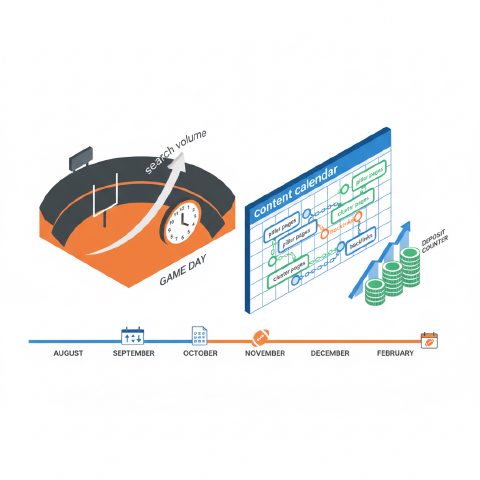
Build the calendar from the fixture list, not the other way around, pull domestic league and Champions League schedules 6-12 months ahead, batch-produce templated elements, and reserve human editorial bandwidth for the 15-20% of fixtures (derbies, title deciders, knockout legs) that drive disproportionate traffic and deposits.
Soccer's advantage over most betting verticals is that the calendar is public and known months in advance, league fixtures typically release in June for the following season, Champions League group stage draws happen in late August, and knockout draws are set by the competition format. That predictability means you should never be scrambling to write a Champions League final preview the week of the final. I build these calendars a full season ahead and slot in production weeks for high-value matches well before the content is needed.
Not every fixture deserves the same content investment. I grade matches by expected search volume and deposit potential, a Manchester derby or an El Clásico gets full editorial treatment: unique analysis, expert commentary, maybe a dedicated video embed. A mid-table Tuesday night fixture in a league your market cares less about gets a leaner, more templated page. That tiering is how you keep output high without diluting quality on the pages that actually matter for revenue, I typically see 70-80% of organic deposits from soccer content come from under 20% of the fixture pages published.
Resourcing-wise, this is where content ops and link building need to sync. The derby and title-decider pages are exactly where I push extra link equity, internal links from the homepage and league hub, external PR pushes, social amplification, because they're the pages capable of ranking for high-volume, high-intent terms within days if the signal is strong enough going in.
What technical SEO problems kill soccer betting sites at scale?
Crawl budget waste from orphaned old fixture pages, duplicate content across near-identical match previews, and poor indexation of programmatically generated pages are the three technical issues I find most often. A site with 10,000+ fixture URLs needs disciplined log file analysis and a clear deindexing policy for expired content.
Scale is soccer betting SEO's blessing and its curse. A multi-league, multi-season operator can easily have 15,000-30,000 historical fixture URLs sitting on the domain. Googlebot has a finite crawl budget for your site, and if it's spending that budget re-crawling three-year-old Championship fixture pages with zero current search value, it's not crawling your new Champions League knockout content fast enough to catch the traffic window. I run log file analysis (Screaming Frog's log file tool or a dedicated setup through GSC's crawl stats report) on every soccer client quarterly, and it's routine to find 30-40% of crawl budget going to pages that haven't earned a single click in 12 months.
The fix isn't blanket deletion, that wastes link equity those URLs may have accumulated. It's a tiered policy: fixture pages older than one full season get noindexed but kept live (they retain link equity passed through internal links, but stop competing for crawl budget against your active content); pages older than three seasons with zero backlinks and zero search impressions get 410'd outright. I've recovered meaningful crawl efficiency, and watched new content get indexed in days instead of weeks, just by running this cleanup quarterly.
Duplicate and near-duplicate content is the other recurring issue, especially with programmatically generated previews. If your templating system produces "Team A vs Team B: Preview, Odds and Prediction" with only the team names and a swapped stat block changing, Google's duplicate content detection collapses those pages in the index and picks one canonical version, usually not the one you wanted. The fix is the same one I mentioned on odds pages: force genuine variance into each page through unique injury notes, unique quotes or analysis, and varied internal link targets, not just variable substitution in a fixed sentence structure.
How should international operators structure hreflang for multi-market soccer content?
Build separate URL paths or subdomains per target market with correctly implemented hreflang pointing to localized league priorities, LATAM markets need Liga MX and Copa Libertadores weighted heavily alongside Champions League, while EU markets need domestic league depth first. Never rely on auto-translation of a single English hub.
Soccer is the one betting vertical where market localization genuinely changes which content matters most, not just which language it's written in. A LATAM-facing site needs Liga MX, Brasileirão and Copa Libertadores coverage at the same depth UK operators give the Premier League, and a straight English-to-Spanish translation of UK-centric content misses the actual demand entirely, because search behavior and league interest differ by market, not just by language.
Technically, I push clients toward ccTLD or subdirectory structures (site.com/es-mx/ or similar) over subdomains where possible, because subdirectories inherit domain authority faster and consolidate your link building effort into one domain instead of fragmenting it. hreflang tags need to be bidirectional and complete across every localized version, missing reciprocal tags is the single most common hreflang error I find in audits, and it causes Google to serve the wrong market version in search results, which tanks both relevance and conversion even when rankings look fine on paper.
Content prioritization by market is where the real strategic work happens. I run a quick volume-and-value matrix per target market before building anything: for a LATAM launch, that's typically domestic league (Liga MX, Brasileirão) first, Copa Libertadores and Copa Sudamericana second, Champions League and European leagues third because the diaspora interest is real but smaller than local league loyalty. For a UK or EU-facing book, it flips, Champions League and the big five European domestic leagues dominate, with lower-tier domestic leagues filling out the long tail. Get this prioritization wrong and you'll have built a technically flawless multi-market site that's simply covering the wrong leagues for each audience.
| Target market | Primary leagues to weight heaviest | Secondary priority | European competition weighting |
|---|---|---|---|
| LATAM (Mexico, Brazil, Argentina focus) | Liga MX, Brasileirão, Liga Profesional | Copa Libertadores, Copa Sudamericana | Moderate, diaspora and bandwagon interest |
| UK / EU | Premier League, La Liga, Serie A, Bundesliga | Ligue 1, domestic cups | High, Champions League is a top-tier driver |
| US | Premier League, Liga MX (growing Hispanic audience) | MLS, domestic cups | Moderate, growing with World Cup cycle |
| Asia-Pacific | Premier League, J.League / K League where local | Champions League, Europa League | High for Premier League crossover audience |
How do you measure ROI on soccer betting SEO content?
Track deposits per 1,000 organic sessions segmented by content type, domestic league hub, fixture page, competition page, not aggregate rankings or raw traffic. Champions League content typically converts at a different rate than regular-season league content, and treating them as one bucket hides which investment is actually paying back.
I built this agency on refusing to report vanity metrics to operators, and soccer content is where that discipline matters most because the traffic volumes are genuinely huge and genuinely easy to misread. A Champions League final preview page can pull 40,000 sessions in a week. If you're reporting that as a win without tying it to deposits, you don't actually know if it's a win, high-volume, low-intent informational traffic around a major final can convert far worse than a steady, lower-volume domestic fixture page that's attracting bettors already deep in their decision journey.
My standard setup ties GA4 or a server-side tracking equivalent to the sportsbook's deposit event through UTM-tagged internal CTAs and consistent URL taxonomy, so every page type reports deposits per 1,000 sessions as the core KPI, not just conversion rate on clicks. Across the campaigns I've run, domestic league fixture pages for major clubs typically convert new-depositor traffic meaningfully better than general competition hub pages, because the searcher intent is sharper, someone searching a specific weekly fixture is closer to placing a bet than someone searching general "Champions League odds" content, which often pulls broader, more casual interest including a chunk of non-bettors just checking scores and markets out of curiosity.
The other ROI lever operators miss: lifetime value attribution by acquisition content. A bettor who first deposited off a Champions League final page during a one-off surge often has different retention characteristics than one acquired through weekly Premier League fixture content, because the latter signals habitual engagement with the product. I push clients to run at least quarterly cohort analysis by first-touch content category, it consistently reshapes where the content budget goes the following season, usually toward more domestic league depth and less one-off competition-spike content than the initial instinct suggests.
Is SEO or PPC the better channel for soccer betting acquisition?
SEO wins on cost-per-deposit over a 12+ month horizon and is often the only legally available channel given Google and Meta's restrictions on gambling ads in most markets, but PPC still wins for immediate, time-boxed spikes like a Champions League final week where there's no runway to rank. Run both, weighted by timeline.
This question comes up in nearly every operator consultation I run, and the honest answer is that it's a false binary for soccer specifically, because Google Ads' gambling policy restrictions mean PPC simply isn't available at all in a large share of the markets operators want to target, certain US states, most LATAM markets, several EU jurisdictions require certification that takes months and significant compliance investment before you can even bid. SEO doesn't have that gatekeeping, which makes it the default primary channel for soccer betting by necessity in a lot of operator portfolios, not just by preference.
Where PPC genuinely wins: time-boxed, high-intent spikes where ranking organically simply isn't achievable in the available window. If a client needs visibility for a World Cup final or a one-off Champions League final between two clubs with no prior content history on the site, PPC (where legally available) can capture that demand in days versus the months SEO would need to build equivalent authority. I've run both channels for the same client simultaneously during major tournament windows, PPC absorbing the immediate spike while SEO content gets built and indexed to capture the long tail and the next cycle.
Cost-per-deposit tells the real story over time. I've tracked campaigns where blended PPC cost-per-deposit for competitive football betting terms sits meaningfully higher than mature organic content's cost-per-deposit once you amortize the SEO investment past month 8-10, SEO has a slower ramp but a much flatter long-run cost curve, while PPC cost stays roughly linear with spend indefinitely and tends to climb as competitors bid up the same football keywords during peak season. The operators getting this right run PPC for speed and compliance gaps, SEO for compounding, durable volume, and they measure both against the same deposit-based KPI so budget allocation decisions aren't guesswork.
| Factor | SEO | PPC |
|---|---|---|
| Availability by market | Available almost everywhere, no ad policy gatekeeping | Blocked or restricted in many jurisdictions (Google/Meta gambling policy) |
| Time to impact | 3-9 months for competitive football terms | Immediate, same-day visibility |
| Cost-per-deposit over 12 months | Declines as content compounds | Stays roughly linear, often rises during peak season bidding wars |
| Best use case in soccer | Domestic league depth, long-tail fixture and market terms | One-off major events with no existing content runway |
| Risk profile | Algorithmic, manual actions, core updates | Account suspension, policy violations, rising CPCs |
What are the biggest risks of aggressive soccer betting SEO tactics?
The biggest risks are manual action penalties from exact-match anchor PBNs, de-indexation from scaled thin-content abuse, and domain-wide trust damage from football tipster link schemes that Google has specifically modeled after years of spam in this niche. Diversify tactics and keep aggressive link building off your primary money domain where possible.
I won't pretend grey-hat tactics don't work in this vertical, I run them for clients and they move rankings faster than pure white-hat content ever will. But soccer betting specifically carries elevated risk compared to, say, slots or poker content, because football tipster spam has been a known abuse pattern for Google's spam teams for well over a decade. Scaled content abuse enforcement and the various link spam updates since 2021 have disproportionately hit football and soccer prediction sites, in my experience auditing penalized domains, because the pattern, thin AI-generated previews, exact-match anchors, PBN link farms built purely for betting tips, is so well documented in their training data.
My standard risk mitigation: run the most aggressive link tactics (heavy PBN tiers, high-volume expired domain redirects) against a secondary or "satellite" domain funneling to your primary brand, rather than directly against the money site. If the satellite takes a hit, you lose that domain's equity, not your primary brand's search presence and the years of trust it's built. I also stagger link velocity deliberately, a sudden jump from 20 to 400 referring domains in a month on a competitive term like "Champions League betting odds" is exactly the unnatural pattern that triggers both algorithmic suppression and manual reviewer attention, so I keep velocity curves that look plausible for the content and authority level of the site at that point.
The other underrated risk is reputational and compliance-adjacent, not purely algorithmic. Aggressive content that reads as tipster-style guaranteed-win language ("lock of the week," "guaranteed winner") creates regulatory exposure in markets with strict responsible gambling advertising rules, the UK's CAP code and several US state regulators scrutinize exactly this kind of language. I've had clients need to retroactively rewrite thousands of pages of football prediction content because the tone created compliance risk that had nothing to do with Google at all. Build the content discipline in from the start; it's far cheaper than the rewrite.




Comments
No comments yet, be the first.