Betting Match Preview SEO in 2026: My Playbook for Turning Fixtures Into Deposits

What is betting match preview SEO and why does it drive deposits?
Betting match preview SEO is publishing structured, keyword-targeted fixture pages, team news, head-to-head data, odds context, prediction angles, timed to rank for '[Team A] vs [Team B] preview' and 'prediction' queries. It converts because it intercepts bettors in a 48-72 hour decision window right before they pick a book and deposit.
I've run acquisition for operators where match preview content outperformed every other content category on deposits-per-click, and the reason is simple: search intent here isn't informational in the dictionary sense, it's transactional with a sports wrapper. Someone typing 'Arsenal vs City preview odds' three days out is shopping. They're deciding where their money goes before kickoff, not reading for leisure.
Volume on a single fixture keyword might only run 200-2,000 searches globally depending on the match, but multiply that across 300 fixtures a week in five leagues and you're looking at six-figure monthly search volume that PPC can't touch in most markets because Google Ads restricts gambling creative and landing pages heavily outside licensed jurisdictions.
The conversion mechanism matters too. A preview page that embeds your odds widget, links to your bet builder, and name-drops your boosted price on the match outcome does double duty, it ranks AND it closes. I've seen preview pages convert at 2-4x the rate of generic 'how to bet on football' evergreen content because the user is already in a betting mindset, not a learning mindset.
How do you build a match preview template that scales without reading like a template?
Build a modular template with fixed structural blocks, team news, form, H2H, key stats, prediction, betting angle, but make 40-60% of each page's content genuinely unique: fresh injury data, specific player stats, localized odds. The skeleton can repeat; the substance can't, or Google will flag the pattern.
The mistake I see constantly is operators treating the template as the finished product instead of the scaffolding. If your 'recent form' section is just a table swapped with new numbers and every surrounding sentence is identical boilerplate, you've built a pattern Google's algorithms are specifically tuned to catch post-Helpful Content Update.
My standard preview template runs eight blocks: headline hook, quick-fire prediction box, team news/injuries, last-5 form table, head-to-head record, key stat or trend (set piece record, over/under history, home/away split), a betting angle tied to your odds feed, and a final verdict with your CTA. Five of those eight blocks pull from a live data feed (Opta, Sportradar, StatsPerform) and render dynamically, low editorial cost, naturally unique per fixture because the underlying data is unique. The other three, hook, angle, verdict, need a human or a well-prompted AI pass to avoid sounding identical across 400 pages.
| Content block | Automation level | Uniqueness risk if templated raw |
|---|---|---|
| Team news / injuries | High, pull from data feed | Low (data changes per fixture) |
| Form table (last 5) | High, automated table render | Low (numbers inherently unique) |
| Head-to-head record | High, automated | Low |
| Key stat / trend callout | Medium, AI draft, human select | Medium, needs angle variation |
| Betting angle / odds tie-in | Medium, template + live odds | Medium-High, repeat phrasing risk |
| Prediction / verdict copy | Low, human or edited AI | High if left unedited |
| Intro hook | Low, human or heavily edited AI | High, most-copied block on the page |
How many fixture previews do you actually need to publish per week?
Competitive operators covering 3-5 major leagues need 150-500 previews a week to maintain coverage parity with sites like talkSPORT, Sporting News or BettingExpert. Under-publishing against the full fixture list is the fastest way to leave long-tail traffic, and deposits, on the table for a competitor to absorb.
Run the math on a single league. The EPL alone generates 380 fixtures a season. Add the Champions League, La Liga, NBA and NFL and you're easily past 2,000 previewable fixtures annually just in core markets, before you touch darts, tennis or esports, which convert surprisingly well for crypto-casino audiences with younger demographics.
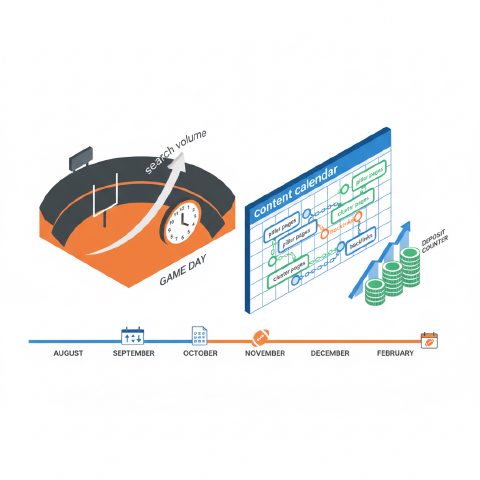
I tell clients to think in weekly sprints tied to the fixture calendar, not monthly content plans. A gap of even 20% missed fixtures in a league you're trying to rank for compounds, Google rewards topical completeness, and a competitor with full coverage builds a stronger entity signal around 'Premier League betting previews' than you will with gaps. In one campaign I ran for a mid-tier sportsbook, moving from 60 to 240 previews/week across three leagues lifted organic sessions 140% in four months and organic-attributed deposits roughly tripled, not because each page ranked higher individually, but because the sheer coverage expanded the long-tail net dramatically.
Don't publish fixtures nobody searches for just to hit a number, though. Cross-check against Ahrefs or SEMrush keyword data before committing a league to full coverage, darts and table tennis previews in off-peak slots can cost more in editorial time than they return.
Should you use AI, freelancers, or in-house writers to scale preview production?
A hybrid model wins: AI or a data-feed engine drafts the structured, stats-heavy blocks; a small in-house or retained freelance team of sports editors writes the prediction angle, bylines and quality control pass. Pure AI output risks thin-content flags; pure freelance doesn't scale past 50-80 previews/week economically.
I've tested all three models across different client budgets. Pure freelance scales to maybe 60-100 previews a week before quality control collapses or costs hit $15-25 per 600-word preview, which at 300 previews/week is $4,500-7,500 weekly just in copy, unsustainable for most mid-market operators. Pure AI output is cheap, $0.50-2 per page in generation cost, but if you publish it raw at scale you're building exactly the kind of pattern-matched, low-value page cluster the Helpful Content Update and subsequent core updates have been specifically tuned to suppress since September 2023.
The hybrid model I run with clients now: a data pipeline auto-generates the stats blocks and a structured AI draft for the narrative sections, then a retained editor (often a genuine football or basketball analyst with a real bio and LinkedIn presence, this matters for E-E-A-T) reviews, rewrites the prediction and hook, and signs off. That gets you to 300-400 previews/week at roughly $3-6 per page in blended cost, with human fingerprints on every page that actually matters for rankings.
| Model | Realistic weekly output | Blended cost per preview | Helpful Content risk |
|---|---|---|---|
| Pure freelance | 60-100 | $15-25 | Low, but unscalable cost |
| Pure AI, unedited | Unlimited | $0.50-2 | High, thin/pattern content |
| Hybrid (AI draft + editor) | 300-500 | $3-6 | Low-Medium if editor adds genuine insight |
| In-house editorial team | 150-250 | $8-14 (salary-loaded) | Low, best E-E-A-T, slowest to scale |
What's the real risk of Google penalties when scaling preview content this fast?
The risk isn't a manual action for gambling content specifically, it's algorithmic suppression under the Helpful Content Update and site-wide core update impact from thin, duplicate-pattern pages. I've seen preview sections lose 40-70% of visibility within weeks when templates were left unedited across hundreds of near-identical pages.
Google doesn't need to manually review 2,000 preview pages to catch a problem. The classifier looks at site-wide patterns: sentence structure repetition, boilerplate-to-unique-content ratio, time-on-page, and whether users immediately bounce back to search. A preview section that's 80% boilerplate scaffolding gets flagged as a pattern even if no single page trips a spam filter, this is how entire /previews/ subfolders got de-indexed or demoted across the gambling vertical in 2023-2024 when operators leaned too hard into raw GPT output post-ChatGPT launch.
The fix isn't abandoning scale, it's raising the unique-content floor. I run a rule with every client: no preview page ships without at least one data point or insight that didn't exist on any other page that week, an injury update, a specific stat, a line movement note. It's a small editorial cost that prevents the algorithmic pattern match from forming in the first place.
Separately, be aware that 'prediction' and 'tips' framing can trigger stricter ad policy and regional compliance reviews in licensed markets (UK ASA, Ontario AGCO rules on inducement language), that's a compliance risk layered on top of the SEO risk, and legal should sign off on prediction copy templates before they go to 400 pages.
How should you structure internal linking across thousands of preview pages?
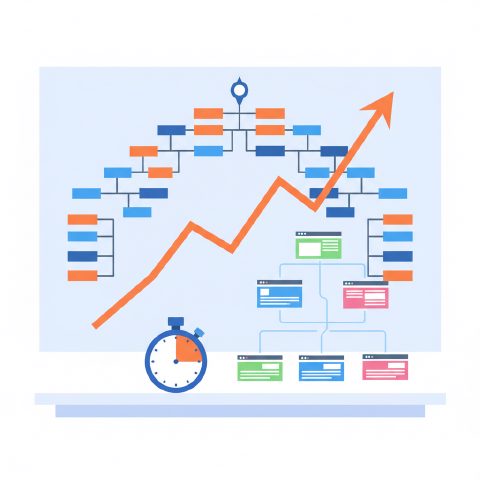
Build league and team hub pages that aggregate every preview, result and odds page for that entity, then link every fixture preview up to its two team hubs and its league hub. This creates topical clusters Google can crawl efficiently and passes link equity from high-authority evergreen pages down to fresh, low-authority fixture URLs.
Orphaned preview pages are the single most common technical issue I audit in this vertical. Operators publish 300 fixtures a week, index them via sitemap, and never link to them from anywhere except the homepage's latest-articles widget. Googlebot deprioritizes crawl budget for pages with weak internal link signals, so your Tuesday preview might not get crawled until Thursday, useless for a Wednesday kickoff.
My structure: every sport has a hub (/football/), every league has a sub-hub (/football/premier-league/), every team has a hub (/football/premier-league/arsenal/), and every fixture preview links upward to both team hubs and the league hub in its breadcrumb and body copy, plus sideways to the 2-3 most relevant other fixtures that week. Run this through Screaming Frog monthly to catch orphans, I still find operators with 15-20% of preview URLs receiving zero internal links six months after publish, bleeding crawl efficiency and relevance signal for nothing.
What schema and technical SEO elements actually move the needle for fixture pages?
Implement SportsEvent schema with competitor, startDate and location properties, plus Article schema with author and datePublished for E-E-A-T, and FAQ schema where you answer a real betting question per fixture. Core Web Vitals matter disproportionately here because these pages get crawled and viewed on mobile in short, high-volume bursts near kickoff.
SportsEvent structured data is underused in this vertical, most operators mark up previews as generic Article schema and miss the eligibility for sports-specific rich results and Google's sports knowledge panel linkage, which drives meaningful click-through lift when your preview surfaces alongside live score widgets.
Freshness signals matter more here than almost any other content type I work with. A preview published five days before kickoff needs a visible 'last updated' timestamp and ideally a changed URL parameter or modified sitemap lastmod when team news updates 24 hours out, Google re-crawls time-sensitive sports content aggressively when it detects genuine freshness signals, less so when the page is static from publish to kickoff.
Core Web Vitals discipline is non-negotiable at this volume. If your programmatic template loads three ad networks, an odds widget iframe and a live-score embed, LCP creeps past 4 seconds and you lose both rankings and the in-session conversion you built the page for. I push clients to lazy-load everything below the fold and keep the odds CTA above the fold as a static, fast-rendering element, that single change recovered a client roughly 18% of mobile organic sessions after a Core Web Vitals-driven core update dip in 2023.
Is it worth publishing previews for low-volume fixtures and minor leagues?
Yes, but only as part of a long-tail aggregation play, not standalone investment, cluster low-volume fixtures (lower-division football, minor tennis tour events) into roundup hub pages rather than giving each its own thin, barely-searched URL. Full individual previews are reserved for leagues with proven search demand of 100+ monthly searches per fixture pattern.
I run a simple threshold with clients: if a fixture pattern (team vs team, or league-level query) shows under 50 combined monthly searches in Ahrefs/SEMrush, it doesn't get a standalone 600-word preview, it gets a slot in a weekly roundup hub ('This Week's League One Fixtures & Odds') instead. That satisfies the handful of searchers, captures the aggregate long-tail volume, and avoids diluting your site average with hundreds of near-zero-traffic pages, which drags down your Helpful Content classifier signal site-wide.
Where low-volume coverage does pay off is crypto-casino and offshore sportsbook audiences betting on esports and niche combat sports, CS2, Dota, smaller MMA promotions. Individual query volume looks tiny, but these audiences search with high commercial intent and near-zero competition, so a 300-word preview can rank #1 within days and convert at rates your Premier League content will never hit because there's no competing content at all.
How do you manage the content lifecycle from pre-match preview to post-match archive?
Publish the preview 3-5 days out, update it with confirmed lineups 2-4 hours before kickoff, then convert the same URL into a result/recap page post-match rather than creating a new URL, this preserves all accumulated link equity and ranking signal instead of starting from zero on a fresh page every match.
Operators who create a separate /preview/ and /result/ URL for the same fixture are throwing away equity twice a season per fixture. I set up every client with a single persistent URL per fixture that transforms through three states: preview (T-5 days), live/lineup-confirmed (T-2 hours), and recap (T+1 day), with the meta title and primary H1 updating to match search intent at each stage. The URL keeps its backlinks, its crawl history and its index status throughout.
For archiving at season end, don't delete, 301 redirect last season's fixture page to this season's equivalent fixture or to the team hub if there's no direct equivalent. I've recovered 6-10% of a league section's organic traffic simply by fixing a client's habit of letting last season's 380 preview URLs 404 every summer, which Google read as a mass content collapse and suppressed the whole subfolder's crawl priority going into the new season.
How do you measure ROI on match preview SEO versus PPC or affiliate spend?
Track cost-per-deposit by content category in GA4 with UTM-tagged internal CTAs, not just sessions or rankings. In my campaigns, scaled preview content typically lands at $8-20 cost-per-acquisition once production and tooling are amortized, versus $40-120+ on PPC in licensed markets and 25-40% revenue share on affiliate deals.
Rankings are a leading indicator, deposits are the metric that keeps the content budget alive at the next board review. I build every preview campaign with a measurement layer first: unique CTA UTMs per preview template version, GA4 conversion events tied to actual deposit confirmation via server-side tracking where the operator's platform allows it, and a weekly cohort view of cost-per-deposit by league and by content age (0-3 days old vs. 30+ days old, since preview pages decay fast in relevance).
The comparison that actually convinces a CFO: PPC in gambling is either unavailable (Google Ads blocks most unlicensed gambling ads entirely) or extremely expensive in licensed markets, $3-8 CPCs are common in UK and US sports betting terms, pushing blended CPA well past $60 once you factor conversion rates. Affiliate deals hand 25-40% of player lifetime value away permanently. Owned preview SEO content, once the production pipeline is built, has a CPA that keeps dropping as the page archive compounds, a preview page published 18 months ago with zero ongoing spend can still be converting deposits today, something no PPC dollar or affiliate commission ever does.
| Channel | Typical CPA range | Decay profile | Scalability ceiling |
|---|---|---|---|
| PPC (licensed markets only) | $40-120+ | Instant, stops when spend stops | High but linear with budget |
| Affiliate / CPA deals | 25-40% rev share, ongoing | Zero decay, permanent cost | High but margin-eroding |
| Scaled match preview SEO | $8-20 once amortized | Slow decay, compounds for 12-24 months | High with production investment |
What are the biggest mistakes operators make when scaling preview content?
The top three I see repeatedly: publishing raw AI output across hundreds of pages without a human quality gate, orphaning fixture pages with no internal linking, and chasing fixture-count volume in leagues nobody actually searches instead of matching coverage to proven demand. Any one of these can neutralize an otherwise sound production pipeline.
The fourth mistake, less obvious but just as costly, is treating every league with identical template depth. A La Liga preview and a third-division Scottish football preview don't deserve the same word count or the same odds-widget placement, match editorial investment to proven search demand and conversion value, and you free up budget to go deeper on the leagues that actually move deposits.
The fifth is ignoring author identity entirely. Google's current guidance and the broader E-E-A-T framework reward content with identifiable, credible authorship, a real sports editor byline with a bio linking to verifiable experience outperforms an anonymous 'Staff Writer' tag on trust signals, and it's a near-zero-cost fix most operators simply haven't bothered implementing.



Comments
No comments yet, be the first.