Horse Racing Betting SEO in 2026: Build Evergreen Pages That Outlast Cheltenham and the Grand National

What makes horse racing betting SEO different from other sports verticals?
Racing SEO is a hybrid of event SEO and evergreen authority SEO. Demand concentrates brutally around Cheltenham, the Grand National and Royal Ascot, intent splits sharply between tips-seekers and ready-to-bet punters, and racecards, going reports and non-runner updates need live technical handling that static football or NBA betting content never requires.
I've run acquisition for football and basketball operators where demand spreads across 38 fixtures a season. Racing doesn't work that way. A mid-size UK operator can see 20-30% of its annual racing-related organic traffic land inside the four days of the Cheltenham Festival and the single Saturday of the Grand National. That concentration changes everything about how you plan content, link velocity and crawl budget, you're not optimizing for steady weekly demand, you're optimizing for two or three annual cliffs.
The intent split matters just as much. Someone searching 'each way betting explained' wants education and sits top-of-funnel for months. Someone searching 'grand national tips today' three hours before the off wants a decision and converts in minutes. Treating both with the same template is the single most common content mistake I see in this vertical, operators either dumb down evergreen guides into thin tip-sheets, or bury genuine tipping authority under generic betting-guide fluff that doesn't rank for either intent.
Then there's the data layer. Racecards, going/ground conditions, non-runners and live odds grids change by the hour during a meet. Google's quality raters increasingly expect gambling advice pages to show demonstrable track record and named authorship under the YMYL (Your Money or Your Life) guidelines, a generic 'our experts' byline on a tipping page won't cut it the way it might on a casino bonus page.
How do seasonal peaks like Cheltenham and the Grand National actually move organic traffic?
UK search volume for 'grand national' terms can climb from a low thousands baseline to well over 100,000 monthly in race week, per Ahrefs and SEMrush UK data, with tips and runners-and-riders variants spiking 10x+ in the final two weeks. Cheltenham compresses similar demand into four festival days in mid-March.
These are estimates, not gospel, I'd treat any specific Ahrefs or SEMrush number as directional, since both tools model search volume differently and racing terms are notoriously spiky in ways that smooth monthly averages understate. What's consistent year over year is the shape of the curve: slow build from Boxing Day trials through February, a sharp acceleration in the final two to three weeks, a peak on race day itself, then a cliff.
What makes this peak more valuable than an equivalent football spike is the PPC side. Google's gambling ads policy requires jurisdiction-specific certification, and during festival week every certified operator bids on the same thin set of terms, pushing CPCs for competitive terms like 'grand national betting' into aggressive territory. I've seen estimates in the £15-£25 per click range for top positions in UK market during peak days, that's an estimate operators should verify in their own Ads account, but directionally it's accurate. Organic visibility during that exact window isn't a nice-to-have; it's the cheapest acquisition channel you'll touch all year, assuming you built it in advance rather than scrambling in March.
How do you build an evergreen horse racing content hub that doesn't die after the festival ends?
Build one permanent hub page, 'Horse Racing Betting Guide', linking down to pillar pages on racecards, going conditions, each-way rules and tipster methodology. Those pillars then link into seasonal festival pages three months before each event, passing authority that compounds year over year instead of resetting every season.
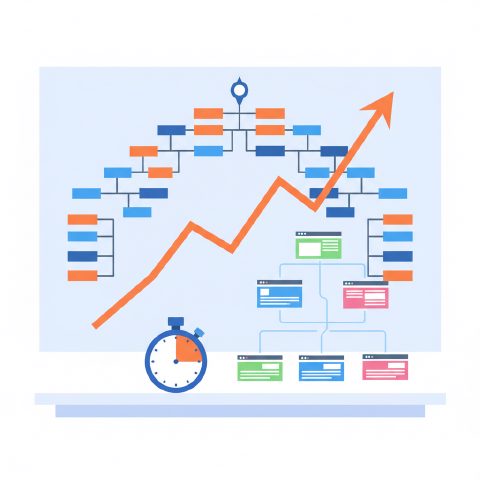
The architecture I push every racing client toward is a three-tier hub: a top-level guide hub, five to eight pillar pages covering genuinely evergreen topics (how to read a racecard, going and ground explained, each-way terms by field size, trainer and jockey form analysis), and seasonal event pages sitting beneath those pillars rather than floating as orphan URLs. The seasonal pages inherit internal link equity from pillars that have been accumulating authority since last year's festival, instead of starting from a cold index.
This matters practically because Google doesn't rank a page the moment you publish it, it ranks a page once it's crawled, assessed against competing results, and given time to prove engagement signals. A pillar page that's been live and earning links for eighteen months will pull a freshly-updated seasonal child page into the top 10 far faster than a standalone page launched in February with no link history.
I'd also flag a mistake worth naming directly: operators who treat 'evergreen' as 'never touched again.' These pillars need refresh cycles too, updated statistics, current trainer form, revised internal links to this year's festival content, ideally every 60-90 days, not a one-and-done publish.
What does a horse racing content calendar look like for a full racing year?
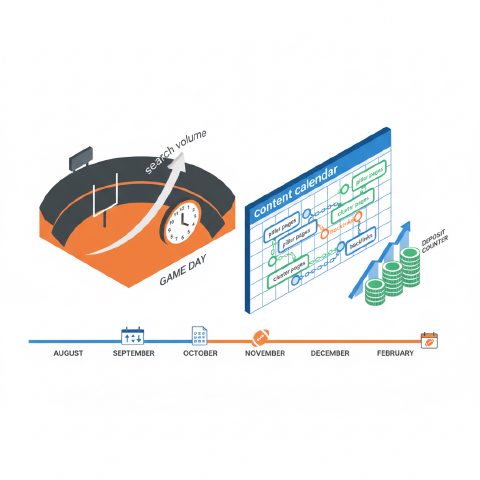
A working racing content calendar maps content action to lead time, not just publish date. Cheltenham content needs refreshing by mid-January for a mid-March festival; Grand National content by February for an early-April race day. Royal Ascot, Glorious Goodwood and Breeders' Cup follow the same 10-14 week lead-time rule.
I build these calendars backward from the event date, not forward from 'when marketing has time.' If Cheltenham runs mid-March, the festival guide and day-by-day tip pages need to be live and link-equipped by mid-January at the latest, Google typically needs 8-10 weeks of crawl and authority signal to move a competitive seasonal page into realistic striking distance, and that's before you account for the link-building lead time underneath it.
The calendar below is the skeleton I'd hand a new racing client in month one. Every operator's exact dates shift slightly year to year with fixture scheduling, so treat months as approximate and verify against the current British Horseracing Authority fixture list.
| Month | Key Race / Event | Content Action | Lead Time Before Event |
|---|---|---|---|
| Jan | Cheltenham trials season | Refresh trial-race previews, trainer form pages, odds comparison | 6-10 weeks |
| Feb | Cheltenham build-up | Publish/refresh festival guide, tips hub, each-way angle content | 4-6 weeks |
| Mar | Cheltenham Festival (4 days) | Day-by-day tips, non-runner updates, live results hub | Live content ready |
| Feb-Mar | Grand National build-up | Refresh GN guide, sweepstake kit, 'how many runners' explainer | 10-14 weeks |
| Apr | Grand National (Aintree) | Day-of tips, fallers history refresh, results page | Live content ready |
| May-Jun | Royal Ascot | Refresh Ascot guide, dress code/sweepstake crossover content | 8 weeks |
| Jul-Aug | Glorious Goodwood, summer flat | Evergreen flat-racing pillar refresh | 6-8 weeks |
| Sep-Oct | Arc, Breeders' Cup previews | US/EU crossover content, odds comparison refresh | 8 weeks |
| Nov | Breeders' Cup, Hunt season start | Jump season pillar refresh, trainer form reset | 6 weeks |
| Dec | King George, Christmas fixtures | Holiday racing guide, 2026 Cheltenham teaser content | 6-8 weeks |
How should you structure racing tips content for SEO without triggering thin-content penalties?
Consolidate daily tips onto one stable, regularly-updated URL rather than generating a fresh dated page every day. Each page needs a named tipster, a visible track record (strike rate, ROI, settled-bet history), and genuine analysis per race, not reshuffled templates. Noindex or canonicalize old dated archives that add no unique ranking value.
This is where I see the most Google-manual-action risk in the whole vertical. Auto-generating '/tips/2026-03-14' style URLs every single day, each with near-identical boilerplate and a swapped-out selection, is a textbook thin-content and doorway-page pattern. Google's helpful content system, folded into core updates since 2023, is specifically tuned to catch exactly this, repetitive, template-driven pages with low unique value per URL.
The fix is structural, not cosmetic. Pick one stable URL, '/racing-tips/today', that updates daily with fresh content but doesn't fragment into infinite dated children. Build a separate, permanent tipster track-record page showing settled results over rolling 30/90/365-day windows; link to it from every tips page. That track-record page does double duty as an E-E-A-T signal for quality raters and as a trust signal for bettors deciding whether to follow the pick.
On internal linking from these pages into money pages (sign-up, odds comparison, specific race betting pages), keep anchor text disciplined: 60-70% branded or naked-URL anchors, 20-30% partial-match ('Grand National odds comparison'), under 10% exact-match ('grand national tips'). Racing tips content gets scrutinized harder than casino content because the affiliate and tipster space has a long history of manipulation, don't give Google an easy pattern to flag.
What link building tactics actually work for racing operators?
Generic sportsbook PBNs rarely move racing rankings because trusted publishers, Racing Post, At The Races, Timeform, dominate the SERP and Google weighs their link graph heavily. Niche edits on genuine tipster and equestrian sites, racing-relevant expired domain acquisition, and digital PR around sweepstake content outperform mass link networks here.</p>
Racing is one of the few gambling sub-verticals with a real, non-gambling media ecosystem around it, training yards, bloodstock press, point-to-point clubs, regional equestrian news. That gives you legitimate niche edit and guest-contribution opportunities you don't get in, say, online slots SEO. I'd budget $150-$500 per placement for genuine tipster-blog niche edits with real traffic and editorial standards, with 4-8 week turnaround for outreach-to-live-link.
Expired domain acquisition works here too, but it's harder to source than generic sportsbook expired domains, you're filtering Ahrefs/ExpiredDomains.net exports for actual equestrian or racing topical relevance with 20+ referring domains and clean link profiles, not just high Domain Rating. PBNs built from racing-adjacent expired domains carry real risk post-2022 spam updates; Google's footprint detection on shared hosting, templated content and unnatural velocity has gotten materially better. I'll use PBN tiers as a supporting layer under a stronger tier-1 asset, never as the sole strategy for a money page I care about long-term.
The highest-leverage tactic I run every April is a Grand National sweepstake kit, a downloadable sweepstake generator and name-the-runners sheet. It's genuinely useful, shareable content that regional and even national press (Metro, Mirror-tier outlets in the UK) will link to naturally every single year without a cold outreach email. That's digital PR doing what crowd marketing and forum seeding can't: earning links from domains a casino operator could never place a guest post on.
Cheltenham SEO vs Grand National SEO: what actually differs between the two festivals?
Cheltenham draws hardcore racing bettors across four days with deeper average stakes and demands day-by-day tipping depth. The Grand National is a single-day mainstream event where sweepstake and novelty searches dwarf pure betting intent, making lifestyle-press digital PR far more effective than it is for Cheltenham.
I treat these as genuinely different SEO campaigns under one shared hub, not one campaign with two landing pages. Cheltenham's audience already knows racing, they want trainer angles, going-dependent value bets, and jockey booking analysis. Grand National traffic includes huge volumes of once-a-year bettors Googling 'how many horses in the grand national' or 'grand national sweepstake generator,' most of whom never place a bet but will click a betting operator's sweepstake tool if it ranks.
That second audience is why sweepstake and novelty content converts worse on a per-visit basis for the Grand National but still earns the most backlinks of anything in a racing content calendar, mainstream outlets pick up sweepstake kits every year because they need that content too, for their own readers.
| Factor | Cheltenham Festival SEO | Grand National SEO |
|---|---|---|
| Search pattern | 4-day spike, builds from Boxing Day trials | Single-day spike, lower baseline, faster rise |
| Core audience | Experienced racing bettors, higher average stake | Mainstream once-a-year bettors, huge top-of-funnel |
| Top content format | Day-by-day tips, trainer/jockey value pieces | Sweepstake kits, fallers history, 'how many runners' guides |
| Best link tactic | Niche edits on Racing Post-adjacent tipster sites | Mainstream press digital PR via sweepstake tools |
| Conversion profile | Lower volume, materially higher deposit rate | Massive volume, lower deposit rate but near-zero marginal cost |
What technical SEO issues are unique to horse racing betting sites?
Racecards, odds grids and non-runner feeds often render client-side, which Googlebot can fail to crawl in time during fast-moving festival updates. Load-test CDN and TTFB before race week, traffic can jump 10-20x on festival days, and reuse one permanent URL per annual race instead of rebuilding a fresh dated URL every year.
The single costliest technical mistake I still see from racing operators: creating '/grand-national-2025', then '/grand-national-2026' as a brand new URL each year instead of updating one permanent '/grand-national' page. That habit throws away every backlink, every engagement signal and every bit of accumulated trust the previous year's page earned, and forces you to rebuild authority from zero every single April. Keep one URL, update the content annually, and 301 any legacy dated URLs into it.
Second issue is rendering. Live odds widgets and racecard grids built in heavy JavaScript frameworks can outpace Googlebot's render queue, especially during the exact week you most need fast indexation of non-runner changes. I'd run a Screaming Frog crawl in JS-rendering mode a month before each festival specifically to confirm racecard and odds content appears in the rendered HTML Googlebot actually sees, not just in the browser DOM.
Third, infrastructure: festival-day traffic commonly runs 10-20x a normal weekday for racing-heavy operators. Load-test before the event, not during it, a slow TTFB during exactly the window Google is deciding how to rank your live pages against competitors directly costs you both rankings and conversions, since page speed affects both algorithmic signals and real user bounce rate on the day that matters most financially.
How do you measure ROI on horse racing SEO versus just running PPC during peak weeks?
Track deposits-per-content-cluster, not keyword rank. Evergreen tips and guide pages often convert at 2-4% deposit rate with solid lifetime value, while mainstream Grand National sweepstake traffic can convert under 0.5% but still pays back fast given near-zero marginal cost against PPC CPCs that spike sharply during festival week.
I pull Google Search Console query-to-landing-page exports and match them against deposit events in the BI stack, segmented by page type, evergreen pillar vs seasonal festival page vs tips hub. That segmentation matters because blended conversion rate across a racing site hides a real split: evergreen educational traffic tends to convert well because it's self-qualified bettors researching before depositing, while mainstream festival-day traffic is dominated by curious non-bettors.
The payback math that actually sells this internally to a finance team: if top-3 organic visibility during Cheltenham or the Grand National displaces clicks you'd otherwise have bought at an estimated £15-£25 CPC during peak bidding, even a modest 5,000-10,000 incremental organic clicks across festival week represents tens of thousands in avoided ad spend for a mid-size operator, on top of whatever those clicks deposit directly. That's the number I lead with when an operator asks why SEO deserves a 10-week head start budget instead of waiting to see if PPC "covers it" in March.
What are the biggest mistakes operators make with horse racing betting SEO?
The three recurring mistakes: rebuilding a fresh seasonal URL every year instead of reusing one permanent page, publishing festival content two to three weeks out when Google needs 10+ weeks to rank it, and treating content as the whole strategy while ignoring technical readiness for the live traffic spike.
Mistake one, the annual URL reset, I've covered, but it's worth repeating because it's the single most avoidable loss of compounding equity in the entire vertical. Fix it once and every following year gets easier, not harder.
Mistake two is timing discipline. I've had operators come to me in late February asking for a Grand National ranking by early April. That's roughly six weeks, survivable for low-competition long-tail terms, not for 'grand national tips' or 'grand national runners.' The fix isn't more budget crammed into six weeks; it's a calendar that starts the refresh cycle in December for an April event, every single year, regardless of who's running marketing that quarter.
Mistake three is assuming content alone wins festival week. I've watched well-ranked racing pages lose real money because the site couldn't handle a 15x traffic spike on Grand National Saturday, slow pages, broken odds widgets, non-runner updates that didn't propagate. Rankings get you to the page; infrastructure determines whether that visit turns into a deposit.



Comments
No comments yet, be the first.