Esports Betting SEO in 2026: The Sportsbook Niche Your Competitors Haven't Found Yet

Why Is Esports Betting SEO the Most Underpriced Channel in Sportsbook Marketing Right Now?
Esports betting SEO is underpriced because operators keep dumping budget into saturated football and basketball terms while CS2, Dota 2 and Valorant betting searches sit wide open. Keyword difficulty runs 30-50 points lower than mainstream sports, the audience skews younger and mobile-first, and most ad platforms won't even let you bid on it.
I've pulled Ahrefs data across a dozen sportsbook accounts in the last two years and the pattern repeats every time: a term like "nfl betting odds" sits at Keyword Difficulty 68-74 with a backlink gauntlet nobody's winning without six figures of link spend. Run the equivalent query for "cs2 major betting odds" or "dota 2 betting predictions" and you're looking at KD 8-25, sometimes lower during off-peak months. That gap exists because sportsbook SEO teams are staffed by people who understand point spreads and don't know a Dota draft from a CS2 economy round. They skip the vertical entirely.
Google and Bing Ads also restrict esports wagering ads in most jurisdictions far more aggressively than they restrict traditional sports betting ads, the policy language is vague enough that platforms default to blanket rejection rather than case-by-case review. That means PPC isn't even an option for a huge slice of this traffic. If you've got a licensed book accepting esports markets and you're not building organic content around it, you're leaving a channel on the table where your only real competitor is Google's algorithm, not a rival's ad budget.
The audience economics matter too. Esports bettors trend 18-34, deposit smaller amounts per bet but bet more frequently during tournament windows, and they're heavy second-screen users, watching the stream while checking live odds on a second tab. That behavior pattern rewards fast-loading, mobile-first content with live odds widgets far more than it rewards a 3,000-word evergreen guide. Build for that behavior and you capture deposits other books are structurally blind to.
How Is Esports Betting SEO Different From Traditional Sportsbook SEO?
Esports betting SEO runs on content velocity, not content volume. Patch notes, roster swaps and map-pool changes shift betting value within hours, so you need publishing workflows closer to a gaming news site than a sportsbook blog, plus writers who actually understand the games rather than generalist sports copy.
Traditional sportsbook content decays slowly, an NFL team preview is useful for a week, a season outlook for months. Esports content decays in hours. A CS2 map-pool rotation announcement, a Dota 2 patch that reworks a core hero, or a roster change three days before a Major can flip betting value entirely. If your content team works on a Monday-planning, Friday-publish cycle, you're publishing stale odds analysis by the time it goes live. I've had operators ask why their esports hub underperforms despite decent backlinks, the answer is almost always publishing cadence, not authority.
The E-E-A-T angle is also harder to fake here than in mainstream sports. Google's reviewers and, increasingly, AI answer engines can tell the difference between a writer who understands CS2 economy management and one paraphrasing a press release. Hire someone who's actually ranked in competitive Dota or watched 200+ hours of CS2 pro play, their content reads differently, gets cited differently, and tends to earn organic links from gaming communities without you chasing them.
Link sources differ too. Mainstream sportsbook links come from sports media, tipster networks, and general betting comparison sites. Esports betting links need to come from gaming press (think outlets covering HLTV, Liquipedia-adjacent communities, Dot Esports-style publications), Twitch/YouTube creator blogs, and gaming subreddits where crowd marketing still works if you're not heavy-handed about it. Pull links from a generic sports PBN into an esports page and the topical mismatch is obvious, Google's relevance models catch it even when the DA numbers look fine.
Which Esports Betting Keywords Actually Drive Deposits, Not Just Traffic?
The highest-converting esports betting keywords are event-specific and transactional: team-vs-team odds pages, Major and Champions Tour betting predictions, and live-odds queries during tournament windows. Broad informational terms like "how to bet on esports" pull volume but convert at a fraction of the rate, treat them as top-funnel, not revenue drivers.
I split esports keyword targets into three tiers for every client intake. Tier one is event-and-matchup specific, "cs2 major 2026 odds [team] vs [team]", low individual volume, often 50-500 searches during the event window, but conversion rates that outperform generic sports betting content by a wide margin because searcher intent is almost purely transactional. Tier two is tournament-level, "dota 2 the international 2026 betting predictions", higher volume (think 500-3,000 depending on tournament tier) with a mix of informational and transactional intent. Tier three is the broad funnel, "best cs2 betting sites," "how to bet on valorant", decent volume (1,000-8,000) but far more competitive and far less likely to deposit on first visit.
Don't ignore the long-tail around in-game mechanics either. "Cs2 map pool betting strategy," "dota 2 draft advantage betting," "valorant agent pick rate odds", these terms have almost no competition and signal a bettor who's done research and is close to placing a wager. That's the exact profile I want landing on a page with a live odds table and a clear deposit CTA, not buried three clicks deep in a generic esports hub.
| Keyword tier | Example query | Est. monthly volume | Competition (Ahrefs KD) | Deposit conversion potential |
|---|---|---|---|---|
| Event/matchup specific | cs2 major odds [team] vs [team] | 50-500 (spikes during event) | 5-15 | High, near-purchase intent |
| Tournament level | dota 2 the international betting predictions | 500-3,000 | 15-30 | High during tournament window |
| In-game mechanics long-tail | cs2 map pool betting strategy | 20-200 | <10 | Medium-high, research-stage bettor |
| Broad commercial | best cs2 betting sites | 1,000-8,000 | 35-55 | Medium, affiliate-heavy competition |
| Broad informational | how to bet on esports | 3,000-8,000 | 40-60 | Low, top-of-funnel only |
How Do You Build a CS2 and Dota Betting SEO Content Hub That Google Actually Trusts?
Build a hub-and-spoke structure with a central /esports/ pillar linking to game-specific hubs (/cs2/, /dota-2/, /valorant/), each feeding tournament and matchup pages. Pair that architecture with genuine topical authority, writers with real competitive knowledge, and a publishing cadence tied to the tournament calendar, not an editorial whim.
Architecture first. I run /esports/ as the top-level pillar, branching into game-specific hubs for CS2, Dota 2, Valorant and League of Legends, each of those branching into tournament pages and then individual matchup/odds pages. Internal linking flows both directions, tournament pages link up to the game hub and down to live matchup pages, and every matchup page links back to a "how odds work" explainer that captures the informational long-tail. This isn't novel architecture; it's the same silo logic that's worked in mainstream sportsbook SEO for a decade, just mapped onto a content calendar that moves on patch cycles instead of league seasons.
Content depth matters more here than in mainstream sports because competitors are thinner. A 1,200-word matchup page with genuine map-pool analysis, recent roster form, and head-to-head history will outrank a competitor's 400-word odds dump most of the time, even without a heavier backlink profile. I've seen CS2 matchup pages hit page one within 6-8 weeks purely on content depth and internal linking, no outside links at all, during low-competition tournament windows.
The piece operators consistently underinvest in is freshness signals. Google's QDF (query deserves freshness) weighting kicks in hard around live tournaments, update your matchup page within an hour of a roster change or map veto and you'll often hold rankings against sites with stronger domain metrics that update daily instead of hourly. Set up Screaming Frog crawls tied to your content calendar so stale pages get flagged automatically during tournament weeks, manual checking doesn't scale once you're covering four or five active titles.
What Link Building Tactics Work for Esports Betting Sites Without Burning the Domain?
Niche edits on gaming and tech blogs, digital PR to esports journalists, and controlled crowd marketing on gaming forums and Reddit outperform generic sports PBNs for esports betting pages. Topical relevance beats raw domain authority here, a DA 25 gaming blog link often outperforms a DA 60 sports PBN link because Google's relevance models weight niche match heavily.
Niche edits remain my first move for esports betting link building, inserting a contextual link into existing, indexed content on gaming and tech sites with real traffic. Expect to pay $150-$600 per placement depending on the site's traffic and niche fit, and prioritize sites that actually cover esports editorially, not generic tech blogs padding out a sidebar. Velocity matters: ramping from zero to 40+ links a month on a fresh domain reads as unnatural and risks a Penguin-style devaluation even post-2012, since the core spam signals Penguin introduced got folded into Google's standard spam systems. I keep new esports domains under 15-20 new referring domains a month for the first two quarters.
Expired domain acquisition works well in this niche specifically because gaming and esports blogs die off constantly, tournament sites, fan hubs, old guide sites. Buying an expired domain with existing topical relevance and 301-redirecting it (or rebuilding it as a tiered asset) gives you authority that's genuinely on-topic rather than borrowed from an unrelated vertical. Budget $80-$400 per domain depending on metrics, and always check the backlink history in Ahrefs before buying, plenty of expired esports domains carry old spam link profiles you don't want to inherit.
PBNs still work, but I flag them as higher-risk-higher-reward here specifically because esports niche PBNs are thin on the ground, there aren't many agencies running them, so footprint detection is less mature than in mainstream casino/sportsbook PBN networks that Google's spam team has had a decade to study. I use PBNs as tier-two support pointing at niche edits and guest content, never as direct money-page links on a client's primary domain. Crowd marketing, native-sounding mentions in Reddit threads on r/GlobalOffensive or Liquipedia talk pages, forum posts on HLTV-adjacent communities, drives referral traffic and brand signal more than raw link equity, but don't underestimate that signal; Google's helpful content systems increasingly reward brands with genuine community presence.
| Tactic | Risk level | Typical cost | Time to ranking impact |
|---|---|---|---|
| Niche edits on gaming/tech blogs | Low-medium | $150-$600 per link | 4-8 weeks |
| Expired domain acquisition + redirect | Medium | $80-$400 per domain | 6-10 weeks |
| Digital PR to esports journalists | Low | $500-$2,000 per campaign | 8-12 weeks |
| Tiered PBN support links | Medium-high | $30-$100 per link (tier 2) | 4-6 weeks |
| Crowd marketing (Reddit/forums) | Low | $20-$80 per placement | 2-6 weeks (traffic), longer for link equity |
What's the Real SEO vs PPC Math for Esports Betting Acquisition?
PPC on esports betting terms is mostly unavailable or heavily restricted across Google and Meta, which pushes cost-per-deposit on paid channels to $80-$150 where it exists at all. SEO's cost-per-deposit drops to $15-$35 by month six once rankings stabilize, making organic the only channel that scales profitably in this vertical.
Run the numbers honestly and the esports case for SEO is stronger than almost any other sportsbook vertical. Google Ads policy restricts gambling advertising broadly and treats esports wagering with extra scrutiny in several markets, approvals are inconsistent, accounts get suspended, and even when campaigns run, CPCs on competitive esports betting terms sit in the $3-$9 range with conversion rates that don't justify the spend once you factor in restricted ad copy that can't even mention "bet" or "odds" directly in some regions. Meta's gambling ad policy is tighter still, often requiring pre-approval that most offshore operators can't get.
Compare that to organic. A client of mine running a mid-tier offshore sportsbook put $18,000 into esports content and link building over six months, writer costs, niche edits, a handful of expired domain buys. By month seven, esports pages were driving roughly 40-60 first-time depositors a week during tournament windows, dropping to 15-25 a week in off-season lulls. Back-calculate that against total spend plus hosting and tooling and cost-per-deposit landed around $22, against a blended $95 CPD on the paid channels that were even available to them.
The caveat I give every operator: SEO's payoff curve is back-loaded. You're not seeing meaningful deposit volume until month four or five in most cases. If you need deposits this week, PPC, where it's available, still wins on speed. If you're planning a 12-month acquisition strategy, esports SEO wins on cost and it wins on defensibility, since a competitor can't simply outbid you for a position you already hold.
| Channel | Availability | Est. CPC/CPM | Est. cost-per-deposit | Time to scale |
|---|---|---|---|---|
| Google Ads (where approved) | Restricted, inconsistent | $3-$9 CPC | $80-$150 | Immediate, unstable |
| Meta Ads | Mostly unavailable | N/A in most markets | N/A | N/A |
| Affiliate/CPA deals | Available | Revenue share or $20-$60 CPA | $20-$60 | 1-3 months |
| Organic SEO (this guide) | Fully available | N/A | $15-$35 by month 6 | 4-8 months to scale |
How Long Until Esports Betting SEO Produces Deposits, Not Just Rankings?
Expect first meaningful ranking movement at 6-10 weeks for low-competition matchup and tournament pages, with deposit-level traffic volume building between month four and month eight. Full payoff tracks the tournament calendar, your first Major or Worlds cycle after launch is usually where deposit volume jumps noticeably.
Low-competition esports pages move faster than almost any other sportsbook vertical I've worked in. A well-built CS2 matchup page with solid on-page structure and internal links can hit page one for its target query in 4-8 weeks with zero outside links, purely because competition is thin. That's the good news. The less convenient truth is that early rankings on brand-new pages don't equal deposit volume, Google often ranks fresh content provisionally during the "sandbox"-adjacent evaluation window, and rankings wobble for 60-90 days before settling.
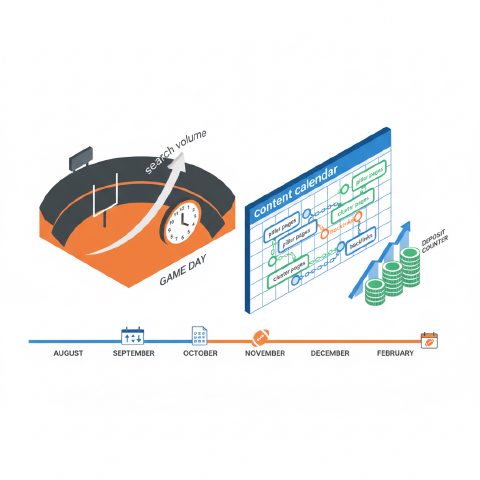
I tell clients to plan around the tournament calendar rather than a generic 6-month SEO timeline. If you launch your esports hub in January ahead of a February Major, you want your core matchup and tournament pages indexed and earning initial links by early January so Google has time to evaluate them before the traffic spike hits. Launch content the week of the tournament and you'll miss the bulk of the search volume entirely, esports betting search demand is brutally seasonal around Majors, Worlds, The International and Champions Tour stops, with 60-80% of annual search volume for some terms concentrated in 10-15 tournament weeks.
By month six, with consistent publishing and a disciplined link program, I expect a mid-tier esports hub to be capturing meaningful deposit volume across at least two major titles. Month eight to twelve is typically when the hub becomes self-sustaining, ranking for new tournaments and roster changes within days purely on domain trust built from the first two quarters.
What Technical SEO Issues Kill Esports Betting Sites in Google's Eyes?
The biggest technical killers are duplicate thin content across near-identical matchup pages, crawl budget wasted on expired live-odds URLs, and Core Web Vitals failures caused by heavy odds widgets and embedded Twitch players. Fix templated duplication and lazy-load embeds before chasing more links.
Matchup pages are the recurring offender. Operators template them aggressively, same boilerplate, same 150-word intro, odds table swapped out, and end up with hundreds of near-duplicate pages that Google's helpful content and spam systems increasingly flag as low-value at scale. Run a Screaming Frog crawl segmented by content similarity and you'll usually find 20-40% of matchup pages sitting above an 80% textual similarity threshold. Fix it by requiring genuinely unique analysis per matchup, recent form, head-to-head history, map-specific or hero-pool specific notes, not just swapped team names in a template.
Crawl budget is a real issue on esports sites because live odds pages expire fast, a matchup page for a match that happened eight months ago has zero commercial value but still gets crawled if it's still linked and indexed. I run quarterly audits pulling expired/completed event pages into either a consolidated archive page (301 or canonical to a season summary) or outright removal with a 410, freeing crawl budget for active tournament content. On sites with thousands of historical matchup URLs, this alone has recovered 15-25% more crawl frequency on money pages in GSC's crawl stats report.
Core Web Vitals failures are almost always caused by live odds widgets and embedded Twitch/YouTube players loading render-blocking scripts above the fold. Lazy-load anything below the first viewport, defer third-party odds-feed scripts until user interaction where possible, and self-host critical CSS rather than pulling it from a widget provider's CDN. I've seen LCP scores drop from 4.2s to under 2.5s just from deferring a single odds-widget script, and that directly correlates with better mobile rankings given how mobile-heavy this audience is.
How Do You Measure ROI on Esports Betting SEO Campaigns?
Measure esports betting SEO ROI by tying organic sessions on esports content to first-time depositor (FTD) events in GA4, not by tracking rankings or raw traffic. Set up assisted-conversion reporting since esports content often sits early in a multi-touch journey before the deposit happens on a different device or session.
Rankings are a leading indicator, not a result. Every ROI report I build for clients leads with FTDs and deposit value attributed to esports content, pulled via GA4 event tracking tied to account creation and first deposit, cross-referenced against landing page in Google Search Console. If your platform supports server-side conversion tracking through your affiliate or CRM system, tie that back to the specific URL or content cluster rather than just "organic/search" as a channel, esports traffic behaves differently enough from your core sportsbook traffic that lumping them together hides the real performance.
Account for the multi-touch reality of this audience. A bettor reads a CS2 matchup page on mobile during a stream, doesn't convert, then deposits later that night on desktop after checking a live odds app. Last-click attribution punishes your content for this constantly. I push clients toward GA4's data-driven attribution model specifically for the esports segment, and where possible, a 7-14 day lookback window on assisted conversions rather than the default last-touch view most dashboards ship with.
The other metric I watch closely: revenue per tournament cycle versus content and link spend in that same window. Esports ROI isn't linear month-over-month, it's lumpy, tied to the calendar. A flat month-over-month ROI report will make a genuinely strong campaign look mediocre during off-season months and inflate confidence during tournament spikes. Report in tournament-cycle windows, not calendar months, and you get a far more honest read on whether the strategy's actually working.
What Are the Legal and Regulatory Risks of Targeting Esports Betting Keywords Across Markets?
Esports betting legality mirrors your sports betting license, a book licensed by MGA or Curaçao can generally offer esports markets, but US state-by-state rules vary sharply, with several states explicitly excluding esports from legal sports betting definitions. Content targeting those states needs geo-aware disclaimers and, in some cases, geo-blocking entirely.
In the US, esports betting sits in a legal gray zone that varies by state even where traditional sports betting is legal. Nevada, New Jersey and a handful of others have approved specific esports titles or events for licensed sportsbook wagering on a case-by-case basis through their gaming commissions, while other states' statutory language defines "sporting event" narrowly enough to exclude esports outright. If you're running content targeting US search traffic, don't assume a state that's legalized NFL or NBA betting has automatically legalized esports betting, check the specific gaming commission ruling before you build out state-level landing pages, and geo-restrict or disclaim accordingly.
Offshore operators licensed under Curaçao's eGaming framework or Malta's MGA generally have broader latitude to offer esports markets, and that's where most of the esports betting volume I've worked with actually sits, books serving LATAM, EU and international traffic rather than chasing the patchwork US market. The SEO implication is straightforward: build your esports content and link profile around the markets where your license actually permits esports wagering, and use hreflang and geo-targeting in Search Console to keep Google from serving your esports pages to searchers in jurisdictions where you can't legally accept their deposit anyway. Ranking for a keyword you can't monetize in that geography is wasted effort and, worse, can trigger compliance headaches if a regulator notices you're visibly marketing into a restricted state.
Affiliate disclosure matters here too, more than operators often realize. If your esports content links out through affiliate or CPA arrangements to third-party books, FTC-style affiliate disclosure requirements apply in the US regardless of the esports legal gray area, and the UK's ASA and ad-standards bodies take a similarly firm line on clearly labeling paid or incentivized betting content. Build disclosure language into your content templates from day one, retrofitting it across hundreds of matchup pages after a compliance flag is a miserable, avoidable project.





Comments
No comments yet, be the first.