US Sports Betting SEO in 2026: A State-by-State Ranking Playbook
What makes US sports betting SEO different from standard gambling SEO?
US sports betting SEO is regulatory SEO first, keyword SEO second. Every state has its own licensing body, launch date, tax structure and advertising rules, so a single domain has to prove local relevance and compliance dozens of times over without triggering duplicate-content or doorway-page penalties.
I run crypto and no-KYC campaigns where the whole game is dodging ad bans through organic. Legal US sports betting is the opposite problem, you're fully licensed, fully compliant, and still can't buy Google Ads traffic at scale because gambling ad policy is restrictive and CPCs on terms like "best sportsbook bonus [state]" run $40-$90. Organic is the only channel with real margin, which is exactly why every operator from DraftKings to Fanatics to regional names like Hard Rock Bet is pouring content budget into state hubs right now.
The core structural difference versus a generic gambling site: Google treats "sports betting Ohio" and "sports betting Pennsylvania" as genuinely different search markets because the underlying regulatory facts differ, the Ohio Casino Control Commission sets different rules than the Pennsylvania Gaming Control Board, tax withholding differs, and even what counts as a legal bet type (same-game parlays, in-play betting) varies by compact or statute. A templated state page that just swaps the state name is a doorway page in Google's eyes, and sportsbook domains get manual-action reviews more often than almost any other vertical because of the YMYL overlap with gambling harm policy.
The other difference is competitive density. You're not just fighting other operators, you're fighting affiliate giants (Covers, Action Network, Gambling.com Group properties, VegasInsider) that have been building state-specific authority since PASPA fell in 2018. Ranking an operator domain against an affiliate that's published 400 state-specific articles since 2019 takes a different playbook than outranking a random iGaming competitor in an unregulated grey market.
How should you structure site architecture across 20+ legal sports betting states?
Build one canonical state hub per legal market under a flat URL pattern (/sports-betting/[state]/), with unique regulatory, tax and launch-date content per hub, then branch into sub-pages for promos, odds and team-specific betting guides. Never auto-generate state pages from a single template with only the state name swapped.
The pattern I've seen work across operator and affiliate sites alike: a flat architecture with state hubs one click from the homepage, each hub carrying at minimum 800-1,200 words of genuinely state-specific content, licensing authority name, legal betting age (19 in some states, 21 in most), retail vs. online launch dates, local team betting angles, and a responsible gambling resource specific to that state's helpline. Below the hub sit promo pages, odds comparison pages, and team or league-specific landing pages that inherit the state's regulatory context via internal linking rather than repeating it verbatim.
Screaming Frog crawls on multi-state sportsbook sites almost always surface the same issue: near-duplicate content scores above 85% similarity across state pages because the boilerplate (how to bet, how to deposit, FAQ) dominates the unique regulatory paragraph. Fix this by moving universal content to a single hub page ("How to bet on sports in the US") and linking out, keeping state pages lean and fact-dense instead of padded.
Geofencing adds a technical wrinkle most generic SEO advice ignores. If your site serves different content or redirects based on IP location for compliance reasons, you need to make sure Googlebot (which crawls from US data center IPs, not the visitor's actual state) sees the full, correct state page every time, cloaking risk is real here. I'd rather serve a visible state-selector and let geofencing kick in only at the betting-slip or account-creation stage, keeping all content crawlable and indexable regardless of visitor IP.
| Element | Operator domain approach | Affiliate/comparison site approach |
|---|---|---|
| URL pattern | /sports-betting/[state]/ under root domain | /[state]/sportsbooks/ or state subdomains |
| Primary CTA | Account creation, deposit, app download | Outbound affiliate link to operator |
| Content depth needed | 800-1,200 words, compliance-heavy | 1,500-3,000 words, comparison-heavy |
| Link building priority | Brand mentions, press, local sports media | Niche edits, resource page links, guest content |
| Biggest risk | Doorway pages / manual action | Thin affiliate content / Penguin devaluation |
Which legal sports betting states offer the biggest organic opportunity in 2026?
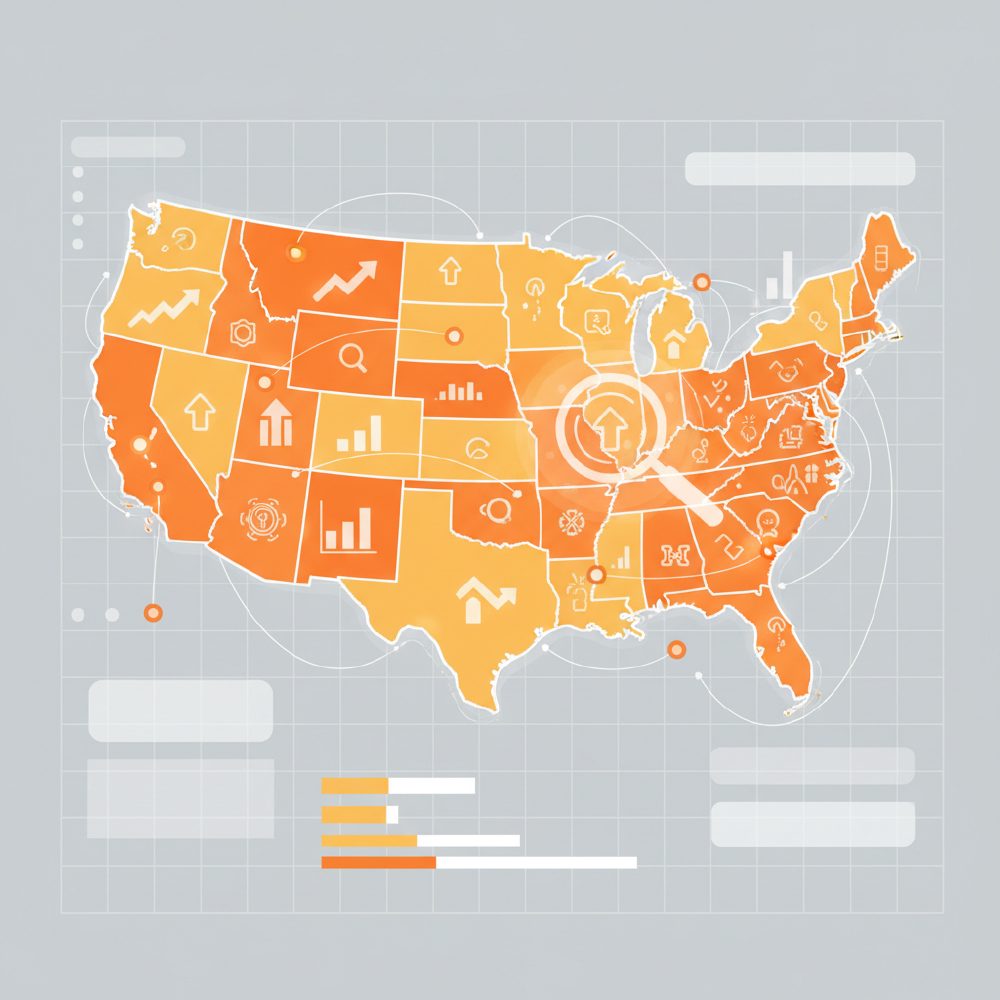
The best 2026 opportunities are newly-legalized or newly-launched markets with low existing content supply: Missouri (live since December 2025) is the clearest window right now, with Georgia, Minnesota and a handful of other states carrying pending legislation that could flip the moment a bill passes.
Mature markets, New Jersey, Pennsylvania, Michigan, Illinois, Virginia, Colorado, Arizona, Tennessee, are saturated. Affiliate sites have five-plus years of backlinks and content depth there, and ranking a new operator page-one for "[state] sports betting promo" in those markets takes 12+ months and a six-figure link budget. I don't recommend greenfield SEO pushes into those states unless you already have domain authority from an adjacent vertical.
Missouri is the one to move on now if you haven't already, it launched online sports betting in December 2025, meaning the content and link landscape is still thin. I've seen new-market launches like this produce page-one rankings for commercial state-modifier terms within 60-90 days simply because there's almost no competing content yet, versus 8-12 months in a mature market. The same logic applied when Vermont, North Carolina and Maine went live in 2024, the operators and affiliates who published deep state hubs within the first 30 days of legal status captured rankings that newer entrants still haven't dislodged.
Watch legislative trackers (Legal Sports Report, PlayUSA's state tracker) for 2026 movement in Georgia, Minnesota, and any state with a ballot measure or compact renegotiation in play. The SEO play isn't waiting for launch day, it's publishing pre-launch "when will sports betting be legal in [state]" content the moment a bill clears committee, because that search volume spikes months before any operator can legally take a bet, and ranking that content early builds the domain authority you cash in the day licenses go live.
| State status | Examples | SEO opportunity | Competitive density |
|---|---|---|---|
| Mature (live 3+ years) | NJ, PA, MI, IL, CO, TN, AZ | Low, requires major link investment | Very high |
| Recently launched (1-2 yrs) | OH, MA, KY, VT, ME, NC | Medium, gaps still exist in local/team content | High |
| Just launched (2025-26) | MO | High, thin content supply, fast ranking window | Low-medium |
| Pending legislation | GA, MN (status shifts yearly) | High, pre-launch content capture play | Low |
| Unlikely near-term | CA, TX | Speculative only, don't over-invest yet | N/A |
How do you build local betting SEO pages that don't get flagged as doorway pages?
Avoid doorway-page flags by anchoring each local or state page to a genuinely unique commercial or regulatory angle, a specific team, promo code, tax rule, or retail sportsbook location, rather than rewriting the same generic betting-guide template with a new place name swapped in.
Doorway pages are Google's oldest spam classification and gambling is one of the verticals where the spam team still manually reviews flagged clusters. The tell isn't the existence of multiple state pages, it's near-identical structure, near-identical word count, and zero page-specific facts beyond the state name. I've audited operator sites where 40 state pages scored 90%+ content similarity in Siteliner, and every one of them lost rankings in a spam update within two cycles.
The fix is forcing genuine differentiation at the data layer before you write a word of copy. Pull the actual local facts: tax withholding rate on winnings, retail sportsbook partner locations (tribal casino tie-ins matter in states like Arizona and Connecticut), local team betting trends (Chiefs futures searches spike differently in Missouri than Bills futures in New York), and state-specific promo structures (some states ban deposit-match bonuses, others allow them freely). That factual layer is what makes a page defensible as unique, not thin.
Local betting SEO below the state level, city or metro pages for "sports betting near me" style searches tied to retail sportsbooks, works the same way but with Google Business Profile and local citation signals layered on top. BrightLocal or Whitespark audits help here; retail sportsbook locations should be treated like any multi-location local business, with NAP consistency, local link acquisition from city news sites, and schema markup for the physical venue, not just the digital product.
What link-building tactics work for sportsbook domains without tripping a spam update?
Editorially-earned links from sports journalism, local news, and team fan sites outperform bulk guest posts or PBNs for sportsbook domains because Google's gambling-adjacent manual review teams actively audit high-visibility betting sites. Niche edits on established sports content and genuine digital PR around state launches carry the least risk per link acquired.
I'll be direct about risk tiers because most agency content on this topic is deliberately vague. Tier-1 links from sports media (local ABC/NBC affiliate sports desks, team beat-writer sites, conference/league partner content) carry almost zero risk and the highest ranking value, but they're expensive and slow, often $800-$3,000 per editorial placement or requiring a genuine partnership (data feeds, expert commentary, sponsorship). Tier-2 niche edits into existing high-authority sports betting content (inserting a contextual link into a 2022 "Ohio sports betting guide" that still ranks) are moderate risk, moderate cost ($150-$500 per placement through vetted brokers) and the workhorse of most sportsbook campaigns I run.
PBNs and bulk guest-post networks are where I see operators burn domains. Gambling sites get swept harder in Penguin-style link spam updates because the vertical is flagged for manual review more often, a 40-domain PBN tier that would survive two years unnoticed on a SaaS site gets caught in 4-6 months on a sportsbook domain. If you're running tiered link structures, keep the sportsbook money site two hops away from anything resembling a PBN, and never let anchor text on the money site exceed roughly 8-12% branded-exact-match; I keep most sportsbook anchor profiles 60%+ branded/naked URL, 25% partial match, under 15% exact-match commercial.
Digital PR tied to state launch news is the most underused tactic. When a state legalizes, local news outlets need sourcing on "how does this work" content, pitching your compliance or product lead as a quotable source gets you contextual links from .gov-adjacent trust domains (state news sites, local business journals) that no amount of guest posting replicates. I've landed links this way from outlets like local Fox affiliates and regional business journals within 48 hours of a launch announcement, and those links hold ranking value for years because they're genuinely earned, not placed.
| Tactic | Risk level | Typical cost per link | Durability |
|---|---|---|---|
| Editorial sports media placement | Very low | $800-$3,000 | Years |
| Launch-day digital PR / journalist outreach | Very low | Labor cost only, high ROI | Years |
| Niche edits on established content | Low-moderate | $150-$500 | 12-24 months typical |
| Vetted guest posting on sports/finance sites | Moderate | $200-$600 | 12-18 months |
| Expired-domain PBN tiers | High | $50-$150 build cost | 4-12 months before decay/penalty risk |
| Bulk link networks / link farms | Very high | Cheap, but short-lived | Weeks to a few months |
How does geotargeting affect technical SEO for multi-state sportsbook sites?
Geotargeting must stay separate from crawling and indexing, serve full, crawlable content to every visitor including Googlebot, and restrict actual betting functionality by IP/GPS only at the account or bet-placement layer, never at the content layer, or you risk cloaking penalties and lost state-page rankings.
Most compliance teams want to geofence aggressively because regulators require it for actual wagering, you legally cannot let someone in Texas place a bet on a Missouri-licensed platform. The SEO mistake happens when developers extend that geofencing logic to content delivery, redirecting a visitor from an unlicensed state away from the Ohio page before they ever see it, or worse, showing Googlebot a different (thinner) version of a state page than a real visitor in that state sees.
Googlebot crawls primarily from US-based data center IPs that don't correspond to any specific state, so if your geofencing logic triggers on IP location for content display, Googlebot gets whatever your default/fallback experience is, frequently a generic landing page instead of the rich state hub you built. I've fixed this exact bug on three operator sites where GSC showed state hub pages indexed with wildly reduced word counts compared to what a human visitor in-state actually saw, because the CMS was serving a stripped default template to non-recognized IPs.
The clean separation: content and crawl behavior ignore geolocation entirely, every state page is fully indexable from anywhere. Geofencing kicks in only behind a login wall or at the "place bet" / "create account" action, using the licensed geolocation vendor (GeoComply is the industry standard most licensed operators already use for compliance) rather than crude IP lookups. This keeps your SEO layer and compliance layer architecturally independent, which is what regulators actually require anyway, they care about where the bet is placed, not where the content is read.
How do you handle duplicate content when every state page has the same promo?
When the underlying offer is identical across states, differentiate pages through state-specific regulatory framing, local proof points and canonical tags pointing to the primary promo page, rather than trying to force artificial uniqueness into marketing copy that's legitimately the same everywhere.
Operators standardize promos for operational reasons, a $200 bonus bet structure often runs identically in Ohio, Massachusetts and Tennessee because the marketing team built one creative asset. Forcing SEO copywriters to invent fake differences in the promo mechanics itself produces worse content than just being honest about what's genuinely different: eligibility rules tied to state age minimums, tax treatment of bonus funds (taxable as gambling winnings regardless of state, but reporting thresholds and state tax rates on net winnings vary), and the specific sportsbooks/apps actually licensed in that state.
My rule: one canonical "current promo" page that ranks for the generic commercial term, with state pages linking to it rather than duplicating the full promo terms block. The state page itself leads with regulatory and local context, then references the promo with a clear link rather than re-pasting three paragraphs of bonus terms twenty times across the domain. This also solves an internal competition problem, without canonicalization, you end up with twenty pages cannibalizing each other for "sports betting bonus" instead of each state page owning its specific "[state] sports betting bonus" query cleanly.
Where I disagree with a lot of generic advice: don't use canonical tags to just point every state page at one master page. That kills your ability to rank each state page independently for its own high-intent local query. Canonicalize the promo-terms module, not the state page itself, the state page stays a distinct, indexable, independently-ranking asset; only the duplicated legal-terms boilerplate gets consolidated.
What's a realistic timeline and budget to rank in a new legal sports betting state?
Expect 60-90 days to page-two/three visibility and 4-8 months to sustained page-one rankings in a freshly-launched state, versus 10-14 months in a mature market. Budget $8,000-$15,000/month for a new-state push and $20,000-$35,000/month to unseat established affiliates in a saturated market like New Jersey or Pennsylvania.
Timeline compresses dramatically in low-competition new states because there's so little existing content to outrank. When North Carolina and Vermont launched in 2024, operators and affiliates that published complete state hubs within the first two weeks saw meaningful organic sessions (low thousands monthly) by month three, scaling to five-figure monthly sessions by month six, largely because they were competing against near-empty SERPs rather than entrenched five-year-old affiliate content.
In mature markets the math changes entirely. A new operator trying to rank in Pennsylvania against Covers, Action Network and five years of PGCB-era content needs a sustained 10-14 month campaign, heavier editorial link investment (the $800-$3,000 placements from the earlier section, not niche edits), and realistically should expect to compete for long-tail terms ("[team] betting odds [state]," "[sportsbook] promo code [state]") before challenging head terms like "best sportsbook Pennsylvania."
Budget allocation I'd actually recommend: 40% content production (state hubs, promo pages, team/league guides, expect $300-$800 per well-researched page from writers who understand gambling compliance language), 45% link acquisition split across the tiers above, 15% technical SEO and tracking infrastructure (Screaming Frog audits, log file analysis to confirm Googlebot sees correct geofenced content, GSC monitoring per state hub). Cutting content spend to pad link spend is the most common mistake I see, thin state pages with strong links plateau around page 2-3 and never break through, because Google's helpful content systems increasingly weight depth and specificity over raw link count in YMYL verticals.
Should operators build their own state content or rely on affiliate partnerships?
Run both, but for different goals: owned state hubs build brand-controlled organic traffic and long-term domain authority, while affiliate partnerships (revenue-share or CPA deals with sites like Gambling.com or VegasInsider) capture traffic you can't realistically outrank in mature states within a reasonable timeline.
I've worked both sides of this. Affiliates win mature-state head terms because they've compounded five-plus years of content and links with zero regulatory constraint on how aggressively they can publish comparison content, an affiliate can say "Operator A has better odds than Operator B" in ways an operator's own site legally and ethically shouldn't. That's a structural advantage operators can't SEO their way around quickly.
Where owned content wins is anywhere brand trust or product specificity matters, app download pages, state-specific how-to-bet guides tied to your actual UI, and anything requiring you to showcase your own data (live odds feeds, same-game parlay builders) that an affiliate can't replicate. These pages also compound domain authority you keep forever, versus affiliate spend that stops producing the moment you stop paying placement fees.
Practical allocation: in new or recently-launched states, prioritize owned content because the competitive window favors fast movers regardless of domain authority. In saturated markets, run affiliate deals for head-term visibility while your owned content quietly builds long-tail and branded search dominance, "[your brand] promo code," "[your brand] app review," "[your brand] vs [competitor]." Those branded and semi-branded terms are winnable regardless of market maturity because no affiliate is incentivized to rank your brand name above a comparison page that monetizes clicks to multiple operators.
What E-E-A-T signals matter most for sports betting content under Google's gambling policies?
Google weighs author credibility, licensing transparency, and responsible-gambling disclosure heavily on sports betting content because it sits in the YMYL category. Author bios showing real gambling-industry experience, visible state license numbers, and clear 21+/problem-gambling resources on every commercial page are the baseline, not optional extras.
Gambling content sits alongside medical and financial advice in Google's YMYL classification, which means the usual content-marketing shortcuts, unattributed AI-generated guides, generic "our team" bylines, get filtered harder here than in most verticals. Every state hub and promo page should carry a named author with demonstrable subject expertise, a visible state gaming license number where applicable, and a responsible-gambling block linking to the National Council on Problem Gambling (1-800-GAMBLER) or the state-specific equivalent.
I push every operator client to publish a transparent "how we rank/review" or "our licensing" page linked from every state hub, it costs almost nothing to build and consistently correlates with better recovery after core updates on gambling-adjacent sites I've tracked through 2023-2025's updates. Google's gambling policy documentation explicitly calls out licensing transparency as a trust signal, and sites that treat it as a footnote rather than a structural element tend to be the ones that lose visibility hardest in broad core updates.
The other signal that matters more in this vertical than almost any other: content freshness tied to actual regulatory change. A state page last meaningfully updated in 2022 that still references outdated tax rules or pre-launch promo structures signals staleness in a space where facts genuinely change. I run quarterly audits on every state hub specifically checking license numbers, tax rates, and promo terms against current regulator publications, not just a cosmetic "last updated" date stamp, which Google's systems are increasingly good at distinguishing from genuine content refreshes.





Comments
No comments yet, be the first.