Sportsbook SEO vs Casino SEO in 2026: Key Differences a Forensic Audit Reveals

What's the core difference between sportsbook SEO and casino SEO?
Sportsbook SEO chases live, time-decaying demand, odds, lines, injury news, in-play markets, while casino SEO targets stable, evergreen demand around slot titles, bonuses, and payment methods. That difference dictates content velocity, link acquisition speed, and technical priorities even inside the same operator domain.
Pull Ahrefs Content Explorer data on a 'Lakers vs Celtics odds' page and you'll see traffic die within 48-72 hours of tip-off. Pull the same report on 'best online slots real money' and the curve holds flat for a year or more. That's not a stylistic difference, it's a structural one that should dictate how you staff, template, and internally link your content.
I've audited hybrid operator domains (think DraftKings-style platforms running both books) where one content team handled both verticals with a single publishing cadence. It failed both sides: sportsbook pages went stale because the team couldn't publish fast enough for game-day volume, and casino pages got rushed and thin because the team was constantly firefighting sports content. You need two different production clocks under one roof.
Log file analysis backs this up. Googlebot hits sportsbook subfolders 5-8x more frequently than casino subfolders on the same domain when internal linking signals freshness correctly, new event pages linked from a live hub get crawled within hours. Casino game pages, by contrast, get crawled on a weekly-to-biweekly rhythm unless something material changes, like an RTP variant update from a provider.
How does search intent differ between sports betting and casino search terms?
Sports betting search is overwhelmingly transactional and event-bound, fixture names, prop bets, live odds, parlay calculators, while casino search splits between brand/bonus transactional queries and long-tail informational queries about RTP, volatility, and game strategy. That split changes your content mix and template design.
Sportsbook queries spike violently around fixtures. 'Chiefs vs Bills prop bets' might do near-zero volume most weeks and 40,000+ searches the week of the game. Casino queries don't behave that way, 'Sweet Bonanza RTP' pulls a steady 200-500 searches a month regardless of season, but multiply that across a game catalog of 3,000-8,000 titles and the aggregate volume rivals any sportsbook keyword set.
Programmatic SEO looks different across the two. Sportsbook programmatic pages run on live odds-API feeds and need render logic that updates lines without breaking crawlability, I've seen React-heavy odds widgets that Googlebot renders as blank pages in Search Console's URL Inspection tool. Casino programmatic pages run on static game-database templates (provider, theme, volatility, RTP band) and the risk isn't render failure, it's duplicate content across thousands of near-identical slot pages.
The informational layer diverges too. Casino informational content, blackjack basic strategy, video poker pay tables, bankroll management, has genuine long-term search demand and ranks for years. Sportsbook informational content ('how to read American odds', 'what is a same-game parlay') behaves the same way, but it's a small fraction of the sportsbook keyword universe compared to event-driven transactional terms.
Why does content freshness matter more for sportsbook SEO than casino SEO?
Sportsbook content needs same-day updates, line movement, injuries, weather, because Google's query-deserves-freshness signal drops stale event pages within hours of kickoff. Casino content can sit unedited for 12-18 months, provided RTP figures and bonus terms remain accurate and verified.
I run content-decay audits constantly as part of penalty diagnostics, and the curves for the two verticals don't even look like the same chart. A sportsbook page tied to a specific matchup loses roughly 90% of its traffic within a week of the event resolving, it's not a ranking drop, it's demand evaporating. Evergreen sportsbook hub pages behave more like casino content and hold rankings for months.
That means sportsbook operators effectively need a live editorial desk: someone publishing or updating odds, injury notes, and line-movement commentary daily, ideally hourly during marquee events. I've seen operators try to run this with a weekly freelance cadence and watch their event pages get outranked by ESPN, Action Network, and Covers.com within days, every single week.
Casino operators face the opposite maintenance problem, not speed, but accuracy drift. RTP variants change when providers like Pragmatic Play or NetEnt patch game math, and a page citing an outdated RTP figure is both an SEO liability and, in regulated markets, a compliance liability. Quarterly content refresh cycles catch most of this if you're tracking provider patch notes; annual refresh cycles don't.
How should link-building strategy change for sportsbooks versus casino brands?
Sportsbook link building can ride real seasonal news cycles, velocity spikes 3-5x around Super Bowl or March Madness look natural because demand genuinely spikes. Casino link building has no comparable news hook, so the same velocity spike reads as manipulative to spam-detection systems and needs a steadier, niche-edit-driven approach instead.
This is one of the most common mistakes I find when auditing toxic link profiles. An operator's SEO team notices sportsbook links spiking naturally around football season and tries to replicate that exact pattern, 40-60 new referring domains in a month, on the casino side of the same brand. There's no real-world event driving that casino demand, so it looks exactly like what it is: a purchased link campaign, and it's usually what triggers the manual action review.
Sportsbook content earns natural links from sports journalism, roundup articles like 'best sportsbook promos for the Super Bowl' link out organically because the event is genuinely newsworthy. Casino content earns links mostly from affiliate review sites, comparison hubs, and forum/crowd-marketing activity, which moves at a much slower, steadier pace.
Anchor text ratios should reflect that difference too. I target 60-70% branded/naked-URL anchors and under 5% exact-match commercial anchors for casino link profiles, because there's no editorial justification for heavy commercial anchoring on evergreen content. Sportsbook profiles can tolerate slightly more topical variation (team names, league names) because that mirrors how sports media actually links, but exact-match 'best sportsbook bonus' anchors are still a red flag regardless of vertical.
| Factor | Sportsbook SEO | Casino SEO |
|---|---|---|
| Link velocity pattern | Spiky, event-driven (3-5x around majors) | Steady, low-variance monthly growth |
| Safe anchor text ratio | 60-65% branded, up to 10% topical (team/league) | 60-70% branded, under 5% exact-match commercial |
| Primary earned-link sources | Sports media, journalist roundups, forums | Affiliate review sites, comparison hubs, crowd marketing |
| Seasonal spikes considered safe? | Yes, if tied to real events | No, flags as manipulative without a news hook |
| Typical tactic risk level | Medium, paid guest posts disguised as 'expert picks' | High, PBN/expired-domain networks feeding bonus pages |
What technical SEO issues are unique to sportsbook sites?
Sportsbooks need real-time odds schema, high-frequency crawl budget allocation, and render-safe JavaScript for live data, a stale-cache or blank-render issue can drop an event page from rankings within hours. Casinos deal less with real-time rendering and more with pagination and canonical control across thousands of near-duplicate slot pages.
The single most common technical issue I find on sportsbook audits is odds widgets rendering client-side without a server-side fallback. Run the page through Screaming Frog's JavaScript rendering mode versus its text-only crawl and you'll often see the odds data simply isn't in the raw HTML, Googlebot can render it, but on a crawl-budget-constrained site, it may not render it often enough to catch line movement before the market closes.
SportsEvent and FAQ schema help here, but only if the timestamp fields update in sync with the actual line changes, I've caught operators shipping schema with a 'dateModified' field that hadn't updated in three days while the odds on the page had moved six times. That mismatch is exactly the kind of structured-data inconsistency Google's systems increasingly cross-check.
Casino sites carry a different technical burden: faceted navigation. Provider filters, theme filters, RTP-band filters, and volatility filters combine to generate thousands of near-duplicate URLs. In audits I regularly find 40-60% of a casino site's indexed pages are thin or duplicate variants of the same 200-300 actual games. Canonical tags, parameter handling in GSC, and disciplined robots directives fix most of it, but it takes a dedicated crawl-budget cleanup, not a quick fix.
Which vertical carries higher Google penalty risk, sportsbooks or casinos?
Casino SEO carries higher structural risk from thin, duplicated bonus and review content that trips Helpful Content and spam-detection systems, while sportsbook SEO's bigger exposure is manipulative link velocity tied to disguised paid placements on sports media. I've recovered both, and the diagnostic path differs sharply.
The September 2023 Helpful Content Update and the March 2024 core update hit casino affiliate content especially hard. I've worked recoveries where a site ran 200+ near-identical 'best online casino bonuses 2024' pages targeting slightly different geo or bonus-type variants, and lost 60-80% of organic traffic in one update cycle. The fix wasn't rewriting each page, it was consolidating 200 thin pages into 15-20 genuinely comprehensive hubs and 301-redirecting the rest, which is a harder call to make than it sounds when a client's traffic dashboard is on fire.
Sportsbook sites face a different exposure. The picks-and-predictions content genre attracts paid guest posting disguised as editorial expertise, 'expert picks' articles placed on sports media sites through undisclosed paid arrangements. When that gets caught by Google's link spam systems (the successor systems to Penguin now run largely in real time), it tends to trigger a targeted algorithmic devaluation of the linking pattern rather than a broad manual action, but I've also seen manual actions land directly on the sportsbook domain when the paid-link footprint was blatant, identical anchor phrasing across dozens of placements is the tell.
Both verticals sit squarely in YMYL territory under Google's Search Quality Rater Guidelines, which explicitly call out gambling content as requiring demonstrable expertise and authoritativeness. Neither gets a pass, but the trigger mechanism and recovery timeline differ.
| Risk factor | Sportsbook exposure | Casino exposure |
|---|---|---|
| Thin/duplicate content risk | Moderate, mostly on evergreen hub pages | High, bonus and review pages, faceted slot pages |
| Manipulative link velocity risk | High, disguised paid picks placements | Moderate, PBN/expired-domain networks |
| Helpful Content Update sensitivity | Low-to-moderate | High |
| Typical recovery timeline | 6-10 weeks after link cleanup | 3-6 months after content consolidation |
| Common trigger | Identical anchor phrasing across paid placements | Hundreds of near-identical thin bonus pages |
How do E-E-A-T requirements differ between sportsbook and casino content?
Casino E-E-A-T leans on demonstrable game-math expertise, RTP citations, provider verification, testing-lab references, while sportsbook E-E-A-T leans on demonstrable analytical expertise, verifiable pick-tracking records, transparent methodology, and betting credentials. Both need visible licensing, but the proof points aren't interchangeable.
When I audit a casino review page for E-E-A-T weaknesses, I check whether the author actually cites a testing lab, eCOGRA, iTech Labs, or GLI, and whether RTP figures match the provider's own published data rather than a rounded guess. AI-generated casino review farms without genuine game testing are, in my experience, the single most common casualty of the Helpful Content Update; there's no expertise signal Google's raters can find because there isn't any real testing behind the content.
Sportsbook content needs a different kind of proof. A 'best NFL picks' article carries more weight when the byline links to a disclosed, dated record of past picks, win/loss tracked publicly, not just claimed. I push clients toward transparent pick-tracking pages precisely because it's the one E-E-A-T signal in this niche that's hard to fake and easy for both users and Google's raters to verify.
Licensing disclosure matters equally on both sides. A visible MGA, UKGC, or relevant state gaming license number in the footer isn't just a compliance requirement, it's a trust signal the Quality Rater Guidelines specifically ask reviewers to check for YMYL gambling sites. I've seen sites recover ranking ground simply by moving license verification from a buried terms page to visible footer placement across every template.
How should keyword and topical architecture differ for sportsbook vs casino sites?
Sportsbook topical maps organize around leagues, teams, and bet types with a hub-and-spoke structure refreshed per season, while casino topical maps organize around game categories, providers, and bonus mechanics with a flatter, longer-lived structure. Mixing both architectures in one silo confuses Google's entity understanding of the domain.
A sportsbook pillar like 'NFL Betting' branches into spokes for each team, weekly matchups, prop bet guides, and season-long futures, and that entire structure needs refreshing on a weekly cadence during the season and going semi-dormant in the off-season. A casino pillar like 'Online Slots' branches into spokes by provider, theme, and RTP band, and that structure barely changes month to month once it's built correctly.
The internal linking cadence has to match. I've seen sites hurt themselves by applying the same internal-link-refresh schedule to both silos, either casino pages get needlessly re-linked every week (wasted crawl signal) or sportsbook hub pages go stale because nobody's touching internal links during a live season. Google's document-understanding models read internal linking patterns as a signal of what's currently important on the domain, so the update rhythm itself communicates something.
Keeping the two silos structurally distinct, separate URL patterns, separate breadcrumb logic, separate schema types, also protects against topical dilution. I generally recommend operators avoid cross-linking sportsbook and casino content except through a small number of deliberate hub-to-hub links (like a homepage or 'promotions' page), rather than scattering casual cross-links throughout both silos.
| Element | Sportsbook SEO structure | Casino SEO structure |
|---|---|---|
| Core organizing entity | League / team / bet type | Game category / provider / bonus type |
| Content refresh trigger | Fixture schedule, injury/line news | Provider RTP patch, bonus term change |
| Typical hub-spoke depth | 3-4 levels, seasonal churn | 2-3 levels, largely static |
| Internal link update frequency | Weekly to daily in-season | Monthly to quarterly |
What does a realistic sportsbook SEO strategy look like in 2026?
A workable 2026 sportsbook SEO strategy pairs programmatic odds/event pages with a lean editorial desk publishing 3-5 fresh picks pieces daily, backed by controlled link velocity from sports-media niche edits and quarterly disavow hygiene ahead of major events. Casino strategy this year should prioritize consolidation over expansion.
Start with a crawl-budget audit using log files, not just Screaming Frog's simulated crawl, confirm Googlebot is actually hitting your live odds pages at the frequency your schema timestamps claim. If there's a gap, fix internal linking from your homepage and category hubs before spending a dollar on links; a page Google isn't crawling won't benefit from any link campaign.
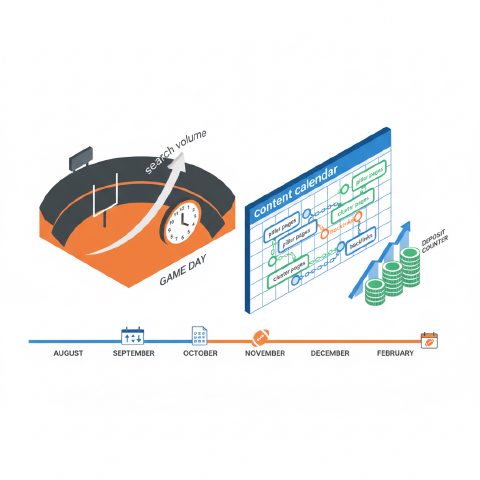
Build an editorial cadence mapped to the actual sports calendar: daily during NFL/NBA season, intensified around March Madness and the Super Bowl, scaled back in genuine off-seasons. Niche edits from sports media sites currently run roughly $300-$1,500 per placement depending on domain rating and topical relevance, budget for a spike in spend around marquee events, since that's when the velocity increase looks natural rather than manipulative.
Run disavow audits quarterly, not annually. Sportsbook niches attract aggressive negative SEO from competitors, I've traced spam link floods pointed at a client's odds pages timed deliberately before major events, clearly meant to trigger algorithmic suspicion during peak traffic windows. Catching and disavowing those before Google's systems act on them is cheaper than recovering afterward.
On the casino side, 2026 priorities should be consolidation, not expansion: merge thin bonus and review pages into fewer authoritative hubs, add genuine gameplay video or screenshot evidence of testing, and target long-tail RTP/strategy queries that AI-generated competitor content generally handles poorly.
How should multi-market operators split sportsbook and casino SEO resources?
Multi-market operators should run sportsbook and casino SEO as separate workstreams with distinct KPIs, budgets, and publishing calendars, even on one domain, because success metrics diverge fundamentally: sportsbook measures freshness and velocity, casino measures depth and consolidation. One undifferentiated team handling both is the most common inefficiency I find in audits.
Rank tracking should be segmented by vertical from day one. Sportsbook keyword sets show massive week-to-week volatility in Ahrefs or SEMrush position tracking that has nothing to do with your SEO quality, it's driven by fixture schedules. Blend that volatility into a single dashboard with steady casino keyword tracking and you'll misread noise as signal, chasing phantom wins and losses.
Budget allocation should flex seasonally rather than sit fixed. I typically see a 60/40 split favoring sportsbook during football season for US-facing operators, flipping toward casino-weighted spend in the summer off-season. Operators who lock in a static 50/50 split year-round tend to underinvest in sportsbook content exactly when demand, and competitive link activity, peaks.
Jurisdictional complexity compounds this. A US operator managing state-by-state licensing (New Jersey DGE, Pennsylvania Gaming Control Board, and others) faces different content and disclosure requirements than an EU/UK operator under the UKGC or MGA, or a LATAM operator navigating Colombia's Coljuegos framework, or an offshore crypto casino under a Curacao license. Each jurisdiction's compliance content review cycle should run independently for sportsbook versus casino product lines, because the regulatory triggers, responsible gambling messaging, odds disclosure rules, bonus term transparency, don't map identically across the two verticals.





Comments
No comments yet, be the first.