Sportsbook League Pages SEO in 2026: The Hub Architecture That Outranks Affiliates

What are sportsbook league pages and why do they matter for SEO in 2026?
League hub pages aggregate every team, fixture, market and prop for one competition, Premier League, NBA, UFC, under a single permanent URL Google treats as the topical authority node for that league. They matter because they capture high-volume league-plus-betting queries affiliates currently own, then push link equity and users down into team and match pages that convert.
Run "premier league betting odds" or "nba betting lines" through Ahrefs or SEMrush and the top 10 is almost entirely affiliates, Oddschecker, OddsShark, Covers, Action Network. Volume swings with the season and the tool you're using, but I typically see somewhere in the 15k-35k/mo range for US NBA terms, spiking hard around the trade deadline and playoffs. Operators are nearly invisible on these terms despite owning the actual odds data.
The reason is structural, not a content-quality problem. Most sportsbooks build a promo-driven landing page for each season or bonus cycle, then delete or redirect it when the offer expires. Google never gets the chance to accumulate topical authority around a URL that doesn't exist long enough to earn it. A league hub fixes this by becoming a permanent entity node that Google can keep crawling, indexing, and associating with "NBA betting" or "Premier League betting" across years, not weeks.
This matters even more on the crypto and no-KYC side, where I spend most of my time. Google Ads bans most offshore and crypto sportsbook accounts outright, so organic is the only reliable top-of-funnel channel. I took a no-KYC, NBA-focused sportsbook from zero to north of 6,200 organic sessions a month in under seven months, with no paid spend, purely by building one hub page, 30 team sub-pages, and a weekly match-preview cadence feeding links back into the hub.
How should a league hub page be structured to actually rank?
Structure it as a permanent three-layer hierarchy, league hub, team sub-pages, match pages, sitting in a flat, logical URL path like /sports-betting/nba/, not buried under /promotions/. Put a live odds module above the fold, standings and futures below it, then 600-900 words of unique editorial, then links to every team page.
URL architecture is the first thing I audit on a new engagement. I want /sports-betting/nba/ or /nba-betting/, a flat and permanent path, never a parameter-driven or session-based URL that changes per promo and fragments crawl budget. Run a Screaming Frog crawl on most sportsbook sites and you'll find three or four orphaned variants of the same league page from past campaigns, each competing with itself for the same query, classic internal cannibalization.
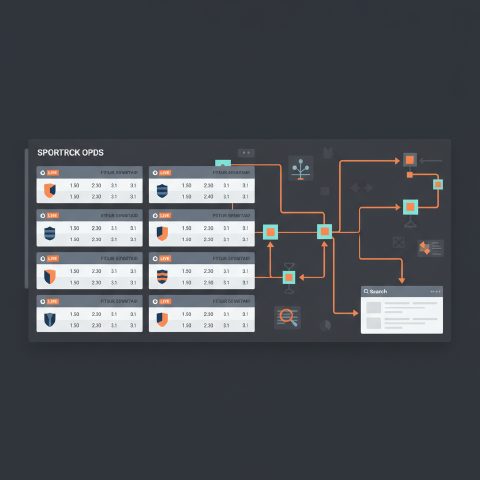
Layout matters almost as much as the URL. Breadcrumb navigation (Home > Sports Betting > NBA) establishes hierarchy for both users and crawlers. Above the fold, a live odds widget pulling from a data feed, Sportradar, Genius Sports, or an in-house API, gives immediate utility. Below that: standings, futures markets, then the unique editorial block, then an FAQ, then full team-page links. Thin pages that skip straight from a hero banner to a deposit button convert terribly for informational-intent searchers and give Google nothing to rank.
The mistake I see most in offshore operations specifically is spinning up near-identical state or region variants, /ny/nba-betting/, /nj/nba-betting/, with 90% duplicate copy and no canonical tag pointing to a primary version. That's a self-inflicted duplicate content problem that dilutes the one page that could actually rank, instead of helping any of them.
What content modules does a Premier League betting page need to rank?
A Premier League betting page needs a live 1X2/handicap/totals odds table, a full 20-team standings grid, links to all team hub pages, title and relegation futures, and 600+ words of unique editorial on form and fixtures, refreshed at least weekly during the season to avoid a stale-content signal.
Futures markets are the biggest gap I find on operator pages versus affiliates. Title odds, top-four odds, relegation odds and golden boot markets carry real search volume with comparatively weak competition, because a lot of affiliate sites bury them below the fold or skip them to prioritize matchday odds. A dedicated futures module with its own H2 and a short explainer paragraph often outranks generic "premier league betting" pages on these long-tail variants within a few months.
Gameweek structure also needs its own logic. Soccer runs on 38 fixed gameweeks, so a gameweek-by-gameweek fixture module with a clear "this week" anchor and links to past gameweek archives builds a predictable internal linking pattern crawlers can follow season over season. That archive, left live rather than deleted, becomes a second source of long-tail traffic for fixture-specific queries months after the matches happened.
| Module | Premier League page | NBA page | Notes |
|---|---|---|---|
| Live odds table | 1X2, Asian handicap, totals | Spread, moneyline, totals | Pull via API, cache 60-90 seconds |
| Schedule/fixtures | Gameweek-by-gameweek, 38 total | 82-game season, rolling | Paginate past games, keep archive live |
| Standings | Single 20-team table | Conference standings | Update daily in-season |
| Team hub links | 20 team pages | 30 team pages | Backbone of the internal link graph |
| Futures/props | Title, top-four, relegation odds | Championship, MVP, player props | High volume, comparatively low competition |
| Editorial depth | 600-900 words, form/fixture angles | 600-900 words, trade/injury angles | Weekly refresh minimum in-season |
What makes an NBA betting page different from a soccer league page?
NBA pages run on an 82-game season instead of 38 gameweeks, so schedule modules need rolling pagination rather than fixed gameweeks, conference standings replace a single table, and player-prop and MVP futures carry proportionally more search volume than soccer props. The publishing cadence for trade and injury content also has to be faster, daily during the season, not weekly.
Volume math changes the content priorities. A 30-team league with an 82-game regular season generates far more individual match pages than a 20-team soccer league with 38 fixtures, so pagination and canonical discipline on the schedule module matter more here, without it you end up with thin, near-duplicate match pages competing against each other for crawl priority.
Player props deserve their own dedicated block on NBA pages in a way they rarely do for Premier League. Points, rebounds, assists and three-pointer props drive meaningful long-tail search volume around star players, and affiliate sites often treat this as an afterthought widget rather than its own content module with explainer text. Around April, I also build a dedicated playoff bracket module with seeding scenarios, a seasonal content spike that, if planned a month ahead instead of rushed, captures bracket-related search demand affiliates scramble to publish at the same time you do.
How do you build the internal linking architecture between league hubs, team pages and match pages?
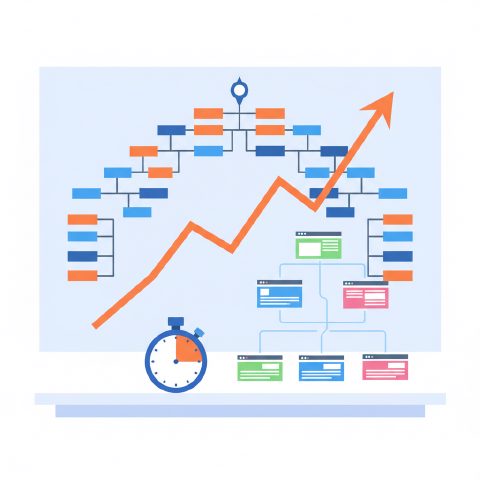
Build a four-tier structure: the homepage links to every league hub, each hub links down to every team page and top futures market, each team page links to its own match pages and player props, and every page links back up through breadcrumbs. No match page should ever exist without a crawlable path back to its league hub.
Link equity flows downward from hub to team to match, but trust and freshness signals need to flow back up too. If a match page earns an external link, the breadcrumb and "back to NBA betting" link at the bottom passes a slice of that equity back to the hub, reinforcing it as the authority node for the whole league, not just a single game.
Vary anchor text on these internal links the same way you'd vary it on external links. Don't send every single internal link to a team page with the exact phrase "Lakers odds", rotate between "Lakers betting lines," "LA Lakers odds," and contextual anchors like "Lakers vs Celtics preview." I target a maximum click depth of three from the homepage to any match page, and audit for orphan pages monthly using a combination of Screaming Frog crawls and the GSC coverage report, orphaned match pages are one of the most common silent traffic leaks I find on sportsbook sites.
| Tier | Page type | Links down to | Links up to |
|---|---|---|---|
| Tier 0 | Sportsbook homepage | All league hubs | - |
| Tier 1 | League hub (/nba-betting/) | Team pages, futures, top matches | Homepage |
| Tier 2 | Team page (/nba-betting/lakers/) | Player props, match pages, schedule | League hub |
| Tier 3 | Match/event page | Odds comparison, same-game parlay builder | Team page, league hub via breadcrumb |
What on-page and schema elements actually move the needle for league pages?
Four schema types matter most, SportsEvent on match pages, BreadcrumbList across the hub-team-match hierarchy, FAQPage on the hub's betting FAQ block, and Organization/SportsTeam on team pages. Skipping them doesn't tank rankings outright, but it forfeits rich-result real estate that affiliate sites are already claiming on the same queries.
Title tag formula matters more than people assume: "NBA Betting Odds & Lines 2026 | [Sport] + [League] + [Primary intent]" consistently outperforms generic "Bet on the NBA" formats in click-through rate, because it mirrors the actual query pattern. One H1 per page, structured H2s for each module, and a meta description that names the markets covered (spread, moneyline, totals, props) rather than generic brand copy.
JSON-LD implementation is where most dev teams cut corners under deadline pressure. SportsEvent schema needs accurate startDate, competitor entities and location data pulled from the same feed powering the live odds widget, stale or mismatched schema data can get flagged in Search Console's rich results report and lose eligibility entirely. Google's sports rich-result eligibility criteria shift periodically, so I'd flag this as an area to re-audit quarterly rather than assume a one-time implementation holds forever.
| Schema type | Where it goes | Risk if skipped |
|---|---|---|
| SportsEvent | Individual match pages | Loses rich-result eligibility for fixtures |
| BreadcrumbList | League > team > match hierarchy | Weaker sitelinks, confused crawl path |
| FAQPage | League hub betting FAQ block | Misses FAQ rich snippet real estate |
| SportsTeam/Organization | Team entity pages | Weaker entity association in Knowledge Graph |
How much content and word count does a league page actually need to rank?
There's no fixed target, but league hubs sitting in the top 5 for competitive terms typically run 1,200-2,000 words of genuinely unique content once you count editorial, FAQ and data tables. A 300-word page stuffed under a promo banner doesn't survive a core update once Google re-weights content depth signals.
Affiliate competitors routinely run 2,500-3,500 words on their flagship league pages, but I don't recommend chasing that number blindly. Structured data counts toward functional depth without inflating word count artificially, a well-built futures table, a standings grid and an FAQ block deliver real information density that a wall of filler text never will. I'd rather ship 1,400 genuinely useful words plus three data modules than 3,000 words of padded commentary.
One client's NBA hub sat around 450 words for over a year, stuck on page 2 for its core terms. We rebuilt it to roughly 1,600 words across editorial, a futures module, a player-prop explainer and an FAQ block, without touching backlinks. It moved from position 14 to position 6 within about ten weeks, content depth alone closed most of the gap, though the existing domain authority obviously helped it move that fast.
How do you keep league pages fresh across a season without rewriting everything?
Treat the hub as a living document: pipe standings and odds in real time via API feed, refresh the editorial block weekly in-season and monthly off-season, and archive old futures and gameweek content rather than deleting it. A visible "last updated" date combined with continuous revision history beats a page that goes dark for six months.
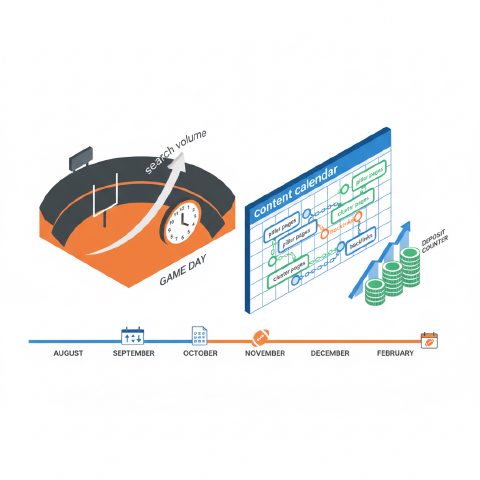
Freshness on league pages isn't a one-time edit, it's a calendar. In-season, the editorial block (form analysis, injury notes, betting angles) needs a weekly touch minimum; off-season, that shifts to draft coverage, trade rumors and early win-total content that keeps the page crawled and relevant even when there are no live games. I track content decay in Ahrefs' Content Explorer and in GSC's performance report side by side, a sudden impression drop on a hub usually means the editorial block has gone stale longer than the algorithm tolerates.
Archiving beats deleting almost every time. Past gameweek pages, old futures odds, and last season's standings still pull long-tail traffic for comparison and historical queries months later. Deleting them and 404-ing the URLs throws away accumulated link equity and crawl history for no real benefit, redirect only when a page is genuinely being consolidated, not just because the season ended.
What's the realistic link building strategy for sportsbook league hub pages?
League hubs earn links through tools and data worth citing, not cold outreach, build a free odds-comparison widget, standings tracker, or historical futures-odds chart, then layer in niche edits and a handful of tiered links pointing at team sub-pages to push equity upward without hitting the money page directly.
Outreach emails pitching a generic league page rarely land in this niche, editors get dozens a week. What earns links is a tool or dataset worth citing: a live odds-comparison widget, a historical standings tracker, or a futures-odds movement chart. Build something a sports journalist or data blogger would reference in their own article, and the links come without the pitch.
For the harder cases, I use niche edits into existing sports and betting content, relatively low risk, since you're inserting into already-ranking, already-trusted pages rather than building new ones. Anchor text ratio across the whole campaign matters: I target roughly 70% branded or naked-URL anchors, 20% partial-match, and under 10% exact-match, keeping it well away from the patterns Penguin and ongoing spam systems still flag. Link velocity discipline matters just as much, jumping from zero to 200 links in a month on a fresh gambling domain is a near-guaranteed path to a manual action or algorithmic suppression, even in 2026.
Expired-domain acquisition and PBNs are the aggressive end of the spectrum. Some offshore operators I've worked adjacent to run them deliberately, accepting the burn risk because the upside, fast authority on a brand-new domain with no organic history, outweighs the downside of losing a disposable domain. I wouldn't put a client's primary licensed brand on that strategy; I would consider it for a secondary or feeder domain built to absorb risk the flagship site can't afford.
What mistakes tank league page rankings before they even get a fair shot?
The five most common mistakes: treating league pages as seasonal promo landers that get deleted, burying them three folders deep under /promotions/, skipping schema entirely, duplicating near-identical hubs per state without canonical tags, and loading odds widgets client-side with nothing crawlable in the raw HTML.
Client-side odds rendering is the one I flag most often in technical audits. If the live odds table loads entirely via JavaScript with no server-rendered fallback, Googlebot's rendering queue can delay indexing of fresh data by hours or days, and some crawlers never execute the JS at all. Server-side rendering or at minimum a static snapshot in the initial HTML, refreshed by the same API, solves this without sacrificing live data for users.
Deep URL burial is a close second. I've audited sites where the NBA hub lives at /us/promotions/2026/nba-season-bonus/betting-guide/, five folders deep, with a URL that screams "temporary promo" to both users and crawlers. Flattening that to /nba-betting/ and 301-redirecting the old path with full link equity transfer is often the single highest-impact fix I make on a legacy sportsbook site, sometimes producing a ranking lift within four to eight weeks purely from the URL and crawl-path cleanup, before any new content goes live.
How do affiliate league pages beat operator pages, and how do you close that gap?
Affiliates win on update frequency, odds-comparison breadth across multiple books, and raw content volume because that's their entire business model. Operators can win on direct conversion path, first-party odds accuracy, and entity trust, once they match the affiliate's publishing cadence instead of treating the league page as a seasonal side project.
Affiliates publish league content as their core product, which means daily or near-daily updates, odds pulled from a dozen books side by side, and dedicated editorial staff. Operators treat the same page as a marketing afterthought owned by whoever has spare time between campaigns. That cadence gap, not content quality in isolation, is the real reason affiliates dominate these SERPs.
What's worth stealing directly: the comparison-table format, the data visualization habit (odds movement charts, implied-probability breakdowns), and the FAQ depth. What operators actually have that affiliates don't: a direct, frictionless path from informational content to a live bet slip on first-party, verifiable odds, plus license and responsible-gambling signals that affiliates can only reference secondhand. Once a league hub matches affiliate publishing frequency, the operator's conversion and trust advantages tend to show up in bounce rate and time-on-page within one or two algorithm cycles.
| Factor | Typical affiliate page | Typical operator page | What to steal |
|---|---|---|---|
| Update frequency | Daily or near-daily | Weekly at best, often seasonal | Shift to a publishing calendar, not a one-off build |
| Odds breadth | 5-15 books compared | Single first-party price | Add a "best odds" comparison module where licensing allows |
| Content volume | 2,500-3,500 words | 300-900 words | Target 1,200-2,000 with real data modules, not filler |
| Conversion path | Outbound affiliate link | Direct, one-click bet slip | Lean into this, it's the structural advantage affiliates lack |
| Trust signals | Secondhand license mentions | First-party license, RG tools, verified odds | Surface these prominently near the odds module |



Comments
No comments yet, be the first.