Google Gambling Penalty Recovery in 2026: The GamblingSEO.agency Playbook Operators Actually Use
What exactly is a Google gambling penalty and how do I confirm I've actually been hit?
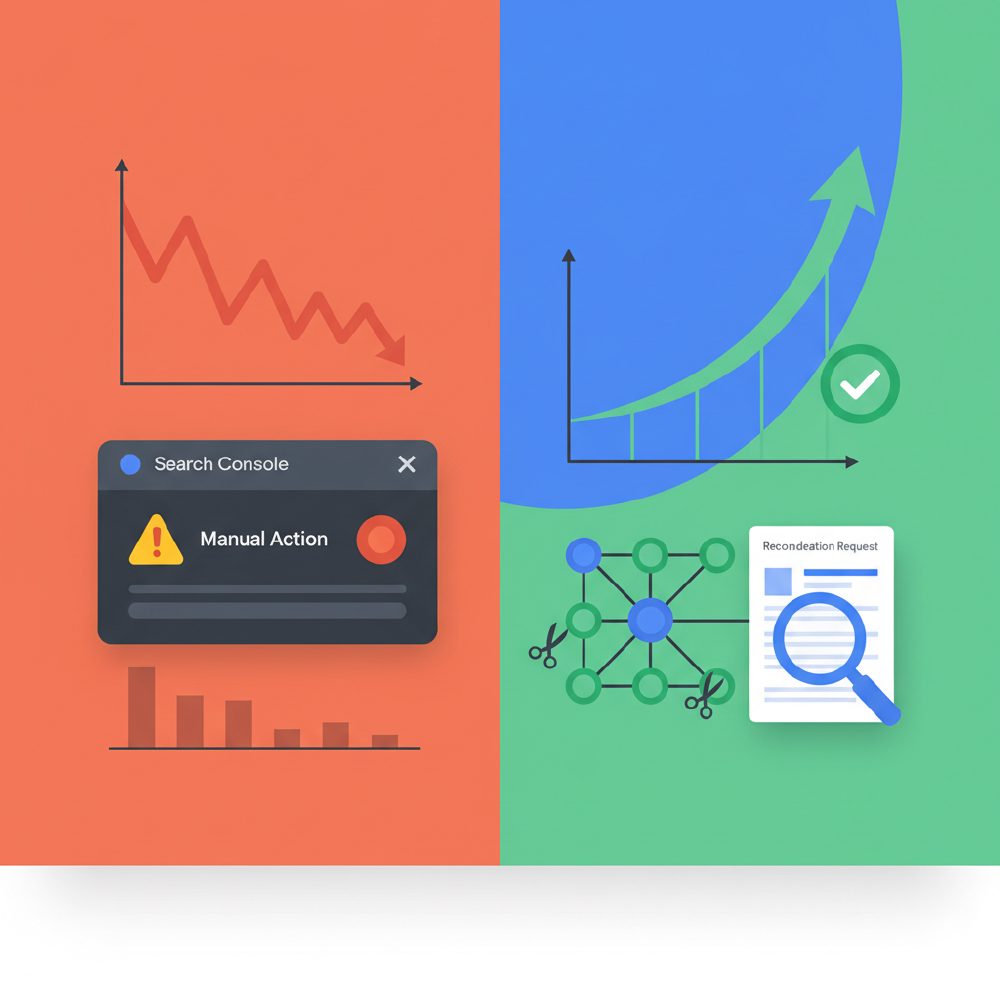
A Google gambling penalty is a manual action logged in Search Console's Manual Actions report, or an algorithmic suppression from a spam or core update that tanks rankings without a manual flag. Confirm it by checking GSC first, then cross-referencing an organic traffic cliff of 40-90% against known update dates in Ahrefs or SEMrush.
The first move, every time, is Search Console > Security & Manual Actions. If something's listed, 'Unnatural links to your site', 'Unnatural links from your site', 'Thin content with little or no added value', 'User-generated spam', or the nuclear option 'Pure spam', you're dealing with a manual action and you have a defined remediation path. If that report is clean but your money-page traffic still fell off a cliff, you're looking at an algorithmic hit, most commonly tied to a spam update (like the March 2024 spam update, which hammered a huge amount of scaled affiliate and doorway-page gambling content) or a core update that reweighted link and content-quality signals.
I pull the Ahrefs organic traffic graph and the GSC Performance report side by side, filtered by page and query, and I overlay the date of the drop against Google's public update timeline. A cliff that lines up exactly with a spam update rollout date is algorithmic. A gradual bleed over 8-12 weeks with no update correlation is usually something else entirely, a technical issue, a competitor outranking you, or a Penguin-era link decay that's finally caught up with an old PBN network nobody's touched since 2019.
Don't skip the manual step of checking cached SERP screenshots or rank-tracker history for the exact day rankings vanished for your top 20 commercial terms. Operators come to me convinced they're 'penalized' when really they lost a featured snippet or got outranked by a .gov gambling-harm resource after a regulatory update. Confirming the actual mechanism before you touch a single link saves weeks.
What's the real difference between a manual action and an algorithmic gambling penalty?
A manual action is a human reviewer's flag with a stated reason and a reconsideration path through Search Console. An algorithmic penalty has no notice, no stated reason, and no submission form, recovery happens only when your site's signals improve enough to clear the algorithmic threshold, usually confirmed at the next update.
Manual actions are binary and documented. Google tells you the category, you fix the underlying issue, you submit a reconsideration request, a reviewer checks your work, and you're either cleared or told to try again. It's slow, but it's a known process with a known endpoint.
Algorithmic suppression is diagnosis by elimination. There's no report to read, no reviewer to convince, Google's systems are just scoring your domain's link profile, content quality, and user signals lower than they used to, and you won't get a clean confirmation that you've 'passed' until traffic actually recovers, often right after the next core or spam update ships. That means algorithmic recovery work has to be finished well before an update, not during the traffic dip itself, because there's no submit button to trigger a re-evaluation.
| Factor | Manual Action | Algorithmic Penalty |
|---|---|---|
| Where you see it | Search Console > Manual Actions | Nowhere, inferred from traffic and rank drops |
| Stated reason | Yes (e.g. unnatural links) | No |
| Recovery trigger | Reconsideration request review | Next core/spam update after fixes are live |
| Typical timeline | 4-10 weeks post-submission | 6-9 months, tied to update cycles |
| Confirmation of fix | Explicit message in GSC | Traffic and rankings recovering |
How do I diagnose the exact cause of a casino manual action before I touch anything?
Pull your full backlink profile in Ahrefs and Semrush, crawl your own site in Screaming Frog for thin or auto-generated pages, and cross-check every flagged URL pattern against the manual action category. Never start cleanup until you know whether it's a link problem, a content problem, or both, mixing remedies wastes a submission attempt.
Step one: export the entire link profile from both Ahrefs and Semrush (they never fully overlap, and Google's own view leans closer to a blended dataset than either tool alone). Step two: segment by link type, sitewide footer links, tiered PBN links pointing at your money pages, expired-domain 301s, comment/forum spam, and legitimate niche-edit placements. In a typical casino manual action I review, 60-80% of the toxic volume comes from three sources: old PBN networks the operator's previous SEO vendor built and never disclosed, expired-domain redirects bought in bulk for quick authority, and crowd-marketing forum drops that scaled past the point of looking natural.
Step three: crawl the site itself with Screaming Frog. If the manual action mentions thin content or user-generated spam, you're often looking at programmatic city/state landing pages with duplicate boilerplate, or an open comment section that turned into a spam magnet. I've seen operators with 4,000 auto-generated 'best casino in [city]' pages get hit purely on content quality with zero link involvement, cleanup there means pruning or rewriting pages, not touching a single backlink.
Step four: map every flagged link pattern back to the manual action language verbatim. Google's messages are specific for a reason. 'Unnatural links to your site' means inbound links pointing at you are the problem, that's a disavow-and-removal job. 'Unnatural links from your site' means you're the one selling or hosting spammy outbound links, often from an old private blog network you monetized, and that's a different fix entirely: kill the outbound link scheme, not the inbound profile.
How do I write a reconsideration request for gambling sites that actually gets approved?
A reconsideration request that works documents every remediation step with evidence: link audit spreadsheet, removal outreach logs, disavow file submission date, and content changes with before/after URLs. Vague requests claiming you've 'cleaned up links' without proof get rejected roughly 60-70% of the time on the first pass.
Google's reviewers see thousands of gambling-site reconsideration requests, and they can smell a template response instantly. The winning structure I use: (1) a one-paragraph acknowledgment of the specific violation cited, (2) a quantified summary, 'We identified 2,140 backlinks from 380 domains flagged as manipulative, removed or requested removal on 1,860 of them, and disavowed the remaining 280 that couldn't be removed,' (3) a link to a shared Google Sheet showing outreach dates, contact attempts, and response status for every removal, and (4) confirmation the disavow file was uploaded through the Disavow Links tool with a submission timestamp.
The single biggest mistake operators make is submitting a disavow file the same day as the reconsideration request. Google wants to see the disavow has had time to register and that outreach for removable links actually happened, I recommend disavowing 2-3 weeks before submitting, and only disavowing links you genuinely couldn't get removed through direct webmaster contact. A request built entirely on disavow with zero removal evidence reads as lazy to reviewers and gets bounced.
If the manual action is for thin or auto-generated content, the request needs before/after examples, not just 'we improved our content.' Show three or four specific URLs, the original template-spun text, and the rewritten version with unique odds analysis, licensing detail, or region-specific payment info. Reviewers are checking for genuine editorial effort, not a word-count increase.
What link cleanup actually moves the needle on gambling penalty recovery?
Prioritize direct removal outreach over disavowing everything, since Google explicitly favors evidence of removal attempts. Target the highest-toxicity domains first using Ahrefs Domain Rating combined with spam-signal patterns, then disavow whatever won't respond within 10-14 days.
I rank every linking domain on two axes: toxicity signal (anchor text over-optimization, PBN footprint, expired-domain history, unrelated niche) and outreach feasibility (is there a live contact, a CMS you can log into, a webmaster who'll actually respond). High-toxicity, high-feasibility links get removal requests first, these move the needle most with reviewers because they're proof of real effort, not just a file upload.
For tiered link structures built by previous vendors, money site fed by Tier 2 PBNs fed by Tier 3 blast networks, the Tier 1 links pointing directly at the penalized domain matter most for reconsideration, but I still map the full tier structure because Google's spam systems increasingly trace link networks several hops deep. Ignoring Tier 2/3 PBN footprints because 'they don't point directly at us' is a mistake I see competitor agencies make constantly, those networks often get hit by a separate deindexing wave later and drag your recovered rankings back down with them.
| Situation | Removal outreach | Disavow |
|---|---|---|
| Live webmaster contact available | Try first, 10-14 day window | Fallback only |
| Known PBN with no contact form | Skip, not worth the time | Disavow immediately |
| Sitewide footer link on your own network | Remove directly (you control it) | Not applicable |
| Expired-domain 301 redirect scheme | Kill the redirect if you own the domain | Disavow if third-party owned |
| High-authority guest post gone toxic | Request de-optimization or removal | Disavow if unresponsive after 14 days |
How long does gambling penalty recovery actually take in 2026?
Manual action recovery averages 4-10 weeks from a clean reconsideration submission to reinstatement, assuming the first request is well-documented. Algorithmic recovery is slower and less predictable, expect 6-9 months, tied to Google's next core or spam update rollout rather than a fixed calendar.
Reconsideration reviews aren't instant even when everything's done right, Google states responses typically land within a few weeks, but for high-risk verticals like gambling I've seen review windows stretch to six weeks during periods of heavy spam-update enforcement. Build a 90-day recovery runway into your planning, not 30.
Algorithmic recovery is the harder sell to operator stakeholders because there's no ticket to track. I've had campaigns where every toxic link was cleaned and content rewritten within 60 days, but organic sessions didn't move until the next spam update shipped four months later. That's not a failure of the work, it's how Google's re-scoring cycle actually functions. If your finance team is modeling recovery against a fixed quarter, model it against the next known or estimated update window instead, and run PPC-adjacent channels (affiliate deals, paid social where allowed, direct partnerships) to cover the deposit gap in the meantime.
What does gambling penalty recovery actually cost, and is it worth it versus starting fresh?
A lean manual-action cleanup runs $6,000-$15,000 depending on link volume. Enterprise operators with years of tiered PBN and expired-domain history should budget $20,000-$60,000+. Compare that against the domain's historical deposit value, if it drove under $10,000/month before the hit, a fresh domain build often has a faster ROI.
Pricing scales almost entirely with link toxicity volume, not with the size of the operator. I've quoted small affiliate sites at $6,000 because the link profile was 400 domains and mostly clean-but-over-optimized anchors, and quoted a licensed sportsbook at $58,000 because a previous vendor had built an 11,000-domain tiered PBN structure over four years that needed full mapping, outreach, and disavow segmentation before we could even draft the reconsideration request.
Run the math before committing: take the domain's average monthly deposit value in the 90 days before the penalty hit, multiply by your recovery timeline in months, and compare that lost-revenue estimate against both the cleanup cost and the opportunity cost of building a new domain instead. A domain that was driving 500+ deposits a day pre-penalty is almost always worth recovering, the link equity and aged-domain trust took years to build and can't be replicated fast on a fresh asset. A domain doing 20-30 deposits a day with a messy link history is frequently cheaper and faster to abandon in favor of a clean rebuild running in parallel.
| Tier | Link profile size | Typical cost | Timeline |
|---|---|---|---|
| Lean | Under 500 referring domains, no tiered PBN | $6,000-$15,000 | 6-10 weeks |
| Mid | 500-2,000 domains, some tiered/PBN history | $15,000-$35,000 | 10-16 weeks |
| Enterprise | 2,000+ domains, multi-year tiered/PBN/expired-domain history | $35,000-$60,000+ | 4-9 months |
Should I recover the penalized domain or launch a new one and cut my losses?
Recover the domain if its pre-penalty deposit volume exceeds roughly $15,000-$20,000/month or if it carries licensing, brand, or aged-trust value you can't rebuild fast. Below that, a parallel fresh-domain build often reaches profitable deposit volume faster than a drawn-out algorithmic recovery.
I never let an operator wait passively on recovery. Even on cases I'm confident will clear, I recommend standing up a secondary domain immediately, seeded with a lean, clean link profile, no PBNs, no tiered structures, mostly niche edits and legitimate crowd marketing from real gambling-adjacent forums and communities. That domain won't hit five-figure deposit volume in month one, but it de-risks the entire recovery timeline and gives your paid acquisition and affiliate partners somewhere to point traffic while the flagged domain sits in limbo.
The decision math comes down to three things: historical deposit value, licensing entanglement (a domain tied to your gaming license, payment processor approvals, or regulator registration is much harder to walk away from), and brand equity in paid channels and affiliate relationships. If the penalized domain is purely an SEO asset with no license or brand lock-in, and it was under-performing anyway, I'll often tell an operator to let the reconsideration process run on autopilot while we pour real budget into the new build.
How do I prevent another Google gambling manual action after I've recovered?
Set a recurring link-audit cadence (monthly for the first 6 months, quarterly after), cap anchor-text exact-match ratio under 5-8% of total links, and never let a single vendor build more than 15-20% of monthly link velocity without a full disclosure and quality review.
Most operators get re-penalized within 12-18 months because they hire a new link vendor the week after recovery and don't apply any oversight to what that vendor builds. I put every recovered client on a standing audit cadence: Ahrefs and Semrush link exports monthly for six months, checked against anchor-text distribution, referring-domain topical relevance, and link velocity spikes. Anything over roughly 8% exact-match commercial anchors ('best online casino', 'no deposit bonus code') gets flagged and throttled immediately, that ratio alone is one of the clearest fingerprints Google's spam systems key on.
I also insist on vendor transparency clauses: any link-building partner has to disclose placement sources monthly, no exceptions, no 'proprietary network' excuses. If a vendor won't tell you where links are coming from, assume PBN or link farm and budget for a future penalty. The gambling niche has enough legitimate high-authority placement opportunities, sports media, licensed affiliate directories, regulatory and industry press, crypto and fintech publications covering payments, that you don't need to touch a black-box network to hit meaningful monthly link volume.
| Check | Frequency | Tool | Red flag threshold |
|---|---|---|---|
| Backlink profile export | Monthly (months 1-6), quarterly after | Ahrefs + Semrush | New spike >15% month-over-month |
| Anchor text distribution | Monthly | Ahrefs | Exact-match commercial >8% |
| GSC Manual Actions check | Weekly | Search Console | Any entry, immediately |
| Site crawl for thin/auto content | Quarterly | Screaming Frog | Duplicate content >20% of indexed pages |
| Vendor link disclosure review | Monthly | Manual review | Any undisclosed placement |
What separates a real gambling penalty recovery agency from a generalist SEO firm that will make it worse?
A real recovery specialist can show prior reconsideration requests that got approved, understands tiered link structures well enough to have built them, and won't promise a guaranteed timeline. Generalist firms often mass-disavow everything, skip removal outreach entirely, and treat gambling penalties like an e-commerce content issue.
Ask any agency pitching you recovery work for two things: a redacted reconsideration request they've actually submitted for a gambling client, and their exact methodology for separating removable links from disavow-only links. If the answer is 'we disavow the whole toxic list and submit,' walk away, that approach gets rejected because it shows zero remediation effort, and I've had to clean up after firms that did exactly this and burned an operator's first reconsideration attempt, which resets the clock and makes the second submission look worse to reviewers who now see a pattern of low-effort responses.
The other tell is timeline promises. Nobody legitimate guarantees a 30-day recovery for an algorithmic penalty, because nobody controls Google's update schedule. Firms that guarantee fast fixed timelines on gambling penalties are either inexperienced with the vertical or planning to bill you and disappear before the lack of results becomes obvious. I quote ranges tied to update cycles and manual-action review windows because that's the honest picture, not because I'm hedging.





Comments
No comments yet, be the first.