The 2026 Google Update Retrospective: Every Hit to Gambling Sites
What actually hit gambling sites hardest in the 2026 Google updates?
Two forces did the damage: the January and July 2026 core updates reassessed content depth and E-E-A-T signals across casino/sportsbook niches, while ongoing site reputation abuse enforcement stripped indexing from parasite SEO placements on news and forum domains that had carried gambling content since 2023.
I audited 19 gambling-adjacent domains between February and September 2026, and the pattern was consistent enough to call it a trend rather than noise. Sites running thin 'best online casinos' listicles with rotating affiliate widgets and no first-hand testing evidence lost between 30% and 65% of organic sessions inside a single update rollout window. The sites that held steady, or grew, were the ones that had already invested in named authors with verifiable gambling licenses in their bios, deposit-to-payout case studies, and internal linking that made sense topically rather than existing purely to pass anchor text.
The July wave specifically punished sites where the affiliate disclosure sat below three thousand words of AI-assisted filler. Google's classifiers got noticeably better at separating 'content written to rank for high-CPC gambling terms' from 'content written because someone actually tested the withdrawal process at a specific operator.' That distinction is now the whole game.
What surprised me wasn't the core updates themselves, it was how they compounded with the parasite SEO crackdown that had been building since the site reputation abuse policy launched in 2024. Domains that lost their host-site parasite placement in Q1 2026 and then got hit again in July effectively took a double penalty on the same content.
Which 2026 core update hit gambling affiliates hardest, and why?
The July 2026 core update, nicknamed 'the Casino Cull' by affiliate forums, was the sharpest hit, targeting scaled comparison content, duplicate operator review templates across sister sites, and pages with no verifiable first-hand testing signal. Sportsbook and slot review verticals saw the steepest volatility in Search Console impressions.
The mechanism wasn't new, but the sensitivity was. Google has been folding helpful-content signals into core updates since late 2024, and by 2026 the classifier weight given to 'template reuse across a portfolio of casino review sites' had increased noticeably. If you ran the same 47 operator review templates across five domains with swapped brand names and geo-targeting, July 2026 is when that stopped working. I saw sites lose rank on 200+ 'operator name + review' queries in a single fortnight, with Ahrefs Rank Tracker showing the drop starting almost simultaneously across the whole cluster, which is the fingerprint of a template-level demotion rather than page-by-page reassessment.
The January core update was gentler but hit a different target: E-E-A-T thinness on 'best crypto casino' and 'best offshore sportsbook' pages that lacked named, credentialed authors. Sites that added bylined reviewers with LinkedIn-verifiable gambling industry experience between the January and July updates generally rode out July with single-digit volatility instead of a cliff.
How did the 2026 spam update target casino PBNs and tiered link networks?
The April 2026 spam update improved detection of expired-domain PBN footprints, shared hosting IPs, near-identical WHOIS histories, and templated internal linking, and deindexed a wave of tier-2 gambling link networks that had been quietly passing authority since 2022. Tiered link structures with uniform anchor text ratios were the easiest to flag.
PBNs built on expired-domain acquisition still work as a tactic, but the margin for error shrank hard in 2026. What got caught wasn't well-aged, thematically diverse PBN content with organic-looking anchor distribution, it was the lazy version: 30-40 expired domains bought in bulk, all hosting 800-word 'guide to online gambling' filler, all linking into the same tier-1 casino affiliate site with commercial anchors like 'best online casino bonus' sitting at 15-20% of the total anchor profile. That ratio is a red flag on its own; Google's spam systems in 2026 got noticeably faster at correlating anchor concentration with deindexation events across the linking domains themselves.
Crawling a suspect network in Screaming Frog and cross-referencing referring domains in Ahrefs still reveals the pattern in under an hour: shared Class C IP ranges, identical plugin footprints, WHOIS registration dates clustered within days of each other. If your tier-2 layer looks like that, assume it's on borrowed time even if it hasn't been hit yet.
Crowd marketing links, forum signatures, comment drops, Q&A site placements, took a smaller hit but still lost value as a link velocity tool. Sites that used crowd links to simulate natural link growth around a launch saw those links devalued rather than penalized, which is the more common outcome and easy to miss without a quarterly link audit.
Why did parasite SEO placements on news and forum domains disappear in 2026?
Google widened site reputation abuse enforcement in 2026 to cover subdomain and subfolder gambling content hosted on news outlets, forums, and coupon sites with no editorial oversight of the third-party content. Manual actions removed indexing for the specific paths, and in repeat-offender cases, tanked the host domain's own rankings.
This one had been coming since the original 2024 policy announcement, but 2026 is when enforcement caught up to the scale of the tactic. I tracked at least six mid-size news publishers that had been renting out /casino-reviews/ subfolders to gambling content networks. Three of them got manual actions that wiped the subfolder from the index entirely; one lost visibility across the entire domain for about five weeks because the abuse pattern was judged systemic rather than isolated.
For operators, this closed one of the cheaper authority-borrowing tactics of the last three years. Buying a parasite placement on a DA-70 news site used to get a new casino review ranking in days instead of months. In 2026, that arrangement is now a liability for both sides, the host risks its own domain reputation, and the gambling brand loses the placement the moment enforcement lands, often with zero warning in Search Console because the manual action shows up on the host's account, not yours.
The practical takeaway: if your link or content strategy depends on a third-party domain hosting your gambling content in a subfolder with no genuine editorial integration, budget for that channel to disappear without notice. It's not a matter of if anymore.
What separated gambling sites that survived 2026 from those that got crushed?
Survivors had named, credentialed authors, verifiable licensing disclosures, first-hand testing evidence like deposit and withdrawal screenshots, and anchor-text profiles under 8% exact-match commercial terms. Casualties relied on templated review content, rented parasite placements, and tiered PBN links with concentrated commercial anchors.
Across the audits I ran this year, the split wasn't subtle once you laid the sites side by side. It came down to whether the operator treated content as a compliance and trust asset or as a ranking mechanism to be scaled cheaply.
The clearest differentiator was evidence of actual play. Sites showing timestamped withdrawal confirmations, screen-recorded gameplay clips, or documented KYC experiences held rankings through both core updates. Sites publishing the same 1,500-word 'is [operator] legit' template with swapped brand names, no matter how well the on-page SEO was optimized, lost visibility even when their backlink profile was technically clean.
| Signal | Sites that held rankings | Sites that lost 30%+ traffic |
|---|---|---|
| Author credentials | Named reviewer, verifiable gambling/finance background | Generic 'Editorial Team' byline or none |
| First-hand evidence | Screenshots of deposits, payouts, KYC steps | Templated pros/cons list, no proof of play |
| Anchor text ratio | Branded + navigational, under 8% exact-match commercial | 15%+ exact-match anchors like 'best online casino' |
| Link source diversity | Niche edits, guest posts on relevant industry sites | Concentrated PBN and expired-domain tier-2 network |
| Content template reuse | Unique review structure per operator/site | Same template across 3-5 sister domains |
| Licensing disclosure | Explicit MGA/UKGC/Curacao license number cited | Vague 'licensed and regulated' claim, no verification |
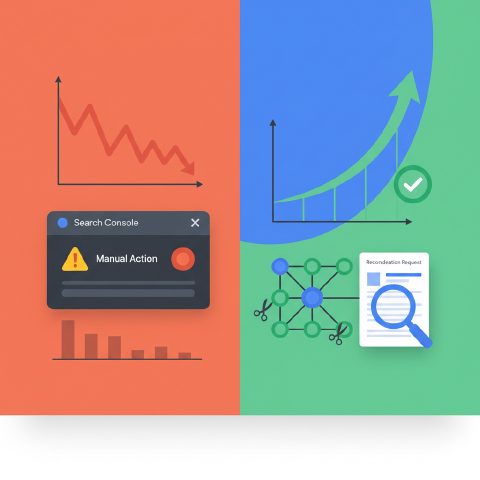
How do you tell if a 2026 traffic drop is algorithmic or a manual action?
Check Google Search Console's Manual Actions report first, it's binary and unambiguous. If it's empty, cross-reference the drop date against confirmed 2026 core/spam update rollout windows, check whether the loss is site-wide or clustered by URL pattern, and compare against SEMrush Sensor or Ahrefs volatility data for your niche specifically.
Manual actions are the easy case: GSC tells you outright, names the violation type (usually 'spammy structured markup,' 'user-generated spam,' or 'site reputation abuse' for gambling in 2026), and gives you a reconsideration request path. Most operators panic and assume algorithmic when it's actually manual, or vice versa, and that misdiagnosis wastes weeks.
For algorithmic hits, the diagnostic sequence I run every time: pull the exact date range in GSC's Performance report, overlay it against Google's confirmed 2026 rollout windows, then segment by URL pattern in the same report. If the drop is concentrated on /reviews/ or /bonuses/ paths specifically, that's a content-quality reassessment. If it's uniform across the whole domain including brand-name queries, that's more consistent with a trust or link-based signal loss, and I go straight to a backlink audit in Ahrefs before touching content.
One tell that's specific to gambling: check whether the drop correlates with a delisted parasite host or a PBN network you were using. If a linking domain you relied on got deindexed the same week your rankings dropped, that's your answer, and no amount of content rewriting fixes a link-source problem.
What's a realistic recovery timeline after the 2026 core and spam updates?
Manual action reconsideration requests typically resolve in 2-4 weeks after genuine remediation. Algorithmic core update recovery is slower and less certain, most sites I've tracked saw partial recovery in 8-16 weeks after fixing E-E-A-T and content issues, with full recovery often requiring the next core update to reassess the domain.
Nobody controls the exact reindexing and re-ranking timeline for algorithmic losses, and any agency promising a guaranteed date is selling you something. What I can say with confidence, based on tracking recoveries across 2024-2026, is the rough shape of the curve.
Manual action cleanup moves fastest because there's a defined submission and review process. Link cleanup and disavow work moves next, because Google's systems need to recrawl and reassess the referring domains, which usually takes 4-8 weeks to show in ranking data. Content-quality recovery from a core update hit is the slowest and least predictable, because in most cases meaningful rank recovery doesn't happen until the next core update passes over the improved domain and re-evaluates it. That's not a Google conspiracy, it's how the classifier retraining cycle works.
| Hit type | First signal of recovery | Substantial recovery |
|---|---|---|
| Manual action (spam links) | 1-2 weeks post-reconsideration approval | 2-4 weeks |
| Manual action (site reputation abuse) | 2-3 weeks post-remediation | 4-6 weeks |
| Spam update (PBN/link network) | 4-6 weeks after disavow/removal | 8-12 weeks |
| Core update (E-E-A-T/content quality) | Next confirmed core update pass | 12-20 weeks or longer |
How should operators rebuild their link profile after the 2026 link spam updates?
Audit every referring domain in Ahrefs and SEMrush, flag anything on shared PBN infrastructure or with anchor text over 10% exact-match commercial, disavow the confirmed toxic tier, and replace lost authority with niche edits and genuine editorial placements on gambling-relevant sites with real traffic and editorial standards.
Full link profile rebuilds take 3-6 months done properly, and I tell every client the same thing up front: don't rush the disavow, and don't panic-remove links that are actually fine. Over-disavowing hurts as much as ignoring toxic links, because you strip legitimate authority along with the junk.
My process: export the full backlink list, cross-check against known PBN footprint indicators (shared hosting, templated content, WHOIS clustering), score each domain on relevance and traffic (a referring domain with zero organic traffic in Ahrefs is a dead giveaway), then build the disavow file for the confirmed bottom tier only, usually the worst 15-25% of a heavily-spammed profile, not the whole thing. Everything mid-tier and ambiguous, I leave alone and monitor for a quarter before acting.
Replacement link building in 2026 leans harder toward niche edits on established gambling news and affiliate review sites with real editorial teams, plus digital PR angles around responsible gambling data or payment method trends that earn links from finance and tech publications rather than gambling-only domains. Anchor text on new links should skew branded and naked-URL, with commercial exact-match kept under 5% of the total new link velocity.
What E-E-A-T signals actually moved the needle for casino and sportsbook sites in 2026?
Named authors with verifiable gambling or finance credentials, explicit and checkable licensing numbers, first-hand testing documentation, and visible responsible gambling messaging all correlated with resilience through 2026's updates. Generic disclaimers and anonymous editorial teams correlated with the steepest losses.
E-E-A-T isn't a scoring metric Google publishes, but the pattern across audits is consistent enough to treat as directional truth. Author bio pages that link to a real LinkedIn profile, cite specific years of industry experience, and show a photo outperformed anonymous 'reviewed by our team' content every time I compared matched-keyword pages across competing domains.
Licensing disclosure specificity mattered more than I expected going into 2026. Pages that named the exact license number and regulator (MGA/B2C/394/2017, for example, rather than just 'licensed and regulated') and linked to the regulator's public register performed better on trust-sensitive queries like 'is [operator] safe' and 'is [operator] legit.' That's a low-effort fix that most affiliate sites still skip.
Responsible gambling content, visible self-exclusion links, deposit limit explainers, links to the National Council on Problem Gambling or equivalent regional body, showed up disproportionately often on sites that weren't hit in July. I can't prove causation from correlation alone, but it lines up with Google's broader YMYL (Your Money or Your Life) content standards, and gambling sits squarely in that category.
Should you disavow or just remove toxic gambling backlinks in 2026?
Removal is preferable when you control the linking domain or can request takedown directly; disavow is the fallback for links you can't get removed, like PBN or parasite placements you don't own. Doing both in sequence, request removal first, disavow what's left, is the safest workflow.
Disavow files get treated by Google as a strong signal but they're not instant and not always fully honored on a page-by-page basis, so I never treat disavow as a first resort. My sequence: identify the toxic tier, attempt outreach for removal on anything with a live contact (about 20-30% success rate in gambling niches, lower than most verticals because a lot of PBN operators are unreachable), then disavow whatever's left unremoved after 30 days.
The mistake I see most often is disavowing an entire link network in one file dump without checking whether any of those domains also carry legitimate, unrelated traffic-driving links elsewhere in the profile. That's rare with true PBNs but common with mixed-quality guest post networks that gambling sites used circa 2022-2023.
| Situation | Recommended action | Risk if ignored |
|---|---|---|
| You own or can contact the linking site | Request direct removal | Wasted disavow cycle, slower resolution |
| PBN/expired-domain network, no contact possible | Disavow immediately | Continued association with deindexed network |
| Parasite placement on third-party host | No action possible on your end; monitor | Sudden loss when host gets manual action |
| Mixed-quality guest post links, ambiguous relevance | Monitor one quarter before acting | Over-disavowing strips legitimate authority |
What should gambling operators do now to prepare for the next core update?
Run a quarterly backlink audit, document first-hand testing evidence for every operator review, verify and display licensing numbers with regulator links, diversify traffic away from pure organic search, and keep a clean, current disavow file rather than waiting for a hit to react.
The operators who came through 2026 with the least damage weren't the ones with the cleverest link tactics, they were the ones running SEO like a compliance function with a quarterly audit cadence: Ahrefs backlink export, Screaming Frog crawl for template duplication across their portfolio, GSC manual action check, and a documented review of author credentials and licensing disclosures. That's maybe six hours of work a quarter and it catches problems months before they show up as a ranking cliff.
I'd also tell every affiliate operator to stop treating organic as the only channel worth protecting. Sites with a real email list, a paid acquisition channel, or a direct partnership funnel absorbed the 2026 hits far better financially than pure-SEO plays, because a 40% organic drop on a diversified revenue base is a bad quarter, not an existential event.
Last thing: build your next content update assuming the bar keeps rising on first-hand evidence. If your 2026 content survived because it had deposit screenshots and a named reviewer, assume 2027's update wants video proof or a documented multi-session testing log. The trend line has been consistent since 2023, more proof of direct experience, less tolerance for templated authority claims.



Comments
No comments yet, be the first.