Unnatural Links Manual Action in 2026: A Casino Site Recovery Plan

What Triggers an Unnatural Links Manual Action on a Casino Site?
Google's link spam team issues this action when it finds patterns of paid, PBN, or manipulative links pointing at your domain, usually exact-match commercial anchors like 'best online casino' or 'real money slots' sitting on low-authority guest posts, casino directories, or sponsored placements missing rel="sponsored" or rel="nofollow".
I've pulled the link graph on more than fifty penalized operator sites, and the pattern repeats with almost boring consistency. Someone ran an aggressive link-building push, often through an affiliate network's in-house link team, or a cheap outsourced vendor promising '200 DA30+ links in 30 days', and the anchor text ratio tipped past 12-15% exact-match commercial terms. That's the tripwire. Google doesn't need to see every link; it samples patterns across referring domains, IP ranges, and CMS templates, and casino niches get extra scrutiny because they sit in the manual-review queue for YMYL-adjacent verticals alongside finance and health.
The specific culprits I see most often: private blog networks built on expired domains with recycled Wayback content, bulk niche edits inserted into old articles on totally unrelated sites (a 2019 recipe blog suddenly linking to a slots review), sitewide footer or sidebar links from casino directories that never should have passed PageRank, and tiered link structures where Tier 2 spam eventually gets crawled and associated with the money site. Link velocity spikes matter too, jumping from 20 new referring domains a month to 400 in six weeks is a flag by itself, independent of quality.
Sponsored content is the other trap. Plenty of casino brands buy legitimate placements on gambling news sites, poker forums, or affiliate hubs, but forget the disclosure markup. Under Google's 2019 nofollow/sponsored guidance, any link tied to compensation, cash, free credit, a reciprocal deal, needs rel="sponsored" or rel="nofollow". Skip that, and even a legitimately negotiated placement on a respected site becomes evidence in your own manual action.
How Do I Know If I Have a Manual Action for Unnatural Links or an Algorithmic Penalty?
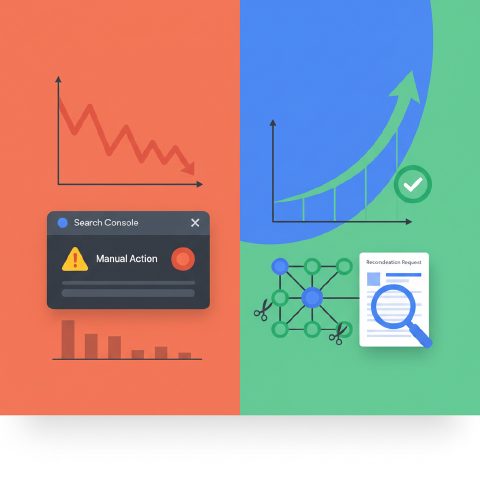
Open Google Search Console's Security & Manual Actions report. A true manual action shows an explicit message, 'Unnatural links to your site' with a scope of 'affects some links' or 'affects this entire site.' If that report is empty and traffic still cratered, you're looking at an algorithmic hit, most likely tied to a core update or the Penguin signals folded into the core algorithm since 2016.
This distinction changes your entire playbook, so I always check it first before touching a disavow file. A manual action is a human reviewer's decision, it sits in GSC with a timestamp, a message, and a 'Request Review' button. An algorithmic drop has none of that; you just see a traffic cliff in GSC's Performance report or Ahrefs' organic traffic estimate that lines up with a confirmed core update date on Google's search-status dashboard or a third-party tracker like Search Engine Roundtable's update log.
The confusion happens because both can look identical in raw traffic charts, a 60-80% drop over 1-3 weeks. What differs is the fix. Manual actions require a reconsideration request after cleanup; algorithmic link devaluation just needs the disavow and cleanup, then patience through the next core update cycle for re-evaluation, since there's no reviewer to petition. I've had operators spend six weeks writing reconsideration copy for a penalty that didn't exist, the actual cause was a core update devaluing thin affiliate content, unrelated to links at all.
Cross-reference the GSC message date against your Ahrefs 'New/Lost Referring Domains' chart. If you see a spike in toxic domains 60-90 days before the manual action date, that's your smoking gun and it tells the reviewer exactly which campaign to blame in your write-up.
What's the Step-by-Step Recovery Plan After an Unnatural Links Manual Action?
Export every backlink source, classify each link as natural or manipulative, run removal outreach before touching disavow, document every attempt with dates and screenshots, disavow what you can't remove, write a specific and honest reconsideration request, then monitor for 30-60 days before assuming you're clear.
I run this as a seven-stage forensic process, and skipping stages is exactly why operators end up filing three reconsideration requests instead of one. Stage one is data collection, pull link exports from GSC (the only dataset Google itself uses), plus Ahrefs, SEMrush, and Majestic, because no single crawler has full coverage and gambling PBNs deliberately hide from some crawlers via cloaking or IP-based blocking.
Stage two is classification: tag every referring domain as natural, borderline, or manipulative based on anchor text, domain spam score, topical relevance, and template fingerprints (shared theme, shared Google Analytics ID, shared hosting IP block, all classic PBN tells). Stage three is outreach: email every site owner requesting removal, with a firm but polite tone, and a 10-14 day deadline. Stage four is documentation, a spreadsheet logging every email, reply, and screenshot, because this becomes Exhibit A in your reconsideration request. Stage five is disavow for anything unremovable. Stage six is the written reconsideration request itself. Stage seven is monitoring, GSC manual action status, ranking recovery in your rank tracker, and a fresh Ahrefs crawl 30 and 60 days out to confirm nothing was missed.
| Stage | Action | Primary Tool | Typical Duration |
|---|---|---|---|
| 1. Link export | Pull all referring domains from every source | GSC, Ahrefs, SEMrush, Majestic | 2-4 days |
| 2. Classification | Tag links natural / borderline / toxic | Spreadsheet + spam score models | 5-10 days |
| 3. Removal outreach | Email site owners, request takedown | Hunter.io, manual outreach | 3-6 weeks |
| 4. Disavow | Submit disavow file for unremovable links | GSC Disavow Tool | 1 day submit, 2-4 weeks to process |
| 5. Reconsideration request | Written petition with evidence | GSC Manual Actions report | 2-3 weeks per review round |
| 6. Monitoring | Confirm status lift, check for relapse | GSC, Ahrefs, rank tracker | 30-60 days ongoing |
How Do I Audit My Backlink Profile to Find the Links Causing the Penalty?
Pull backlinks from Google Search Console, Ahrefs, SEMrush, and Majestic simultaneously, GSC shows what Google itself indexed, while the third-party crawlers catch links GSC underreports. Then sort by anchor text ratio, referring-domain spam score, and shared-template PBN fingerprints to isolate the manipulative cluster.
GSC's link report is the ground truth for what Google's algorithm actually processed, but it's notoriously incomplete and delayed by weeks. That's why I never audit off one source. Ahrefs gives the deepest historical crawl and its Domain Rating + Spam Score combination is the fastest first-pass filter I use to bucket thousands of links. SEMrush's Backlink Audit tool has a built-in toxicity score that's decent for a second opinion, and Majestic's Trust Flow-to-Citation Flow ratio catches link farms that Ahrefs sometimes misses, a domain with high Citation Flow but near-zero Trust Flow is almost always a PBN or expired-domain flip.
For casino sites specifically, I add a manual layer: check for shared CMS templates and shared analytics IDs across referring domains using Screaming Frog's custom extraction on a crawled list, and check WHOIS history for domains registered in bulk around the same date. I've found PBN networks of 40-60 domains this way, all registered within a three-week window in 2021, still linking today with the exact same footer template.
Once flagged, I run every 'toxic' domain through a manual spot check before disavowing, automated toxicity scores flag roughly 15-20% false positives in my experience, mostly legitimate niche sites that just happen to have thin content or an aggressive ad layout. Disavowing a genuinely earned link by mistake wastes authority you're trying to rebuild.
| Tool | Best For | Coverage Limitation | Approx. Cost/Month |
|---|---|---|---|
| Google Search Console | Ground-truth link data Google actually used | Delayed, incomplete sampling | Free |
| Ahrefs | Deepest historical crawl, Domain Rating | Some PBNs cloak against its crawler | $129-449 |
| SEMrush | Built-in toxicity scoring, quick triage | Toxicity score has false positives | $139-449 |
| Majestic | Trust Flow / Citation Flow link-farm detection | Smaller overall index than Ahrefs | $49-399 |
| Screaming Frog | Template/footprint detection across flagged domains | Manual setup required, not automated | Free-£199/yr |
Should I Remove Paid Links or Just Disavow Them?
Attempt removal first on every link, disavow only what's genuinely unremovable. Google's link spam team wants documented proof of real cleanup effort, outreach emails, timestamps, screenshots, not a disavow file submitted in isolation, which reads as 'I hid the evidence' rather than 'I fixed the problem.'
I've reviewed rejected reconsideration requests where the operator disavowed 800 domains and got denied anyway, because the write-up showed zero removal attempts. Google's reviewers can't see your disavow file's contents when judging effort, they read your explanation and check whether it matches reality on the live web. A disavow-only approach signals you're managing risk, not admitting and correcting a violation.
Removal is genuinely achievable more often than operators assume. Legitimate guest post sites and news outlets will usually pull a paid link within 1-2 weeks once you explain the situation and offer to cover their time. PBN owners are a mixed bag, some respond and remove for a small fee (yes, this happens, and it's worth $20-50 per link versus the alternative), others are abandoned domains with no working contact at all. For those, and for pure link farms and directories, disavow is the only realistic path.
My rule of thumb: budget 60-70% of toxic links for removal outreach, expect a 30-40% success rate on genuine responses within your outreach window, and disavow the remainder plus anything you can't verify. Never disavow entire root domains unless the whole domain is compromised, disavowing at the URL level preserves any incidental clean links you might otherwise torch.
| Link Scenario | Recommended Action | Why |
|---|---|---|
| Active site, responsive owner, single paid link | Removal outreach | Fastest, cleanest, shows real effort to reviewers |
| PBN with live contact form, willing to remove for a fee | Pay for removal if under $50/link | Cheaper than the traffic lost to a prolonged penalty |
| Abandoned/expired domain, no contact possible | Disavow at URL level | No removal path exists; document the attempt anyway |
| Sitewide footer link from a directory you can't edit | Disavow entire domain | Volume and template make URL-level disavow impractical |
| Legitimate editorial link with thin/aggressive site design | Leave alone, verify manually | Avoid disavowing links that aren't actually manipulative |
How Do I Write a Reconsideration Request Google Will Actually Approve?
Document every removal attempt with dates and screenshots, attach or reference your disavow file, explain plainly how the links were acquired without deflecting blame, and state specifically what changed in your link acquisition process going forward. Vague, defensive, or incomplete requests get rejected on the first pass almost every time.
The reconsideration request form gives you a text box and an expectation of honesty that a lot of operators fight against instinctively. Don't. Reviewers have seen every excuse, 'our SEO vendor did this without our knowledge,' 'competitors built these links to sabotage us', and unless you have hard evidence of negative SEO (rare, and Google is skeptical by default), blaming a third party without owning the fix reads as evasive.
My template structure: paragraph one states plainly that you identified a pattern of unnatural links, likely from [specific campaign type, PBN links, paid guest posts, sponsored placements without disclosure]. Paragraph two summarizes the audit scope, total referring domains reviewed, number flagged, number where removal was attempted. Paragraph three references your outreach log (I attach a Google Sheet link or summarize counts: '340 removal emails sent, 128 links removed within 21 days'). Paragraph four confirms the disavow file submission date and scope. Paragraph five states the process change, new vendor vetting, no more paid link campaigns, in-house review of any future sponsored content for proper rel attributes.
Keep it under 500 words. Reviewers process thousands of these; density and specificity win over length. And never resubmit an identical request after rejection, if you got denied, something in your evidence or your disavow file was incomplete, and Google's rejection message (though generic) sometimes hints at scope. Redo the audit before round two.
How Long Does Link Penalty Recovery Take for a Casino Site?
Plan for 3-9 months across the full cycle. Removal outreach runs 3-6 weeks, disavow processing takes 2-4 weeks to reflect, and each reconsideration review takes roughly 2-3 weeks. Casino and iGaming domains typically need 2-4 rounds because manual reviewers apply extra scrutiny to YMYL-adjacent verticals.
I set expectations bluntly with clients on this one because hope is not a strategy. A clean, well-documented first submission on a smaller site (under 500 referring domains) can clear in a single round, I've seen that happen in 5-6 weeks total. But casino sites rarely have clean profiles; historic affiliate-driven link campaigns tend to leave thousands of referring domains, and untangling which links belong to which campaign era takes real time.
Realistically, budget one full audit-and-outreach cycle (4-6 weeks) before your first submission, then 2-3 weeks of silence while Google reviews it. If rejected, common on round one for gambling domains with heavy link histories, you need another audit pass to find what was missed, another outreach round for anything new flagged, and a rewritten request. Two rounds is typical; three is not unusual for sites with a 5+ year link-building history involving multiple vendors.
Traffic recovery after the manual action lifts is a separate clock entirely. Lifting the action stops the suppression, but rankings often climb back over 4-8 weeks rather than snapping back instantly, and full recovery to pre-penalty levels sometimes never happens if the removed links were carrying real ranking weight, which is exactly why the rebuild strategy in the next section matters as much as the cleanup itself.
What's the Difference Between "Affects Some Links" and "Affects This Entire Site"?
"Affects some links" means Google devalued a specific set of unnatural links without suppressing full-site rankings, recovery is narrower and usually faster. "Affects this entire site" is the harsher scope: Google may be suppressing rankings sitewide until you clean up and get reconsideration approved, and it demands a more exhaustive audit before resubmitting.
This wording sits right in the GSC manual actions message, and I've watched operators misread it more than once. 'Affects some links' typically means Google has already algorithmically discounted the flagged links, your job is cleanup and documentation, but the site itself may still be ranking reasonably well on its remaining natural authority while you work through the process. It's the more common scope for a moderate paid-link campaign that got caught before it escalated.
'Affects this entire site' is a different animal. This scope signals Google considers the link scheme pervasive enough to warrant a sitewide ranking impact, you'll typically see uniform, dramatic drops across every page and keyword, not just pages that received the flagged links. I treat this scope as requiring the most conservative disavow approach: audit every single referring domain, not just a sample, because the reviewer's bar for lifting a sitewide action is higher than for a partial one.
One nuance worth flagging: a sitewide action doesn't always mean every link on the site is bad. It means Google judged the pattern severe or systemic enough to apply broad suppression as a deterrent. I've cleared sitewide actions where maybe 8% of total referring domains were actually toxic, the scope of the penalty and the scope of the actual violation aren't the same number.
How Do I Rebuild Authority After Cutting Toxic Links Without Losing More Rankings?
Replace removed link equity with legitimate E-E-A-T signals before or during cleanup: licensing and compliance pages, named expert authorship with verifiable credentials, digital PR coverage from real gambling and business press, and editorial links earned through data studies rather than paid placement. Cutting links without rebuilding authority leaves rankings flat even after the action lifts.
This is the step operators skip because they're focused entirely on making the penalty go away, and it's the reason some sites recover the manual action but never recover the traffic. If 40% of your ranking authority was propped up by manipulative links, removing them creates a real gap, Google isn't obligated to backfill it with anything.
The replacement strategy I run in parallel with cleanup: build out licensing and regulatory pages that name your actual license number, jurisdiction, and compliance officer, this is a direct E-E-A-T signal for YMYL gambling content and something legitimate operators consistently under-invest in. Add named author bios with verifiable industry experience for any strategy or odds content, since anonymous "Admin" bylines on financial-risk content are a trust red flag Google's raters explicitly check for in the Search Quality Rater Guidelines.
For actual new links, I shift budget entirely toward earned media: original data studies (state-by-state gambling revenue analysis, slot RTP research, sportsbook odds comparison studies) pitched to gambling trade press like SBC News, iGaming Business, or Gambling Insider, plus mainstream business press when the data angle is strong enough. These links come slower, expect 2-5 placements a month versus the 50+ a PBN could fake, but they're the only kind that won't trigger the next manual action.
Which Link Removal Tactics Actually Work in the Gambling Niche?
Direct email outreach with a clear deadline works on 30-40% of live, maintained sites. For unresponsive PBNs and directories, escalate to hosting-provider abuse reports, registrar complaints, or small removal payments, gambling link networks respond better to money than to polite requests, which is worth acknowledging honestly rather than pretending outreach alone solves everything.
Standard SEO advice says 'email the webmaster and wait.' In the gambling niche, that gets you a 20-30% response rate at best, because a meaningful chunk of the toxic links sit on sites built specifically to sell links, with owners who have no incentive to remove anything for free. I adjust tactics based on what kind of domain I'm dealing with.
For legitimate publishers who accepted a paid post without realizing the SEO risk, straightforward email works well, explain the Google guideline violation, ask for either full removal or a rel="sponsored" tag addition, and most editors comply within two weeks because they don't want their own site flagged either. For PBN operators, I've had better luck offering a small removal fee ($15-40 per link) through the same contact channel used to originally buy the link, mercenary, but it clears links fast and it's documented as a legitimate removal attempt regardless of the mechanism.
For truly abandoned domains with expired WHOIS and no functioning contact form, I skip straight to disavow, chasing a dead domain for six weeks just delays your reconsideration timeline. And for sitewide directory links (a common gambling-specific problem, hundreds of "top online casinos" directory sites with permanent footer links), I request removal via any admin contact I can find, and disavow the domain wholesale if there's no response within 14 days rather than waiting indefinitely.
How Much Does Manual Action Recovery Cost, and Do I Need an Agency?
Agency-led recovery for a casino site typically runs $8,000-40,000 depending on link volume and number of reconsideration rounds needed. In-house recovery is feasible under roughly 200-300 toxic referring domains with an experienced technical SEO on staff, but most gambling sites with multi-year link histories exceed that volume significantly.
I quote this range because I've seen both ends of it in real engagements. A smaller regional sportsbook affiliate with a contained, one-vendor paid-link campaign cleaned up in about five weeks for roughly $8,000 in agency fees, one reconsideration round, done. A larger casino operator with a decade of layered PBN, tiered link, and multi-vendor sponsored content history took four reconsideration rounds, seven months, and closer to $35,000 once you count the audit hours, outreach management, and disavow-payment budget for stubborn PBN removals.
The math that justifies the spend: if your casino site was pulling meaningful organic traffic before the action and that traffic converts even modestly on real-money deposits, the revenue lost during a 3-9 month suppression almost always dwarfs the recovery cost. I've run this comparison for clients directly, a mid-tier affiliate losing 12,000 monthly organic sessions at even a conservative $2-4 revenue-per-session estimate is bleeding $24,000-48,000 a month it sits penalized.
You need an agency or a genuinely experienced technical SEO (not a general content marketer) when the link volume exceeds a few hundred domains, when you've already had one reconsideration rejected, or when the site has a multi-vendor link history nobody currently on staff fully understands. DIY works fine for small, well-documented, single-campaign cases.
What Mistakes Cause a Repeat Manual Action After Recovery?
The most common repeat offense is resuming similar link tactics with the same or a new vendor within months of recovery, followed closely by disavowing without genuine removal attempts, submitting vague reconsideration requests, and failing to audit new links acquired during the cleanup period itself. Google tracks recidivism and treats second offenses more harshly.
I've seen operators clear a manual action and get hit again within a year, and it's almost always one of four failures. First: going right back to a link vendor promising fast rankings, sometimes the exact same vendor whose links caused the original problem, just with a new proposal deck. Second: treating disavow as a substitute for removal in the original request, which either delays the first approval or sets a pattern reviewers remember if you're flagged again.
Third: writing a reconsideration request that's technically true but strategically thin, "we removed some links and are being more careful" without specifics reads as damage control, not genuine remediation, and it's the single biggest reason for first-round rejections I've reviewed. Fourth, and this one catches people off guard: continuing to acquire new links during the months-long cleanup and reconsideration process without vetting them the same way, so you finish removing the old problem while quietly building a new one.
The fix across all four is structural, not tactical: put a link acquisition policy in writing, require anchor text and source vetting for anything new, cap exact-match commercial anchors well under 10% of your total profile going forward, and run a quarterly Ahrefs/SEMrush audit permanently, not just during a crisis. Recovery that doesn't change the underlying process just resets the clock on the next penalty.




Comments
No comments yet, be the first.