Tiered Link Building for Gambling in 2026: The Deposit-First Link Pyramid
What Is Tiered Link Building for a Gambling Site, Exactly?
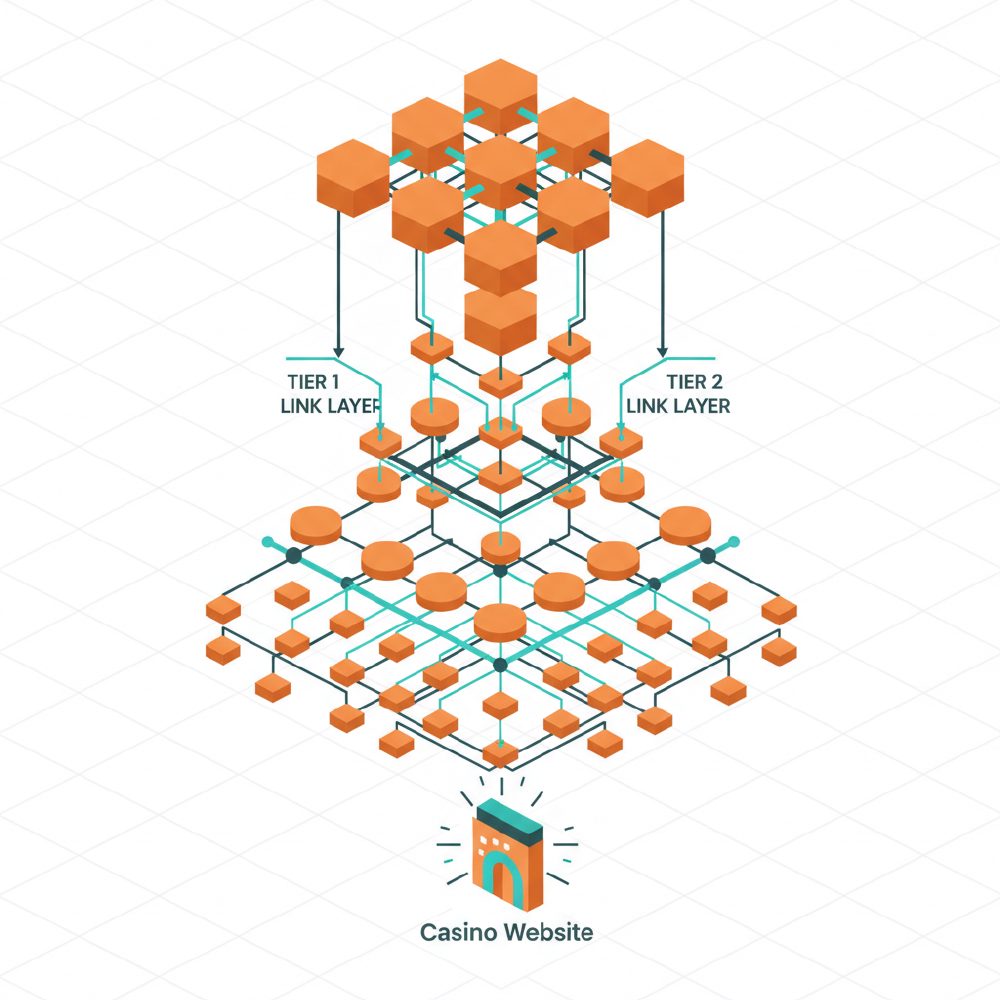
Tiered link building stacks three layers of backlinks, tier 1 pointing directly at your casino or sportsbook domain, tier 2 pointing at tier 1, tier 3 pointing at tier 2, so authority flows downward while the riskiest, most scalable link sources never touch your money site. It's the standard architecture for ranking pages in a vertical Google treats as inherently suspicious.
Gambling operators don't get the luxury of a clean backlink profile building itself through PR and organic mentions. Mainstream publishers won't link to a crypto casino, most finance and lifestyle sites have blanket no-gambling policies, and the sites that will link to you charge accordingly or sit in a grey zone themselves. Tiered link building exists because flat, single-layer link building in this vertical is slow, expensive, and caps out fast once you've exhausted the small pool of legitimate niche-edit and guest-post inventory.
The pyramid solves a specific problem: you need volume and velocity to compete for commercial terms like 'online casino [state]' or 'crypto sportsbook no verification,' but you can't point hundreds of low-quality links at your root domain without eventually eating a Penguin-style devaluation or a manual action. So you insulate. Tier 1 sits close to the money site and has to be clean. Tier 2 and tier 3 do the heavy lifting of passing link equity and anchor text diversity, and if Google ever discounts or disavows them, your actual domain never touched that link directly.
I've run this structure across US-facing sweepstakes casinos, LATAM sportsbooks, and offshore crypto brands. The mechanics don't change much by geo, what changes is how aggressive you can be on tier 2 and 3 before the risk-adjusted return stops making sense.
How Do Tier 1, Tier 2 and Tier 3 Links Actually Differ?
Tier 1 links point straight at your casino domain and must be high-quality, low-volume, and editorially placed. Tier 2 links point at your tier 1 pages to reinforce them and can carry more risk. Tier 3 links point at tier 2 and exist purely for bulk and indexing, they're disposable by design.
Think of it as a filtration system. Every layer you move down, you trade quality for volume and accept more risk because that layer is further from your actual revenue-generating domain.
Tier 1 is the layer I personally sign off on for every client, because this is the layer that shows up in your Ahrefs or SEMrush backlink profile when Google, or a competitor running a negative SEO audit against you, looks at your domain. Tier 2 is where PBNs, expired-domain rebuilds, and aggressive guest posting live. Tier 3 is where you push volume through bookmarking, forum profiles, Web 2.0 properties, and bulk tools like GSA or Fiverr gig networks, almost entirely to get tier 2 pages indexed and juiced fast.
| Tier | Points to | Typical DR range | Risk level | Primary job |
|---|---|---|---|---|
| Tier 1 | Money site (casino/sportsbook domain) | DR 30-70, real traffic sites | Low, must stay clean | Direct authority + trust signal |
| Tier 2 | Tier 1 pages/domains | DR 10-40, PBNs, expired domains, Web 2.0 | Medium, some churn expected | Reinforce tier 1, pass anchor diversity |
| Tier 3 | Tier 2 pages/domains | DR 0-20, bulk/spam-tolerant sources | High, fully disposable | Volume, indexing speed, link velocity |
Why Does Tiered Link Building Work Better Than Flat Link Building for Casino SEO?
Flat link building forces every link to be high quality, which caps your velocity at what niche edits and guest posts can supply, maybe 15-25 links a month for most casino budgets. Tiering lets you scale tier 2 and 3 volume 5-10x without exposing the root domain, so you compete on link count against affiliates who've been building for years.
Affiliate sites and established operators in this vertical have backlink profiles built over 5-10 years. A new sportsbook or crypto casino launching in 2026 can't out-wait them, you have to out-build them on velocity while staying within Google's tolerance band for the money site itself. Flat building, where every link goes straight to your domain, means every single placement has to survive scrutiny. That's expensive and slow when your realistic supply of genuine DR 40+ gambling-friendly placements might be 200-300 live sites worldwide, most of which are already monetized by competitors or link brokers.
The pyramid decouples velocity from domain risk. You can run 300-500 tier 3 links a month into a pool of 40-60 tier 2 assets and never once touch your actual domain's link profile. The compounding effect on tier 1 pages, which do touch your domain, but at low volume, is what moves rankings without moving the needle on spam signals Google's systems are actually scanning for on your root domain.
I've seen this cut time-to-rank on competitive casino terms from 9-12 months down to 5-7 months when the tier 2/3 layer is built properly and tier 1 placements are genuinely editorial.
What Does a Realistic Casino Link Pyramid Structure Look Like in 2026?
For one target money-site URL, a realistic pyramid runs 10-15 tier 1 links, 40-60 tier 2 links distributed across those tier 1 assets, and 150-300 tier 3 links feeding tier 2. Ratios shift based on how competitive the target keyword is and how aggressive the operator's risk tolerance runs.
Scale matters here more than people admit. A sweepstakes casino chasing a low-competition state term needs a fraction of the volume a crypto sportsbook chasing 'best crypto sportsbook' globally needs. I size pyramids per URL, not per domain, because ranking ten money pages means ten overlapping but distinct pyramids, often sharing tier 2/3 infrastructure to control cost.
The ratio that's worked consistently across our client base sits around 1:4:15, one tier 1 link supports roughly four tier 2 links, which are each supported by roughly fifteen tier 3 links. Go heavier on tier 3 and you risk flagging the tier 2 layer for unnatural velocity, which just wastes spend since a devalued tier 2 page passes nothing upward.
| Layer | Volume (per target URL) | Build cadence | Notes |
|---|---|---|---|
| Tier 1 | 10-15 links | 2-4 per month | Niche edits + guest posts, DR 30-70 |
| Tier 2 | 40-60 links | 8-12 per month | PBN + expired domain + Web 2.0 mix |
| Tier 3 | 150-300 links | 40-80 per month | Bookmarks, profiles, forum, bulk tools |
Which Link Sources Actually Belong on Each Tier?
Tier 1 needs niche edits and guest posts on real-traffic finance, lifestyle, or sports sites with gambling-tolerant editorial policies. Tier 2 relies on PBNs, rebuilt expired domains, and Web 2.0 properties with genuine content. Tier 3 uses bookmarking sites, forum profiles, blog comments, and bulk indexing tools.</p><p>
Sourcing tier 1 correctly is the single biggest determinant of whether your pyramid survives a core update. I only approve tier 1 placements on domains with verifiable organic traffic in Ahrefs or SEMrush, not just a high DR with zero real visitors, which is the classic tell of a link farm dressed up as a media site. Niche edits into existing aged content convert faster than fresh guest posts because Google already trusts the page, but guest posts give you cleaner anchor text control.
Tier 2 is where PBNs earn their reputation, private networks of expired domains with real backlink histories, hosted on separate C-class IPs and registrars, running unique WordPress themes and genuinely written 500+ word posts. Done lazily, with shared hosting and template content, tier 2 PBNs get caught in spam sweeps within months. Done properly, with proper domain vetting (no prior gambling or pharma penalties, clean Majestic Trust Flow, natural link history pre-expiration), a PBN tier 2 network can run productively for 2-3 years before refresh.
Tier 3 is intentionally expendable, forum profile links, social bookmarks, blog comments, Web 2.0 properties on Blogspot or WordPress.com, and bulk link-building tools like GSA Search Engine Ranker or scraped Fiverr gig networks. Nobody expects these to survive scrutiny. Their only job is pushing tier 2 pages into the index fast and giving them enough raw link count to pass something upward.
| Tier | Source types | Examples/tools |
|---|---|---|
| Tier 1 | Niche edits, guest posts, digital PR | Real gambling/sports/finance blogs, HARO-style pitches |
| Tier 2 | PBNs, expired domains, Web 2.0 | Rebuilt expired domains via Ahrefs/ExpiredDomains.net, WordPress.com, Blogger |
| Tier 3 | Bookmarks, profiles, forum links, bulk tools | GSA SER, Fiverr link gigs, forum signature links |
How Much Does Tiered Link Building Cost for a Casino or Sportsbook Brand?
Expect $3,000-$8,000 a month for a single-market sweepstakes casino or affiliate site, and $10,000-$25,000+ a month for a multi-geo crypto sportsbook chasing competitive head terms. Cost concentrates in tier 1 placements and PBN domain maintenance, tier 3 volume is nearly free by comparison.
Operators underestimate how front-loaded the cost curve is. Building or acquiring a 20-domain PBN for tier 2 can run $8,000-$15,000 upfront in domain acquisition alone, before a single post goes live, because expired domains with clean gambling-relevant backlink histories sell for $150-$800 each depending on DR and niche relevance. That's a sunk cost that amortizes across every money-site URL you run through it afterward, which is why established operators with mature link infrastructure have a real cost advantage over new entrants.
Tier 1 is priced per placement, not per campaign, niche edits run $150-$600 depending on DR and whether the site explicitly allows gambling content (most don't, so you're paying a premium for the ones that do), and guest posts with full content production run $250-$800 including the writer. Tier 3 is priced in bulk, often under $1 per link through managed services or pennies per link if you're running your own GSA instance.
| Operator profile | Monthly link spend | Where the budget goes |
|---|---|---|
| Single-geo sweepstakes casino | $3,000-$8,000 | Tier 1 niche edits + light tier 2 PBN use |
| Regional sportsbook affiliate | $6,000-$15,000 | PBN maintenance, tier 1 guest posts, tier 3 volume |
| Multi-geo crypto casino/sportsbook | $12,000-$25,000+ | Domain acquisition, multiple PBN clusters, aggressive tier 2/3 scaling |
How Long Before Tiered Links Move Rankings and Deposits?
Tier 3 links index within days to two weeks. Tier 2 pages absorb and start passing authority within 3-6 weeks. Tier 1 movement on the money site typically shows in Search Console around week 8-16, with deposit-attributable ranking gains compounding over 6-12 months as the full pyramid matures.
Clients ask me for week-four results constantly, and I'll tell every operator the same thing I tell them: if a vendor promises page-one casino rankings in 30 days on a competitive term, they're either running a PBN on borrowed authority that'll get deindexed, or they're lying about the keyword difficulty. Real compounding takes time because tier 2 pages need to earn their own crawl trust before they pass meaningful equity downward, a fresh PBN post doesn't transmit the same power on day one that it does at month three once Google's recrawled it a few times and seen it hold steady.
What I do see reliably: within 60-90 days of launching a properly sequenced pyramid (tier 3 first, tier 2 two weeks later, tier 1 placements rolling throughout), money-site pages start moving from page 3-5 into page 1-2 territory for mid-competition terms. High-competition national terms like 'online casino' or 'best sportsbook' realistically need 9-12 months of sustained pyramid building plus content and technical work to break top 10, and that's assuming no core update resets progress mid-campaign, which happens more than anyone likes to admit in this vertical.
Can Tiered Link Building Get a Gambling Domain Penalized?
Yes, if tier 1 links are low-quality or your anchor text ratio skews unnatural, Google's Penguin-descendant systems and periodic spam updates can devalue links or trigger a manual action for unnatural links. The risk concentrates almost entirely at tier 1, tier 2 and tier 3 churn is expected and designed to be absorbed without touching your domain.</p><p>
The failure mode I see most often isn't the pyramid itself, it's operators or junior link builders getting greedy on tier 1 anchor text, running exact-match commercial anchors like 'best online casino' at 15-20% of total tier 1 links instead of the 2-5% that keeps a profile looking natural. Google's systems don't need to understand your pyramid structure to flag that pattern; they just need the anchor distribution on your root domain to look engineered, and it will if you let it.
Google's 2024 and 2025 spam updates specifically targeted expired-domain abuse and parasite SEO patterns, sites hosting third-party content purely to exploit existing authority. That hit a lot of lazily-run tier 2 PBNs where the expired domain's prior content had zero topical relevance to the new gambling posts bolted onto it. The mitigation is domain selection discipline: buy expired domains with some pre-existing topical proximity (finance, sports, lifestyle, entertainment), not just raw DR, and don't rebuild ten domains on the same template in the same week.
A manual action on your root domain from unnatural inbound links is recoverable but costly, expect a disavow file submission, documentation of outreach for any removable links, and 4-8 weeks minimum before reconsideration clears, during which your organic deposits effectively flatline. That's the real cost of a sloppy tier 1, not the Google penalty itself but the 1-2 months of lost acquisition while you clean it up.
How Do You Build Tier 1 Links for a Casino Site Without Burning the Domain?
Source tier 1 exclusively from sites with verifiable organic traffic and an explicit or negotiated tolerance for gambling content, niche edits into aged, already-ranking posts convert fastest, guest posts give cleaner anchor control. Keep exact-match commercial anchors under 5% of the tier 1 mix and diversify the rest across branded, naked-URL, and partial-match anchors.</p><p>
I run every prospective tier 1 domain through Ahrefs traffic estimates and a manual check of the site's existing outbound link profile, if a site is already linking out to five other casinos in a sidebar widget, that's a link farm regardless of its DR, and it'll get discounted or nuked in the next spam sweep. Real tier 1 sites have organic traffic, a plausible editorial reason to run gambling content (a sports blog covering betting odds, a crypto news site covering casino launches), and ideally some history of linking out to other verticals too, not just gambling.
Niche edits beat fresh guest posts on speed-to-impact because you're inserting a link into a URL that's already indexed, already ranking, and already passing some equity, Google doesn't need to warm up to a brand-new page first. But guest posts give you full control over surrounding content and anchor placement, which matters when you're trying to hit a specific anchor text ratio across the whole tier 1 layer. I run both in parallel, roughly 60% niche edits to 40% guest posts, adjusted by how much existing ranking inventory a given publisher has available.
How Do You Structure Tier 2 and Tier 3 to Pass Authority Safely?
Tier 2 PBNs need genuine diversification, separate registrars, separate hosting providers, unique C-class IPs, unique themes, and real written content over 500 words. Tier 3 should never link directly to your money site; its only job is indexing and juicing tier 2, so footprint discipline matters less there but still protects tier 2's longevity.</p><p>
The PBN detection models Google runs aren't looking for one tell, they're looking for correlated footprints: ten domains registered the same week, hosted on the same nameserver, running the same theme with the same plugin fingerprint, all linking to the same cluster of money sites. Break any single one of those correlations and you reduce detection risk meaningfully. I mandate different registrars (Namecheap, Porkbun, Dynadot rotated across a network), different hosting (a mix of shared, VPS, and a few dedicated IPs), and theme variation across every PBN cluster we run.
Content quality on tier 2 matters more than most link builders admit. A 500-800 word post with genuine subject coverage, internal links to other pages on the same expired domain, and a natural outbound link profile (not just the one link to your tier 1 page) reads as a real site to both Google's crawlers and to a human reviewer if your domain ever gets a manual spam check. Spun or AI-generated filler content with zero editorial effort is the fastest way to get an entire PBN cluster deindexed in one sweep.
Tier 3 is the one layer where I accept real sloppiness because the entire point is disposability, forum profile links, bookmark sites, and bulk GSA runs exist to get tier 2 pages crawled and lightly juiced fast, not to survive forever. I do keep tier 3 volume per tier 2 page capped (15-25 links, not 200) because excessive velocity at this layer can still flag the tier 2 domain for unnatural link acquisition even though it never touches the money site.
How Do You Measure ROI on a Tiered Link Building Campaign?
Track keyword rankings as a leading indicator only, the real ROI metric is organic-attributed deposits and cost per acquired depositor, pulled from GSC query data cross-referenced against your deposit funnel. A pyramid that lifts rankings but doesn't move deposit volume within 2-3 months of ranking stability isn't working, regardless of how clean the DR growth chart looks.</p><p>
Every reporting deck I sign off on leads with deposits, not rankings, because operators don't pay invoices with SERP screenshots. We tag organic landing pages, build cohort tracking from first-click to first-deposit, and calculate a blended cost per acquired depositor from the full monthly link spend divided by net new organic depositors in that period. If that number beats your PPC-equivalent CPA, which in gambling is often moot since Google and most networks won't run gambling ads in the majority of geos anyway, the pyramid is earning its budget.
I also watch link velocity against ranking volatility in Ahrefs and GSC weekly, specifically looking for tier 1 pages that gained rankings then lost them within 30-60 days, which usually signals a tier 1 placement got flagged or a tier 2 supporting cluster got deindexed. Catching that early, before it compounds into a broader devaluation, is why I run weekly link audits on every active pyramid rather than the monthly check most agencies default to.




Comments
No comments yet, be the first.