Slot Provider Pages SEO in 2026: The Studio Hub Framework I Use to Rank Offshore Casinos
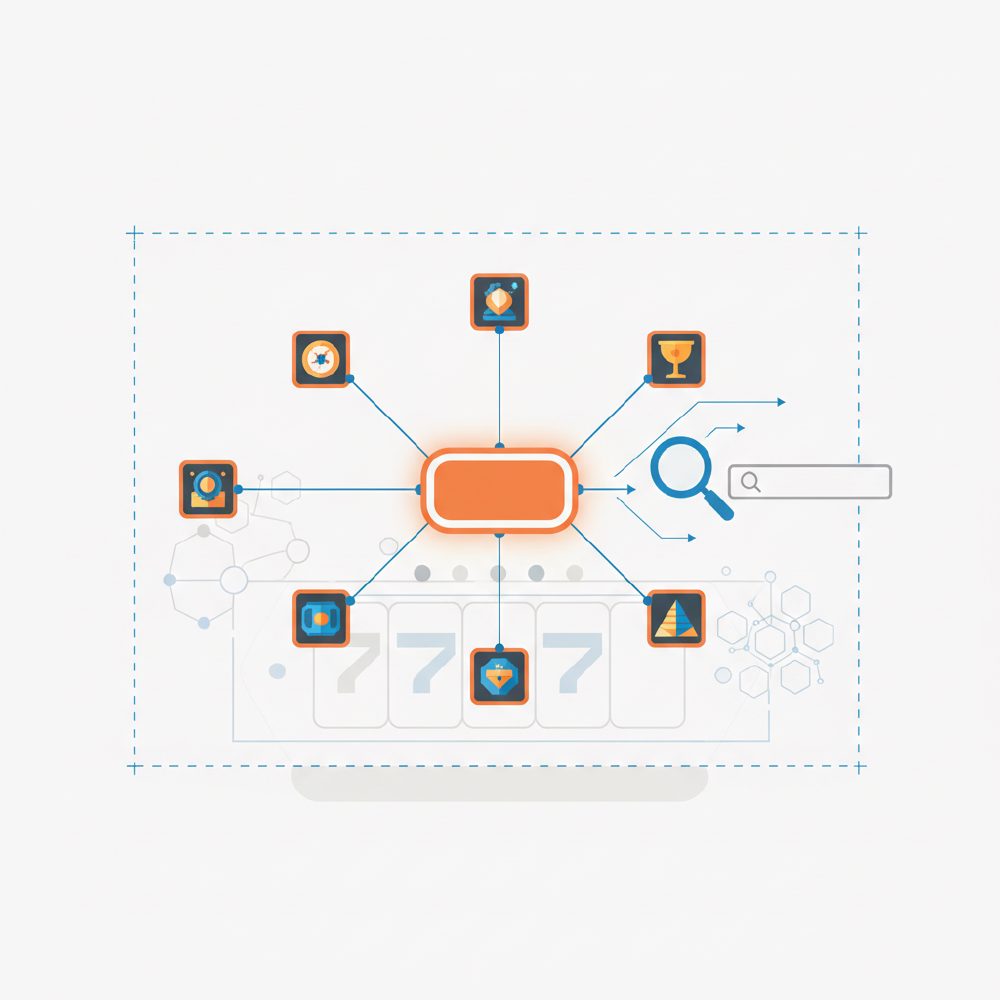
Why Do Slot Provider Pages Matter More Than Generic Slot Category Pages?
Provider pages target searchers who already know what they want, 'Pragmatic Play slots' or 'Hacksaw Gaming casino', which converts far better than generic 'online slots' traffic. These queries carry less competition from .gov and Wikipedia-style results, and they're the pages affiliate sites systematically under-build.
I've run this exact play three times on crypto-casino brands going from zero to five-figure monthly sessions, and the provider hub is almost always the fastest-moving page type in the cluster. A query like 'play Pragmatic Play slots crypto' has maybe 2,000-6,000 monthly searches globally depending on market, but the SERP is dominated by thin affiliate aggregator pages that list ten games and call it a day. That's a weak field. A real hub with proper depth beats that in 8-12 weeks on a domain with any authority at all.
Generic category pages, '/slots', '/live-casino', fight against every casino site on earth, including regulated .com brands with ten-year-old domains and DA 70+. Provider pages let you pick fights you can actually win. Nolimit City alone drives meaningful branded search volume because the studio has a cult following among high-volatility players; ranking for 'Nolimit City no verification casino' is a realistic target for a six-month-old crypto operator, while ranking for 'best online slots' is not, full stop.
There's also a trust signal angle. Google's helpful content systems reward sites that demonstrate real subject knowledge, and nothing demonstrates that faster than a provider page that correctly describes RTP ranges, volatility mechanics, and signature mechanics (tumble reels, xWays, xNudge) instead of regurgitating a press release. I've seen provider hubs outperform homepage rankings within the same site because they're simply more topically dense.
What Actually Belongs on a Provider Hub Page That Ranks?
A ranking provider hub needs unique studio history, mechanics explanation, a curated game grid with internal links, RTP/volatility data, a comparison to 2-3 competing studios, and provably-fair or licensing context relevant to crypto operators. Skip the boilerplate bio copied from the provider's press kit, Google devalues it instantly.
The structure I run across every build: a 150-200 word intro answering 'who is this studio and why does it matter here,' a mechanics section explaining what makes the studio distinct (Hacksaw's Fat Rabbit-style bonus buys versus Nolimit City's xSplit and xNudge mechanics), a filterable game grid of 20-60 titles linking to individual game pages, an RTP/volatility table, and a closing section on payment and verification, for crypto operators this is where you mention instant BTC/ETH/LTC deposits and no-KYC play since that's the actual differentiator search engines and users care about.
What kills most provider pages is copying the studio's own marketing language verbatim. Pragmatic Play's own press kit has been scraped onto thousands of affiliate and operator sites, Ahrefs' Content Gap tool will show you this instantly if you run five competitor provider pages side by side. I write every studio history section from primary sources: licensing registries (MGA, Curaçao, Kahnawake), interviews the studio's execs have given to iGaming trade press like SBC News or iGaming Business, and direct testing of the games themselves for volatility notes.
For crypto-focused operators specifically, add a provably-fair callout where relevant. Most traditional studios (Pragmatic, Play'n GO, Relax) aren't provably-fair, they're RNG-certified by labs like iTech Labs or GLI. Conflating the two is a credibility killer that savvy crypto players and AI answer engines alike will flag. Reserve 'provably fair' language for studios that actually publish seed verification, like Spribe's Aviator or in-house crash-game studios.
How Should Provider Pages Sit Inside Your Site Architecture?
Provider hubs need to sit one or two clicks from the homepage, under a /providers/ or /software/ directory, with reciprocal internal links to and from individual game pages and relevant slot category pages. Flat architecture beats deep nesting, Google deprioritizes crawl budget on pages buried four levels deep.
I standardize on /providers/pragmatic-play/ rather than /casino/games/slots/providers/pragmatic-play/ every time. Screaming Frog crawls routinely show crawl depth beyond level 3 correlating with indexation delays of weeks on newer domains, Google Search Console's Crawl Stats report will confirm this on your own site if you check 'pages not indexed' reasons. Flatten it.
The internal linking pattern that works: homepage links to a /providers/ index hub (not just footer links, a real contextual link from hero or category copy), the index hub links out to every studio page, and each studio page links down to 15-40 individual game pages plus laterally to 2-3 competing studios ('players who like Hacksaw also play Nolimit City'). That lateral linking does double duty, it keeps session depth up, which correlates with better engagement signals, and it distributes link equity across the whole cluster instead of pooling it on one hub.
Don't forget the reverse link. Every individual game page should link back up to its provider hub with the studio name as anchor text, not just 'learn more.' That anchor consistency is what lets the hub rank for the studio name itself instead of just the long-tail game titles. I run anchor ratio audits quarterly on client sites, exact-match studio-name anchors sitting at 8-15% of total internal anchors to a hub page is the sweet spot; above 20% and it starts looking manipulated even internally.
Which Providers Deserve a Dedicated Hub First?
Prioritize studios with high branded search volume and low existing SERP competition, Pragmatic Play, Hacksaw Gaming, Nolimit City and Relax Gaming first, followed by crypto-native studios like BGaming and Spribe that affiliate sites rarely cover in depth. Build 8-12 deep hubs before touching long-tail studios.
I run every new client through an Ahrefs Keywords Explorer pull for '[studio name] slots', '[studio name] casino' and '[studio name] no verification' across target markets before deciding build order. The pattern repeats across almost every crypto-casino project: Pragmatic Play and Hacksaw Gaming carry the highest absolute volume, but Nolimit City and Relax Gaming have the best volume-to-competition ratio because fewer sites bother writing real mechanics content for them.
Crypto-native and provably-fair studios, BGaming, Spribe, Endorphina, 7Mojos, are the real arbitrage opportunity for no-KYC operators specifically. Traditional affiliate sites built for regulated markets often skip these studios entirely because they don't appear in mainstream regulated catalogs. That's a wide-open lane. I've taken a BGaming hub page from nothing to page-one for 'BGaming crypto slots' in nine weeks on a domain with under 20 referring domains, purely because the competing SERP was three thin pages and a Reddit thread.
Resist the urge to build 80 provider pages in month one. Thin coverage across every studio in your lobby is worse than deep coverage on twelve. I set a rule: a studio gets a dedicated hub only if it drives at least 15 of your lobby's games or has standalone branded search volume above roughly 200/month in your core geo. Everything else gets folded into a lighter 'more providers' directory page until it earns a standalone build.
| Tier | Example Studios | Content Depth | Build Priority |
|---|---|---|---|
| Tier 1, flagship | Pragmatic Play, Evolution, Hacksaw Gaming | 1,500-2,500 words, full mechanics + RTP table | Build first, months 1-2 |
| Tier 2, high-intent niche | Nolimit City, Relax Gaming, Big Time Gaming | 1,000-1,500 words, mechanics focus | Months 2-3 |
| Tier 3, crypto-native | BGaming, Spribe, 7Mojos, Endorphina | 800-1,200 words, provably-fair angle | Months 2-4, high ROI/effort ratio |
| Tier 4, long-tail | Smaller studios, 5-15 games each | 350-500 words, lightweight template | Backlog, batch-built after Tier 1-3 |
How Do No-KYC Operators Approach Provider Pages Differently Than Regulated .com Brands?
No-KYC operators win provider-page rankings faster because established .com brands rarely optimize for crypto-specific studio queries or provably-fair framing, leaving that intent uncontested. Offshore sites should lean into instant-deposit speed, anonymity angles, and studios regulated brands can't legally offer.
A licensed UK or Ontario operator can't rank for 'no verification Pragmatic Play slots' even if they wanted to, regulatory requirements force full KYC, so the query intent doesn't match their business model and Google's systems increasingly pick up on that mismatch through engagement signals and bounce patterns. That leaves the entire no-KYC branded-studio SERP to offshore and crypto operators almost by default.
I write provider pages for crypto brands with a deliberate second layer of intent-matching: alongside the standard mechanics and game-grid content, I add a payments-and-verification section that directly answers 'can I play Pragmatic Play with Bitcoin and no ID.' That section alone often becomes the featured-snippet-winning paragraph because regulated competitors structurally can't produce an honest answer to that query.
The risk-benefit trade is different too. Regulated brands protect domain authority conservatively because a manual action threatens a licensed, revenue-critical asset tied to a real corporate entity. Offshore crypto brands can run more aggressive link velocity and tiered link structures on provider hubs because the downside of a temporary ranking drop is lower relative to upside, though I still won't push raw PBN links directly at a money page; tier it through a buffer layer of niche-relevant microsites first.
| Factor | Regulated .com Brand | No-KYC Crypto Operator |
|---|---|---|
| Query intent coverage | Can't target no-verification queries legally | Owns the no-verification query set |
| Link risk tolerance | Conservative, protects licensed asset | Can run higher link velocity on secondary domains |
| Studio coverage | Limited to regulated-market certified studios | Can cover crypto-native studios competitors ignore |
| Content differentiator | RNG certification, responsible gambling framing | Provably-fair framing, instant crypto payout speed |
What's the Right Keyword Strategy for Provider-Specific Slot Pages?
Target a cluster per provider: branded head term, 'play [studio] slots free/real money,' '[studio] no verification,' and 2-4 flagship game names. Don't try to rank the hub for individual slot titles, give each flagship game its own page and let the hub rank for the studio-level terms instead.
The mistake I see constantly on audits: one page trying to rank for the studio name and every individual slot title simultaneously. 'Fat Rabbit' and 'Dog House Megaways' deserve their own pages because they have standalone search volume, Dog House Megaways alone pulls meaningful branded search in several markets. Cramming them into the provider hub dilutes topical focus and you end up ranking for neither.
I build the keyword map in Ahrefs or SEMrush with three tiers per provider: the branded head term ('Pragmatic Play'), the commercial-intent modifier set ('Pragmatic Play slots real money,' 'Pragmatic Play crypto casino,' 'Pragmatic Play no verification'), and the flagship-game long tail that gets spun off into standalone pages with a canonical link back to the hub. This keeps the hub lean around 15-25 target keywords instead of the 200-keyword kitchen-sink pages I still see on client sites from previous agencies.
Watch search intent shifts by market. In LATAM, 'tragamonedas Pragmatic Play' outperforms direct English-to-Spanish translation of US terms, and in markets like the Philippines or parts of Southeast Asia, GCash and crypto-adjacent payment modifiers attach directly to studio queries. Don't run one English keyword set and machine-translate it across five geos, that's how you end up with unnatural anchor phrasing that reads badly to both users and to quality raters evaluating E-E-A-T.
How Do You Avoid Thin and Duplicate Content Across Hundreds of Provider and Game Pages?
Template the structure, never the sentences. Use a content framework with mandatory unique fields per page, mechanics description, RTP source citation, a tested gameplay note, and run Screaming Frog's near-duplicate content check before every batch publish to catch over-80%-similarity pages before Google does.
This is the number-one reason I see casino sites catch helpful content system demotions. Someone built a template, filled in the studio name and logo, left every sentence structure identical across forty provider pages, and wondered why traffic cratered after a core update. Google's systems are explicitly tuned to detect exactly this pattern, scaled content production with no added value, and casino/affiliate-adjacent niches get extra scrutiny because it's one of the most abused patterns in the vertical.
My workaround: build the template around mandatory unique data points rather than unique prose per se. Every provider page must include a game count pulled from the actual lobby (not a stock number), a studio-specific mechanic explained in plain language, a real RTP range with the source named (studio's own published RTP sheet, or a regulator filing where available), and ideally a first-person note from actually testing 3-5 of the flagship titles, volatility feel, bonus frequency, max win hit rate if you've logged it.
For the long-tail Tier 4 studios where 1,500-word depth isn't justified, I still refuse pure spin-template duplication. A 400-word page is fine if every sentence is factually specific to that studio, founding year, headquarters, certification body, game count, one standout title. I run a Screaming Frog near-duplicate report before every content batch goes live; anything flagging above roughly 75-80% textual similarity to another URL on the same domain gets rewritten before publish, not after indexing.
What Link-Building Tactics Actually Move Provider Hub Rankings?
Niche edits on existing iGaming and crypto content sites, crowd marketing on forums where players already discuss specific studios, and tiered links through expired-domain PBNs feeding a buffer layer all work. Avoid direct mass link blasts at money pages, build authority through a middle tier first.
For provider hubs specifically, the highest-ROI tactic I run is niche edits into existing content that already discusses the studio, a crypto-news site's piece on 'top iGaming studios 2026' or a Reddit-adjacent forum thread about Nolimit City volatility gets a contextual edit linking to my client's hub with the studio name as anchor. These convert well because the surrounding content is already topically relevant; Google's link graph rewards that contextual match more than a generic guest post footer link ever will.
Expired-domain acquisition still works for building a tier-2 buffer layer, but I never point those domains directly at a client's money page anymore, too easy to pattern-match post-Penguin and across the various spam link updates Google's run since. The structure I use: expired domains with real historic authority in gambling-adjacent or crypto-adjacent niches get rebuilt with genuinely unique content, those sites link into a tier-2 layer of niche blogs and review aggregators, and that tier-2 layer links into the provider hub with varied, mostly branded or naked-URL anchors. It's slower, figure 90-120 days to see the authority flow through, but it survives algorithm churn that kills direct-blast link schemes within a single update cycle.
Crowd marketing earns its keep on provider pages because studio fandoms are real, Nolimit City and Hacksaw Gaming both have dedicated Reddit communities and Telegram groups where players debate volatility and bonus buy math obsessively. A handful of genuinely useful, non-spammy mentions with a hub link in relevant threads drives both referral traffic and a natural-looking link profile that no manual reviewer flags. I keep this to maybe 5-10% of total link volume per hub, enough for signal diversity, not enough to look like coordinated seeding if someone checks.
What Technical SEO Mistakes Kill Provider Hub Pages Before They Rank?
Faceted navigation generating infinite URL parameter combinations, missing or incorrect canonical tags across paginated game grids, and absent Game/ItemList schema are the three most common technical failures. Fix canonicals and schema before chasing more content or links.
Faceted filters, sort by RTP, volatility, theme, release date, are useful for users but catastrophic for crawl budget if every combination generates a unique indexable URL. I've audited sites with 40,000+ indexed URL variants for a single provider page because of unmanaged filter parameters. Fix it with a canonical tag pointing every filtered variant back to the clean hub URL, and block the parameter patterns in robots.txt or handle them via GSC's URL parameter tool where still applicable, plus noindex on anything that shouldn't be a landing page at all.
Schema markup gets skipped constantly on provider pages even though it's cheap to implement and directly feeds AI answer engines that are increasingly where studio-related queries get answered. I implement Organization schema for the provider entity itself, ItemList schema for the game grid, and individual Game schema (where applicable fields exist) on each linked slot page with ratings, release date, and provider relationship marked up explicitly. This is also exactly the structured signal that helps Perplexity, Google AI Overviews and ChatGPT's browsing mode cite your page correctly when a user asks 'which crypto casinos have the most Nolimit City games.'
Pagination on large game grids (anything past 40-60 games per studio) needs careful handling too, I either load-more via JS with server-rendered fallback content indexable in the initial HTML, or paginate with self-referencing canonicals on each page and a clear rel link relationship, never infinite scroll with client-side-only rendering that Googlebot has to execute JS to even discover. Screaming Frog with JS rendering enabled will show you immediately whether your game grid is actually crawlable or just looks fine in a browser.
How Long Does It Take Provider Pages to Rank and What's a Realistic Timeline?
On a domain with some existing authority, expect initial indexation within 1-2 weeks, meaningful keyword movement by week 6-10, and stable page-one positions for mid-competition studio terms by month 4-6. New domains with no link history should budget 6-9 months for the same result.
I set client expectations in three phases. Phase one, weeks 1-4: publish, get indexed via GSC URL inspection submission, start internal linking from day one so Google's crawlers find the hub through normal site discovery rather than relying solely on manual submission. You'll usually see the page appear in results somewhere beyond page 3 within this window if the domain has any crawl history at all.
Phase two, weeks 6-12, is where the real work shows up, this is when the initial batch of niche edits and tier-2 link flow starts registering in Ahrefs' rank tracker, and you'll typically see movement from page 3-5 into page 1-2 for the mid-competition terms (studio name plus a modifier) before the pure branded head term moves. The flagship branded term, just '[studio name] slots' with no modifier, is usually the last thing to rank because it's competing against the studio's own official site and major aggregators with a decade of authority.
Phase three, months 4-9, is consolidation. This is when well-built hubs on domains I've worked with hit stable top-5 positions for their full keyword set and start pulling in the secondary benefit, ranking for queries you didn't directly target because of topical authority spillover, like 'is Nolimit City provably fair' showing up as a related ranking even if you never wrote that exact phrase as an H2. Brand-new domains with zero link history should roughly double every one of these timelines, and I won't promise page-one rankings inside 90 days on a domain registered this year regardless of content quality, that's a link-authority problem, not a content problem.
| Phase | Timeframe | What Happens | Established vs New Domain |
|---|---|---|---|
| Indexation | Weeks 1-4 | Page indexed, internal links discovered | Similar for both |
| Early movement | Weeks 6-12 | Mid-competition terms reach page 1-2 | New domains lag 2-3x |
| Branded head term | Months 3-6 | Studio-name-only terms reach top 10 | New domains: months 6-12 |
| Consolidation | Months 4-9 | Topical spillover, stable top-5 positions | New domains: 9-15 months |




Comments
No comments yet, be the first.