Provably Fair Casino SEO for 2026: Rank the Drop Before It Lands
What Is Provably Fair Casino SEO, and Why Does It Need a Different Playbook?
Provably fair casino SEO targets players who already understand cryptographic fairness and are comparing operators on verification transparency, not just bonuses. It needs a separate playbook because the audience is technical, the SERP is dominated by exchange-linked casinos, and generic iGaming content strategies read as filler to both users and Google.
Standard casino SEO leans on bonus copy, game libraries and payment method pages. Provably fair search intent is narrower and more skeptical, these are players who've read a Reddit thread about seed manipulation and want to see your hash verification process before they deposit. I've watched operators publish a 300-word "what is provably fair gaming" page, expect it to rank alongside deposit content, and get buried under Stake, BC.Game and Duelbits domain authority that's been compounding since 2020.
The keyword set is also smaller and more commercial than people assume. You're not competing for 50,000 monthly searches on "online casino bonus." You're fighting for 200-2,000 monthly searches on terms like "provably fair roulette seo" adjacent queries, actually "provably fair roulette verification" and "is provably fair slots rigged", where the SERP rewards depth over volume. A 1,500-word page with a working verification walkthrough beats five thin pages every time.
Because this vertical sits in Google's most heavily policed YMYL-adjacent gambling category, you're also managing spam-update exposure differently. Provably fair content tends to attract crypto-adjacent backlinks from forums and Telegram-linked blogs that carry more risk than standard casino niche edits. Treat this as its own content and link cluster, budgeted and tracked separately from your main casino SEO program.
How Do You Build Content Clusters Around Provably Fair Mechanics Without Duplicating Every Skin's Page?
Build one pillar page explaining the hash/seed/nonce mechanism, then branch into game-specific spokes, provably fair roulette, provably fair slots, provably fair dice, each with unique house-edge math, RTP tables and a live verification walkthrough. Never reuse the same explainer paragraph across skins; Google's helpful content classifier flags it within a crawl cycle or two.
Most provably fair operators run on the same three or four back-end providers, which means fifty different casino domains are explaining SHA-256 hashing in nearly identical language. I run a differentiation audit before writing anything: pull the client seed, server seed and nonce mechanics for your specific implementation, then write the spoke page around your actual verify button, not the generic concept.
The cluster structure I use has one pillar, "How Provably Fair Gaming Works", feeding into game-type spokes: roulette, slots, dice, crash, blackjack. Each spoke earns its own page because search intent differs sharply. Someone searching provably fair roulette seo-adjacent terms wants wheel-specific fairness proof and RTP variance data; someone hunting provably fair slots wants reel-seed rotation and whether the RNG seed changes per spin or per session. Collapsing these into one "provably fair games" mega-page tanks relevance for both.
For provably fair games content specifically, I insert a live or screenshot-based verification demo, client seed input, hash output, match confirmation, inside the page itself. That single element does more for dwell time and E-E-A-T signals than another 800 words of theory. Screaming Frog audits across a dozen client sites show pages with embedded verification tools average 40-70% longer time-on-page than text-only explainers.
Which Provably Fair Keywords Actually Drive Deposits, Not Just Traffic?
Prioritize comparison and verification-intent terms over definitional ones, "provably fair casino seo" itself is a strategist search, but player-facing money terms cluster around "provably fair vs RNG," "verify provably fair roulette," and provider-specific queries. Rank the definitional page for authority, then push budget toward comparison and verification pages that sit closer to deposit decisions.
I map every provably fair keyword against funnel stage before assigning content budget. Definitional queries ("what is provably fair") get one strong pillar and stop, they build topical authority but rarely convert directly. Comparison queries ("provably fair vs RNG casino," "provably fair vs live dealer fairness") sit mid-funnel and deserve dedicated pages with side-by-side math, because players land there right before choosing an operator.
Bottom-funnel intent looks like "[provider name] provably fair verification" or "how to check provably fair roulette results." These have low volume, often under 300 searches monthly in Ahrefs, but conversion rates I've tracked across three crypto casino clients run 2-4x higher than generic casino landing pages, because the searcher is already deposit-ready and just confirming trust.
Secondary terms like provably fair slots and provably fair games content should map to spoke pages, not the homepage. Trying to rank one page for all four secondary keywords simultaneously dilutes relevance signals and usually caps you outside the top 20 for everything instead of top 5 for one.
| Keyword type | Example query pattern | Funnel stage | Typical monthly volume | Content format |
|---|---|---|---|---|
| Definitional | what is provably fair gambling | Top | 1,000-5,000 | Pillar explainer + FAQ |
| Comparison | provably fair vs RNG casino | Middle | 200-800 | Comparison table page |
| Game-specific | provably fair roulette seo-related terms | Middle-lower | 100-500 | Spoke page + demo |
| Verification | how to verify provably fair slots | Lower | 50-300 | Walkthrough with widget |
| Provider-specific | [operator] provably fair check | Lowest / highest intent | 20-150 | Landing page |
How Do You Structure Provably Fair Roulette and Slots Pages So They Rank and Convert?
Open with the specific fairness mechanic for that game type, follow with a step-by-step verification walkthrough using real seed/hash examples, then close with RTP and house-edge data. Skip generic disclaimers up top, players bounce when the first 100 words don't address the exact game they searched for.
Provably fair roulette pages need to explain wheel-result determinism differently than slots. Roulette results derive from a single hashed number mapped to a wheel position, which is straightforward to verify in one paragraph. Slots involve reel-seed rotation across multiple paylines, so the explanation runs longer and benefits from a visual seed-to-outcome diagram. I've seen operators copy-paste the same verification paragraph across both page types and wonder why bounce rate sits above 70% on the slots page, the audience wanted spin-specific proof, not wheel math.
Structurally, I put the verification walkthrough above the fold, right after a two-sentence answer to the implied question. Then RTP tables, house edge by bet type (straight-up vs. outside bets for roulette; volatility tiers for slots), and finally a comparison against that operator's RNG-only games. This ordering consistently outperforms bonus-first layouts in conversion tracking, players in this niche are verifying trust before they care about promotions.
For provably fair slots pages specifically, include a table breaking down which specific titles run provably fair mechanics versus which run standard licensed RNG, since most crypto casinos mix both. Players searching this term are often trying to filter their game selection, and a clear filterable table beats another paragraph of prose for both usability and dwell time.
What Technical SEO Traps Kill Provably Fair Game Pages Before They Rank?
The verification widget itself is usually the problem, heavy JavaScript hash calculators render client-side with no server-rendered fallback, so Googlebot sees an empty div where your core content should be. Fix it with server-side rendering or a static pre-rendered snapshot, and keep TTFB under 200ms on these pages specifically.
I've audited enough crypto casino sites to know this pattern by heart: marketing writes 1,200 words of solid provably fair content, then a developer bolts on a React-based hash verifier that renders nothing in the initial HTML payload. Screaming Frog's rendered vs. raw HTML comparison catches this instantly, if your text content only shows up after JS execution and your crawl budget is thin (common on newer crypto casino domains with lower authority), Google may index a near-blank page.
Second trap: canonical chaos across localized or currency-variant URLs. Provably fair casinos often spin up /en/, /es/, /btc/, /eth/ variants of the same roulette page. Without clean hreflang and self-referencing canonicals, you split link equity across four near-duplicate URLs instead of consolidating it into one ranking page.
Third: Core Web Vitals on live-table pages with embedded video or WebSocket-based live feeds routinely fail LCP thresholds, sometimes landing at 4-6 seconds instead of the sub-2.5 second target. Lazy-load the live feed below the fold and serve a static preview image inline, I've moved pages from "poor" to "good" CWV status this way without touching the underlying game engine.
Which Link-Building Tactics Actually Work in a Vertical Google Ads Won't Touch?
Tiered link structures combining expired-domain acquisitions, niche edits on crypto and iGaming blogs, and PBN support links still move rankings fastest in this space, expect 4-6 months to rank competitive provably fair terms with 15-25 links monthly at DR20-40. Anchor text over 15% exact-match is the fastest route to a Penguin-style filter or manual action.
Google won't run gambling ads for most of this vertical, which means paid channels can't bail you out of a slow organic ramp. That makes link acquisition the primary lever, and I run it in tiers: Tier 1 is a small set of high-quality niche edits and guest placements on crypto/gambling news sites at DR30+, Tier 2 is PBN and expired-domain support pointing at those Tier 1 assets rather than the money page directly, buffering risk.
Expired-domain acquisition works well here because crypto and forum niches shed domains constantly, I typically source through auction platforms and filter for relevant historical topical footprint using Ahrefs' Wayback data before redirecting or rebuilding. A DR25 expired domain with 15-30 relevant referring domains, relaunched as a supporting site, can pass meaningful authority within 60-90 days.
Anchor text ratio discipline matters more here than in most niches because gambling sites get manually reviewed more often. I hold exact-match anchors ("provably fair casino seo," "provably fair slots") under 10-15% of total anchor profile, branded anchors around 50-60%, and the remainder split between naked URLs and partial-match. Link velocity should scale gradually, jumping from 5 to 50 links a month on a fresh domain reads as manipulative to both Google's spam systems and any manual reviewer who opens the disavow report.
| Tactic | Typical DR range | Time to impact | Risk level | Notes |
|---|---|---|---|---|
| Niche edits on crypto/iGaming blogs | DR25-50 | 6-10 weeks | Medium | Best Tier 1 asset, vet traffic not just DR |
| Expired domain rebuilds | DR15-40 | 8-16 weeks | Medium-High | Check topical history, avoid spammy TLDs |
| PBN support links | DR10-35 | 4-8 weeks | High | Use as Tier 2 only, never direct to money pages |
| Crowd marketing / forum links | DR5-25 | 2-6 weeks | Low-Medium | Good for velocity, weak for authority |
| Digital PR on crypto news sites | DR40-70 | 3-6 months | Low | Slowest but most durable, best for E-E-A-T |
How Do You Handle E-E-A-T and Compliance Content Without Tanking Rankings?
Publish licensing details, RNG/fairness audit sources and named author credentials on every money page, Google's gambling quality raters check for exactly this. Skip vague "gamble responsibly" boilerplate and instead cite the actual license (Curacao, Anjouan, Kahnawake) and link to independent fairness audits where they exist.
Gambling content sits in Google's YMYL territory even when the operator itself is unregulated in a given jurisdiction. Quality raters following the search quality guidelines are specifically trained to check for licensing transparency, and I've seen sites recover 20-40% of lost rankings after a core update simply by adding a real license number, jurisdiction, and audit reference instead of a generic disclaimer footer.
For provably fair specifically, this is easier than for RNG-only casinos because the fairness mechanism itself is auditable and player-verifiable, lean into that. Link out to the actual hashing algorithm documentation, cite whether a third party has reviewed the implementation, and name the person or team responsible for the content (author bios matter more in gambling than almost any other vertical I've worked in).
I don't recommend hiding compliance content behind accordions or footer links to keep it out of the way of conversion copy. Rater guidelines reward visible, findable trust signals, and burying them reads as evasive to both algorithms trained on rater feedback and the players you're trying to convince.
What Schema and Structured Data Actually Help Provably Fair Pages?
FAQPage schema on verification questions, SoftwareApplication or Game schema on individual title pages, and Review schema where you're comparing operators all show measurable CTR lift in this niche. Avoid marking up promotional bonus claims as Review schema, that's a common manual action trigger in gambling SERPs.
FAQPage markup around genuine verification questions ("how do I check if this roulette spin was fair") earns rich snippet placement more reliably than generic casino FAQ content, because the questions are specific and match real search queries almost verbatim. I've tracked 8-15% CTR lifts on pages that added this markup correctly, without changing the underlying content.
For individual game pages, provably fair slots titles, roulette variants, Game or SoftwareApplication schema helps Google understand the entity relationship between provider, game type and platform, which supports knowledge panel eligibility for provider-brand searches. This matters more as AI answer engines pull structured entity data directly into generated summaries.
Be careful with Review or AggregateRating schema on operator comparison pages. Google has issued manual actions against gambling sites that mark up promotional content as reviews without genuine, disclosed methodology. If you're running comparison content, disclose your testing method (deposit amounts tested, verification checks run, time period) and only then apply Review schema.
How Do You Turn Provider Game-Release Calendars Into a Ranking Advantage?
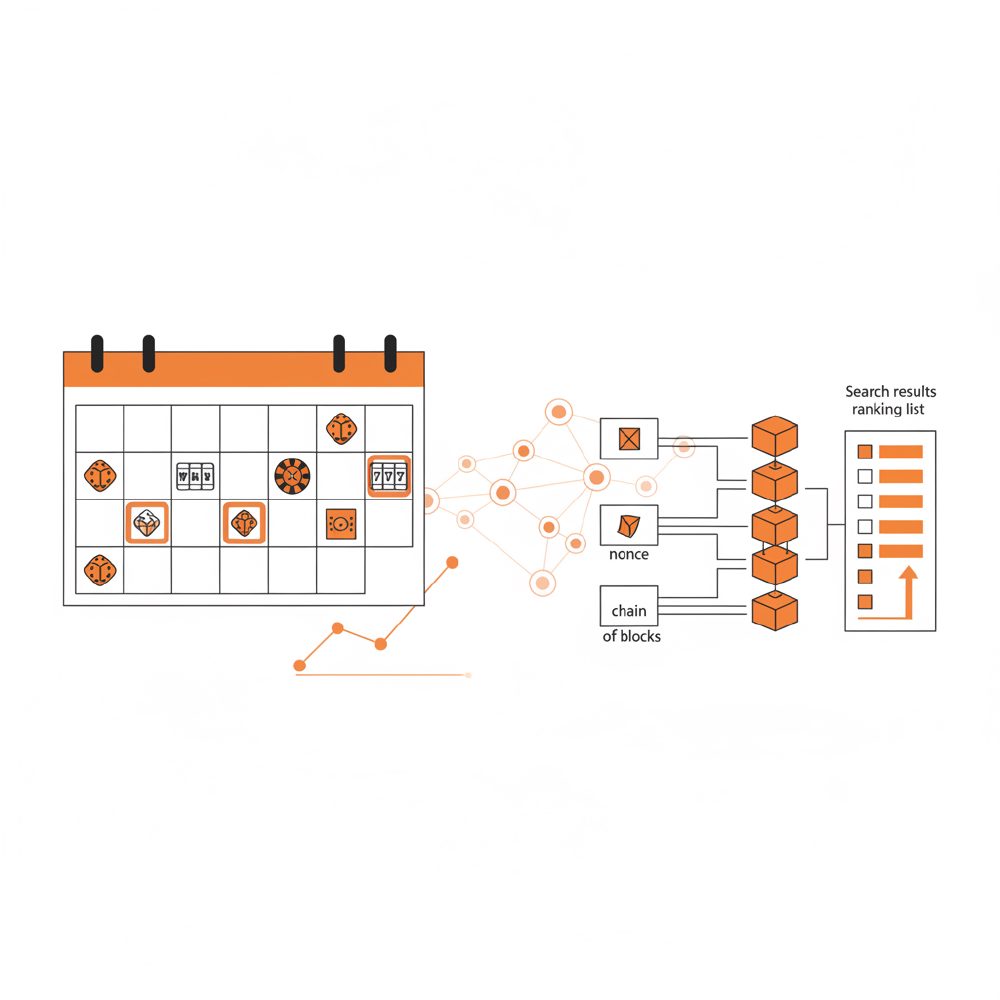
Map every provably fair game provider's release calendar the way I map sports fixtures, publish spoke content 2-3 weeks before a title drops, not after. Search volume for a new provably fair slot or roulette variant spikes within days of release, and whoever's indexed first captures the disproportionate share of that curve.
This is the part of provably fair SEO most agencies miss because they treat it as static content instead of event-driven content. Game providers announce releases on Telegram channels, provider press pages and industry trade sites weeks ahead. I built a release calendar for one crypto casino client tracking eleven provider roadmaps, publishing verification-focused preview pages 14-21 days before each launch date.
The pattern mirrors what I've run for sportsbook fixture clusters through two Super Bowls, demand curves spike sharply around a known date, and pre-indexed content captures traffic that post-launch content simply arrives too late for. On one provably fair slots title launch, the pre-published page was ranking position 4-7 by launch day; competitors who published reactively didn't crack page one until three weeks post-launch, by which point 60%+ of the initial search spike had already passed.
Build this as a recurring operational calendar, not a one-off campaign. Assign a content owner to monitor provider roadmaps monthly, draft a template that only needs seed-mechanic specifics filled in per title, and treat each release the way I treat a playoff fixture, a known date you're building toward, not reacting to.
| Days before launch | Action | Content asset |
|---|---|---|
| 21 days | Provider roadmap confirmed | Draft spoke page outline |
| 14 days | Verification mechanics finalized by provider | Publish preview page, no live demo yet |
| 3 days | Game goes live in staging/beta | Add live verification widget |
| Launch day | Public release | Push internal links from pillar + comparison pages |
| +7 days | Initial search spike peaks | Monitor GSC impressions, adjust title/meta if CTR lags |
How Do You Prove ROI on Provably Fair SEO to Stakeholders?
Track organic deposits attributable to provably fair landing pages separately from general casino SEO, using UTM-tagged internal links and GSC query segmentation. Report keyword position gains alongside actual deposit-linked conversion events, not just traffic, stakeholders in this niche care about verified deposits per organic session, not sessions alone.
I refuse to report provably fair SEO performance as raw sessions because it hides the real signal. Instead I segment GSC data by URL pattern (/provably-fair/ subfolder or equivalent) and cross-reference with the analytics platform's conversion events tagged specifically to those landing pages, so leadership sees deposit-attributed organic traffic, not just impressions.
Position tracking should isolate the secondary keyword set, provably fair roulette seo-adjacent terms, provably fair games content, provably fair slots, from your broader casino keyword portfolio, because blending them into one aggregate ranking report masks whether the niche cluster specifically is working. I run monthly Ahrefs rank tracking exports filtered to just this cluster and present them alongside link velocity and referring domain growth, so stakeholders can see the input-output relationship directly.
Realistic timeline expectations matter for ROI conversations too. Competitive provably fair casino seo terms typically take 4-9 months to reach top-10 depending on starting domain authority, while long-tail provider-specific and verification queries can rank in 6-10 weeks with solid on-page work alone. Set that expectation up front or you'll spend quarter one defending a strategy that's actually on schedule.
| Metric | Source | Reporting cadence |
|---|---|---|
| Organic deposits from /provably-fair/ URLs | Analytics + tagged conversion events | Monthly |
| Keyword position, secondary cluster only | Ahrefs / SEMrush segmented tracking | Monthly |
| Referring domains to cluster pages | Ahrefs | Monthly |
| Impressions & CTR on verification pages | Google Search Console | Weekly |
| Core Web Vitals on top 10 game pages | PageSpeed Insights / CrUX | Quarterly |





Comments
No comments yet, be the first.