Geo-Cloaking Gambling in 2026: The Deposit-vs-Deindex Risk Calculus
What Is Geo-Cloaking in Gambling Gambling SEO, and Why Do Operators Use It?
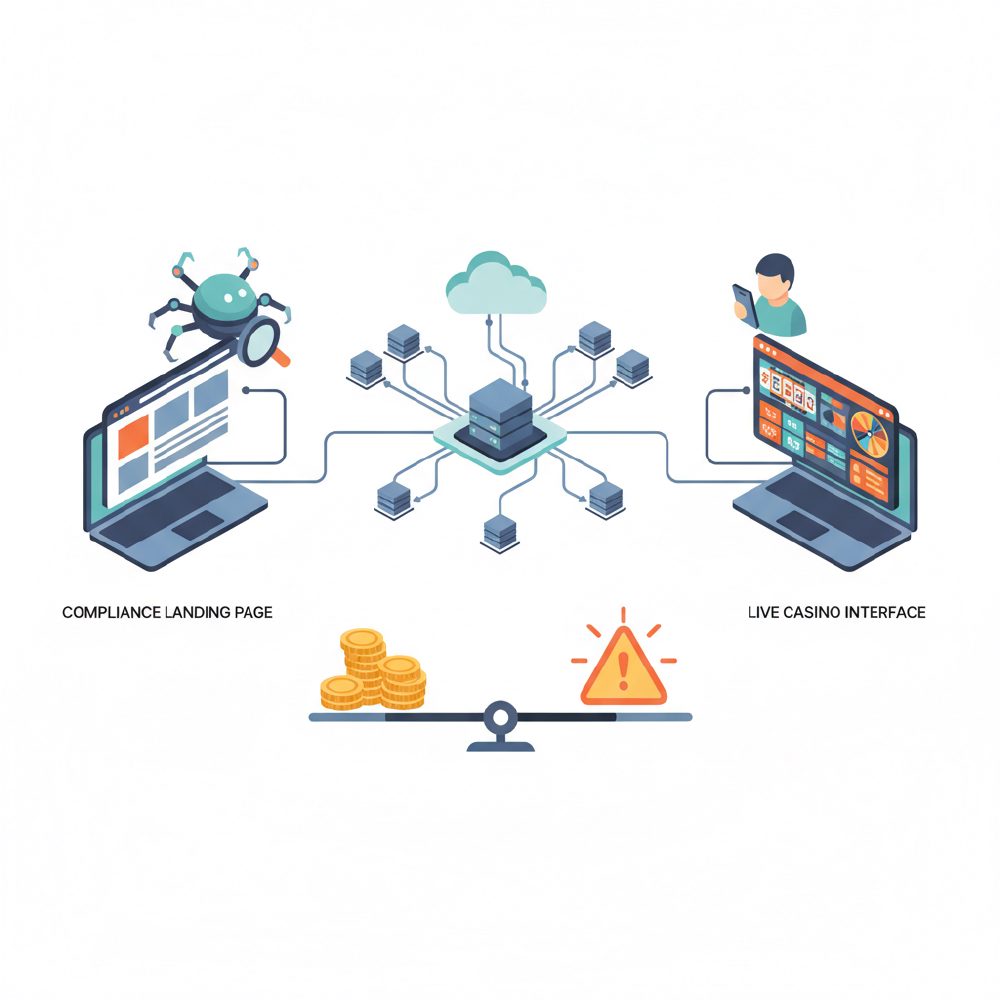
Geo-cloaking serves Googlebot a compliant 'coming soon' or informational page while routing real visitors, identified by IP and geolocation database, to the live casino or sportsbook. Operators use it to rank for high-intent gambling keywords in markets where the actual product is restricted or unlicensed, capturing search demand before regulation or geo-blocking catches up.
I've run this play myself, years back, on a .com targeting US search volume before a state went live with regulated online casino. The setup: Googlebot and any US-tagged crawler IP got a static, brand-safe landing page, age gate, responsible gambling copy, no live tables. Real visitors detected as coming from Curaçao-facing traffic or a specific ASN got server-side redirected straight into the licensed offshore product. It worked. For eleven weeks.
The mechanism is almost always IP-based lookup against a database like MaxMind's GeoIP2, cross-referenced against a known list of crawler user-agents and IP ranges published (and constantly updated) by Google. Cheaper builds skip the crawler-IP check entirely and just detect user-agent strings, which is the fastest way to get caught, because Google now renders pages from rotating cloud IPs specifically designed to look like normal traffic.
Why operators still do it: gambling keyword demand in gray markets is enormous and PPC is closed to you, Google Ads and Bing Ads gate gambling advertisers behind certification that many offshore brands can't or won't obtain. Organic is the only channel left with real volume, and cloaking is the fastest way to occupy page-one real estate for a product that technically shouldn't be indexable in that geography at all.
What's the Difference Between Doorway Pages and Legitimate Geo-Targeted Landing Pages?
Doorway pages exist purely to rank and funnel traffic elsewhere, dozens of near-identical city or state variants with 250-400 words of thin content. Legitimate geo-landing pages have unique licensing disclosures, region-specific payment rails and bonus terms, and serve identical content to bots and humans. The test: would the page exist if it couldn't rank?
I audit this constantly for prospective clients. A classic doorway network looks like 'online casino + [50 city names]' built off one template, swap the city name, swap one sentence, ship. Word count sits under 400, internal links all point to one money page, and there's zero unique regulatory or payment content per page. That's the pattern Google's spam policy names outright as a doorway page, and it's been a documented violation since the original doorway-pages guideline in 2011, reinforced hard in the March 2024 core/spam update sweep.
A legitimate geo page for, say, an AGCO-licensed Ontario brand, carries the actual license number, French-language toggle for Quebec-adjacent compliance, Interac and Paysafecard as payment options specific to that market, and RG resources with the correct provincial helpline. That page earns its rank because the content genuinely differs by jurisdiction, it's not duplicated logic wearing a city name as a costume.
The line Google draws isn't 'does this page mention geography', it's whether the page adds real, non-duplicated value for that specific audience. If you can't answer what's unique about the Ohio version versus the Michigan version beyond the H1, you've built a doorway page, not a geo-targeted asset, and you should expect it treated accordingly.
How Does Google Detect Gambling Cloaking, and What Triggers a Penalty?
Google detects cloaking through cloud-rendered fetches from multiple geographies and IP ranges that mimic real users, competitor and player spam reports (heavily used in gambling because the vertical is cutthroat), and pattern-matching against known doorway templates. Triggers include manual actions from the Trust & Safety team and algorithmic demotions rolled into spam updates.
Google's crawling infrastructure doesn't just hit your server from one predictable Mountain View IP anymore. It renders pages from distributed data centers and, for high-risk verticals like gambling, runs secondary fetches specifically designed to check for parity between what the crawler saw and what a real user in that region would see. If your redirect logic keys off user-agent string alone, you're detected within days, not weeks.
The bigger threat in this vertical is human, not algorithmic. Gambling affiliates and competing operators watch each other's SERPs obsessively, and Google's spam report form gets used as a competitive weapon constantly, I've had competitors report my own client campaigns within 48 hours of a page breaking into top 3. Once a report lands with enough corroborating evidence (screenshots of crawler view vs. VPN view from the reported region), it routes to manual review fast.
Once flagged, you'll see it in Search Console under Security & Manual Actions, labeled specifically as 'Cloaking' or 'User-generated spam' depending on the vector. Algorithmic hits are quieter, no notification, just a sudden 60-90% traffic collapse on affected URL clusters that coincides with a known spam or core update date. Either way, in gambling, the review is stricter than almost any other YMYL category because Google's own quality raters are trained to treat gambling as high-harm-potential content.
| Detection Vector | Typical Time to Flag | Who Triggers It |
|---|---|---|
| User-agent-only detection | 3-14 days | Automated rendering crawlers |
| Competitor/affiliate spam report | 24-72 hours after report | Rival operators, affiliates |
| Template pattern matching | 2-6 weeks | Google spam algorithms |
| Manual quality rater review | 4-10 weeks | Human search quality team |
| Core/spam update sweep | Tied to update rollout dates | Algorithmic, batch |
What Does a Gambling Cloaking Penalty Actually Cost You in Deposits?
In my experience, a manual action on a cloaking-based gambling site drops organic-driven deposits 70-90% within two to three weeks, and reconsideration cycles run 6-10 weeks minimum. During that window paid CPA in gambling ($150-$400 for tier-1 casino/sportsbook traffic) has to cover the entire gap or the P&L bleeds.</p>
I frame every SEO decision as a revenue decision, and cloaking penalties are the clearest example of why. Say a domain drives 40 organic deposits a day at a $200 average lifetime value in year one, that's roughly $8,000 a day, $240,000 a month, riding on rankings that a cloaking detection can zero out overnight. There's no graceful degrade. You go from page-one visibility to deindexed or buried past page five in the same crawl cycle.
The recovery math is worse than operators expect. Even after a successful reconsideration request, and Google's gambling-vertical reconsiderations run slower than most, often 8-10 weeks versus the 2-4 weeks typical in other niches, you don't snap back to prior rankings. Trust signals in the algorithm decay slowly and rebuild slowly; I generally tell clients to budget for 30-60% of pre-penalty organic deposit volume in the first 90 days post-recovery, climbing back toward baseline over 6-9 months if the rest of the site is clean.
That's before counting the opportunity cost of the domain itself. A penalized domain often can't be fully rehabilitated for its original purpose, I've moved clients to a fresh domain entirely rather than fight a damaged one back to parity, which means eating the link equity and domain-age advantage you'd built, sometimes 18-24 months of accumulated authority, gone in a single algorithmic action.
Manual Action vs Algorithmic Demotion: Which Cloaking Penalty Hits Harder?
Manual actions are visible in Search Console, apply site-wide in most gambling cases, and require an explicit reconsideration request to lift. Algorithmic demotions give no notification, hit URL clusters rather than the whole domain, and lift automatically once the offending signal is removed and the next relevant update or refresh crawl processes the fix.
Operators often assume algorithmic hits are 'safer' because there's no scarlet letter in Search Console. In practice they're harder to diagnose, because nothing tells you what happened, you're reverse-engineering a traffic graph against a public list of confirmed update dates. Manual actions are brutal but at least honest: you know exactly what Google flagged and exactly what evidence they're citing.
Full deindexing is the nuclear version of a manual action, reserved for sites Google decides are operating in bad faith at scale, think entire PBN networks of doorway pages feeding one money site. I've seen this applied to gambling doorway networks running 200+ near-duplicate city pages; the whole domain, not just the doorway cluster, gets pulled from the index within 48 hours of the manual action posting.
The practical takeaway: if you're running geo-routing at any scale, monitor both channels, set up Search Console alerts for manual actions and track organic sessions by URL cluster weekly in GSC's performance report so an algorithmic demotion shows up as a graph anomaly, not a mystery three months later.
| Penalty Type | Notification | Scope | Typical Recovery Path |
|---|---|---|---|
| Manual action (cloaking) | Search Console message | Usually site-wide in gambling | Fix + reconsideration request, 6-10 weeks |
| Algorithmic demotion | None, inferred from traffic graph | Affected URL cluster only | Remove cause, wait for next relevant crawl/update |
| Full deindexing | Search Console message | Entire domain | Root-and-branch rebuild, often new domain advised |
Is Compliant Geo-Routing SEO Possible Without Tripping Spam Filters?
Yes, server-side geo-routing is explicitly permitted when the content served to crawlers and users is functionally identical and licensing status isn't hidden. Google's spam policy targets the intent to deceive, not the redirect mechanism itself, so a consistent, disclosed geo-split for legal compliance stays clean.
The distinction that keeps compliant geo-routing safe is parity, not absence of a redirect. If a US-based crawler and a US-based real visitor both get the exact same 'not available in your jurisdiction, here's why, here's where you can play legally' page, that's not cloaking, that's honest compliance, and Google explicitly carves out geo/legal redirects in its own guidance as acceptable.
I build this for clients using edge logic on Cloudflare Workers or a CDN's edge-routing layer that keys strictly off geolocation (IP-to-region mapping), never off user-agent, and applies the same rule to every visitor from that region regardless of whether it's Googlebot, a residential IP, or a VPN exit node the system doesn't recognize. No bot-specific branch in the logic at all, that single design choice is the difference between a defensible geo-compliance system and a cloaking manual action.
Pair that with hreflang tags for genuinely multi-language markets and regional subfolders or ccTLDs (a UK-facing /uk/ path with UKGC-specific RG language, an Ontario /on/ path with AGCO disclosures) and you get a structure that ranks on its own merits per region instead of routing around the index. It's slower, expect 4-6 months to build authority per regional cluster versus 2-4 weeks for a doorway page to catch a ranking, but it survives past the next spam update, which a cloaking network almost never does.
What's the Real Risk Calculus, When Is Casino Cloaking Worth It?
Cloaking pays off only when expected incremental deposit value over the detection window exceeds the expected cost of losing the domain. Model it as (monthly deposits × margin × months-to-detection) versus (domain replacement cost + reconsideration downtime). For most operators that math only clears on disposable microsites, never the flagship brand domain.
Here's how I actually run this calculation for clients weighing an aggressive play. Take a domain projected to capture 25 deposits a day at $150 average value once ranked, with a realistic 8-16 week window before detection based on how crowded and adversarial the niche is (a saturated market like 'online casino' in a state with active regulated operators gets reported fast; a sleepy regional keyword cluster can run longer). That's $150,000-$300,000 of gross deposit value in the exposure window.
Against that, price the domain replacement cost, new domain registration is nothing, but rebuilding link equity, indexing trust, and ranking velocity from zero typically costs 3-6 months of lost opportunity plus whatever you spent acquiring links to the burned domain. If that domain carried 40+ referring domains built over a year via niche edits and tiered links, you're writing off real link-building spend, often $8,000-$25,000 depending on how aggressive the acquisition was.
The number that actually decides it for me is whether the domain touches your payment processor relationship or your brand equity. If it's a burner microsite feeding an affiliate-style funnel with no direct brand exposure, the downside caps at the domain and the link spend, acceptable risk for the right upside. If it's anywhere near your flagship .com that your processor, your license, and your player trust all sit on top of, the calculus flips entirely, because a manual action there doesn't just cost SEO traffic, it can trigger processor risk reviews and licensing-adjacent scrutiny you don't want anywhere near your compliance file.
How Do Doorway Pages Actually Get Built and Served in the Gambling Vertical?
Technically, an edge worker or reverse proxy checks incoming IP and user-agent against a crawler list, serves a static compliant page to matches, and 302-redirects everyone else, increasingly via JS-based redirects to look more organic, into the live casino, often across hundreds of programmatic city or state URL variants.
The build pattern I see most in 2025-2026 audits runs on a templated CMS pumping out '[Brand] Casino [City]' pages by the hundred, hosted either on the money domain directly or, in the more sophisticated (and more dangerous) versions, on a network of expired domains bought specifically for their existing authority and backlink profiles, then repurposed with fresh doorway content pointing into a tiered structure that funnels link equity toward the real brand.
Detecting your own exposure requires the same tooling Google uses against you. I run Screaming Frog in two configurations against every client geo-routing setup, once spoofing Googlebot's user-agent and IP range, once as a plain residential-IP browser session from the target geography, and diff the rendered output. Any divergence in content, not just redirect target, is the exact signature Google's own parity checks are built to catch.
What's changed the arms race since roughly 2019 is that Googlebot now crawls and renders from a much wider, less predictable set of IPs, some deliberately designed to look like normal consumer traffic rather than a known crawler range. Naive cloaking setups that whitelist Google's published crawler IPs get caught within the rendering pass because the check no longer only comes from those published ranges. Anyone still running detection logic built for 2018-era Googlebot is operating on borrowed time.
What Are the Safer Alternatives to Cloaking for Geo-Restricted Operators?
Build compliant regional hubs on ccTLDs or subfolders with genuinely unique per-market content, shift gray-market acquisition to PPC-adjacent channels like affiliate partnerships and paid social where allowed, and use content-parity geo-redirects instead of doorway pages. It's slower to rank but produces a domain that survives past 12 months.
For markets with active regulators, the UKGC, MGA, AGCO, or PAGCOR-style bodies, the durable play is a licensing-honest regional structure: a /uk/ or .co.uk asset carrying the actual license badge, self-exclusion tool links, and UKGC-mandated RG copy, ranking on genuine E-E-A-T signals rather than volume tricks. This costs more upfront in legal and content review, but it's the only structure that isn't a ticking clock.
For genuinely unregulated or gray markets where no honest licensed version of the product exists to route to, I steer clients toward the affiliate/partner model instead of operator-run doorway pages: let a third-party affiliate site absorb the SEO risk and jurisdictional ambiguity, and pay them CPA or rev-share, keeping your own domain clean. It costs more per acquired player than owned organic, typically 25-40% of first deposit value versus near-zero marginal cost on owned-and-ranked pages, but it firewalls your core asset from a spam action entirely.
Content parity redirects, same page for bot and human, geo-blocked visitors get an honest explanation with links to licensed alternatives where they exist, cost almost nothing extra to implement over a cloaking setup and remove the single biggest legal and algorithmic risk factor. If you're already investing in the redirect infrastructure, the marginal engineering cost to make it compliant is small; the marginal risk reduction is enormous.
| Factor | Doorway/Cloaking Network | Compliant Geo-Routing |
|---|---|---|
| Time to first rankings | 2-4 weeks | 4-6 months |
| Expected asset lifespan | 8-16 weeks before detection risk rises sharply | 12+ months, compounds with authority |
| Penalty exposure | High, manual action likely | Low, policy-compliant by design |
| Best domain to run it on | Disposable microsite / burner domain | Flagship or long-term brand domain |
| Relative build cost | Lower content cost, higher link/domain churn cost | Higher content/legal cost, lower churn |
How Do You Recover From a Manual Action or Algorithmic Cloaking Penalty?
Fully remove cloaking logic and purge cached doorway variants before filing reconsideration, disabling the redirect isn't enough. File through Search Console with a clear root-cause statement and fix description, expect a 6-10 week review cycle, and budget for only partial deposit recovery even after approval.
Step one is a full technical audit: render every affected URL as Googlebot and as a real user from each targeted geo, using Screaming Frog's custom user-agent and IP configuration or a rendering service, and confirm zero divergence anywhere in the affected cluster, not just the pages Google specifically cited. Manual reviewers check adjacent URLs too, and a partial fix gets rejected, costing you another 6-10 week cycle.
Step two is removing the doorway inventory outright rather than redirecting it, 410 the thin city/state pages that added no unique value, don't 301 them into the money page, because a mass 301 from hundreds of thin doorway URLs reads as a link-equity consolidation attempt on top of the original violation, which reviewers flag as compounding rather than resolving the issue.
Step three is the reconsideration request itself, and gambling-vertical reviewers want specifics: what the violation was in your own words, what technical change removed it (name the actual mechanism, 'removed user-agent-based branching in edge worker logic'), and what prevents recurrence (code review process, monitoring). Vague apologies get bounced. I've seen well-documented requests clear in one cycle and vague ones bounce twice, adding 12-16 weeks total. Once lifted, model your revenue plan on 30-60% of prior organic deposit volume for the first quarter, with paid channels covering the gap while trust signals rebuild.
How Should Operators Structure a Tiered Domain Risk Approach Across Markets?
Split assets into three tiers: a flagship domain that never runs cloaking or doorway tactics, mid-tier regional domains using compliant geo-routing for near-term expansion markets, and disposable microsites absorbing aggressive tactics in genuinely gray markets. A penalty on tier three should never be able to touch tier one's deposit flow.
This is the structure I put in front of every operator client running acquisition across more than two jurisdictions, because the alternative, one domain carrying every market's risk, means a single manual action can zero out your entire organic deposit pipeline overnight. I've watched it happen to operators who hadn't built the separation; the recovery conversation is a lot harder after the fact than before.
Tier one is the brand: the domain tied to your payment processor, your license, your player trust and reviews. Nothing aggressive touches it, no cloaking, no doorway networks, no PBN link tiers pointed directly at it without a buffer layer. Tier two covers markets where regulation is close or ambiguous but not adversarial; compliant geo-routing and genuine regional content builds here, accepting the slower 4-6 month ramp because these domains need to survive long term.
Tier three is disposable by design, separate registrar accounts, separate hosting, no shared analytics IDs or footprint links back to the brand, funneling converted players through an affiliate-style handoff rather than a direct redirect chain that Google (or a competitor's spam report) can trace back to your core business. When tier three gets penalized, and eventually it will, you replace the domain and keep operating. That's the whole point of the structure: the risk calculus only works if the domain you're gambling with isn't the one your revenue actually depends on.





Comments
No comments yet, be the first.