Homepage vs Inner-Page Links for Casinos in 2026: The Split That Actually Moves Rankings
What's actually different between a homepage link and an inner-page link in casino SEO?
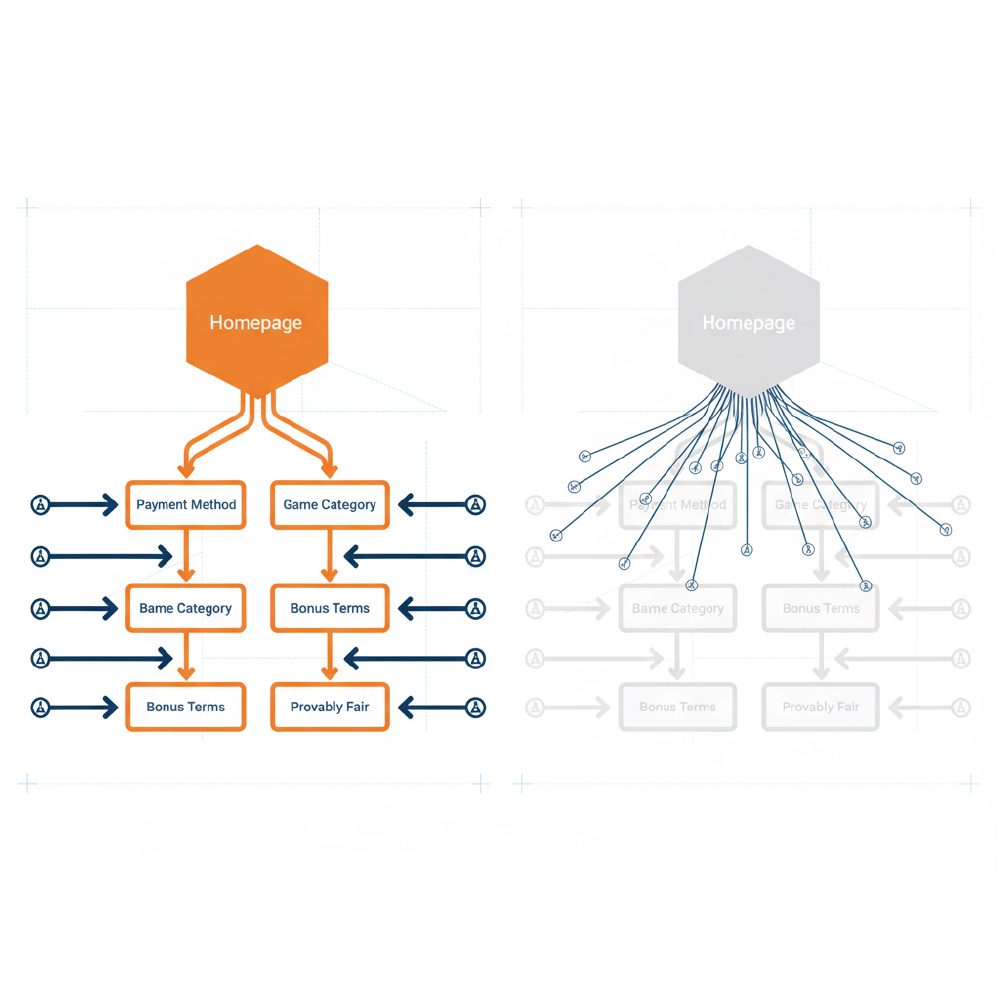
A homepage link passes domain-level authority and brand signals; an inner-page link passes page-specific relevance and topical trust directly to the URL that needs to rank, a game page, bonus page, or payment page. Casinos that only build homepage links end up with strong domains and weak money pages.
I check this constantly in Ahrefs' Best by Links report: pull any casino domain and you'll see the homepage sitting on 60-90% of total referring domains while the pages that actually convert, /deposit-bonus, /provably-fair, /bitcoin-withdrawals, sit on a handful of internal links and zero external ones. That's the default state of almost every casino site that's done nothing but guest posts and PBN links to the root domain.
The mechanism matters here. A homepage link raises the domain's overall authority ceiling (Domain Rating, Trust Flow, whatever metric you track), and some of that trickles down through internal linking and PageRank distribution. But Google's ranking systems increasingly evaluate pages, not domains, for competitive YMYL terms like 'bitcoin casino no verification' or 'crypto casino instant withdrawal.' A page with zero external citations and a thin internal link from the nav menu isn't going to outrank a competitor's dedicated page that's picked up 15 contextual backlinks from gambling forums and niche edits.
I've run this exact split test on three crypto-casino builds: identical homepage link velocity, but one brand got 70% of new links pointed at inner pages (payment methods, game categories, bonus terms) starting month two. That brand hit top-10 for its primary commercial terms about 5-7 weeks faster than the homepage-only control, based on Search Console query data I pulled at the 90-day mark.
Why do casino homepages hoard link equity instead of distributing it?
Homepages hoard equity because that's where most link builders default, it's the easiest page to pitch, the safest anchor to use (brand name or URL), and the one PBN and guest-post networks target by habit. Internal link architecture then fails to redistribute that equity down to deep pages that need it most.
Think about how a typical crowd-marketing or niche-edit campaign gets built. The outreach team or the Fiverr link seller doesn't want to negotiate over which deep URL to use, they default to the homepage because it's the lowest-friction placement and the client (you) rarely pushes back. Multiply that across 200+ links bought over 18 months and you get exactly the lopsided profile I described above.
Internal linking is supposed to fix this by flowing homepage authority down to category and money pages. In practice, most casino site architectures are flat and messy, a mega-menu linking to 40 games, a footer stuffed with payment-method links, and almost no contextual, editorial internal links from blog content into product pages. Screaming Frog crawls of casino sites I've audited routinely show commercial pages three or four clicks deep with fewer than five internal links pointing at them. PageRank sculpting only works if the architecture actually funnels link juice somewhere useful, and most casino CMS setups (WordPress with a casino theme, or a custom React front end) weren't built with that in mind.
The fix isn't abandoning homepage links, domain authority still matters for ranking the brand name and for passing trust to every page on the site. The fix is treating internal linking as its own deliberate SEO project: contextual links from high-traffic blog posts into bonus and game pages, breadcrumb schema, and a silo structure that groups 'no-KYC,' 'crypto deposits,' and 'live dealer' content into clusters that cross-link heavily.
When should you build links straight to inner pages instead of the homepage?
Build directly to inner pages when the page targets a specific commercial query the homepage can't realistically rank for, provably-fair explainer pages, deposit-method pages (Bitcoin, Litecoin, USDT), geo-specific landers, and individual game or bonus pages. These pages need their own citation signals, not borrowed homepage authority.
Google can't rank your homepage for 'provably fair dice game no KYC' and 'best USDT deposit bonus' simultaneously with the same page. Once you've got a URL dedicated to a specific sub-topic, it needs its own external validation, forum mentions, niche edits from gambling and crypto blogs, and ideally a few citations from Reddit threads or Telegram-adjacent crypto content that Google's crawlers pick up through indexed mirrors.
I prioritize inner-page link building for four page types on every casino build: payment-method pages (these convert at 2-3x the rate of generic landing pages in my GA4 data across client accounts), provably-fair/fairness-proof pages (critical E-E-A-T signal for a YMYL vertical where Google is actively suspicious of unverifiable claims), geo-specific landers (needed when you're running country-targeted content for markets like Brazil, Philippines, or Canada under different compliance framing), and high-volume game or slot category pages that carry genuine search demand independent of brand.
The trade-off is volume and cost. Homepage link campaigns scale easily, any guest post or PBN placement can point there. Inner-page campaigns require either custom content for each anchor placement or picky outreach that matches context to page topic, which slows velocity and raises cost per link by roughly 20-40% in my experience, mostly because you're paying for relevance, not just domain metrics.
What's the right homepage-to-inner-page link ratio for a casino site?
There's no universal ratio, but I run 70/30 inner-page-weighted for new no-KYC brands under six months old, 50/50 for established operators with existing domain authority, and 40/60 toward content/category pages for affiliate and comparison sites. The split shifts as the domain matures and commercial pages gain their own footing.
New domains have no brand equity to protect or leverage, so I front-load deep links to get commercial pages indexed and ranking fast while the homepage builds slower, more natural-looking authority in the background through PR mentions, directory citations, and a handful of high-DR niche edits. Established brands (18+ months, existing backlink profile of 500+ referring domains) have already banked homepage authority, the marginal value of another homepage link drops, so I redirect budget toward whichever money pages show weak URL Rating in Ahrefs relative to their ranking position.
Affiliate and comparison sites run differently because their entire business model is content pages (best crypto casinos, best no-KYC sportsbooks, individual casino reviews), the homepage there is often just a hub, so I weight even further toward inner pages, sometimes 30/70.
| Site type / stage | Homepage link % | Inner-page link % | Primary reasoning |
|---|---|---|---|
| New no-KYC/crypto casino (0-6 months) | 30% | 70% | No brand equity yet; commercial pages need independent ranking signals fast |
| Established operator (18+ months, 500+ RDs) | 50% | 50% | Homepage authority already banked; redistribute to weakest money pages |
| Affiliate/comparison hub | 30-40% | 60-70% | Content pages are the product, homepage is just a navigation hub |
| Sportsbook with heavy seasonal landers | 40% | 60% | Event and league pages need standalone authority before each season spikes |
What anchor text should you use for homepage links vs inner-page links?
Keep homepage anchors branded or naked-URL (70%+) to avoid triggering Penguin-style over-optimization penalties on your most-linked page. Inner-page anchors can carry 30-40% partial-match or commercial phrases because the page itself provides the relevance context, spreading risk across hundreds of URLs instead of concentrating it on one.
Anchor text concentration is the fastest way to get a casino domain flagged, and the homepage is where it happens most because it's the single most-linked URL on the site. If 15% of your homepage anchors read 'best bitcoin casino' or 'no verification casino,' that ratio sticks out hard in an Ahrefs anchor cloud report and it's exactly the pattern Google's spam systems have been trained to catch since Penguin 4.0 folded into core ranking signals.
My standard homepage anchor mix: 50-60% brand name (exact and variations), 15-20% naked URL, 10-15% generic ('click here,' 'this site,' 'learn more'), and no more than 10-15% exact or partial-match commercial anchors. On inner pages I flip that, branded anchors drop to 30-40%, and I let partial-match and even some exact-match commercial anchors run higher (up to 30-35%) because the anchor diversity is spread across dozens of distinct URLs rather than stacking on one. Google's algorithms evaluate anchor ratios per-URL and site-wide; distributing commercial anchors across many pages dilutes the risk signature even if the absolute number of commercial-anchor links is similar.
| Anchor type | Homepage target % | Inner-page target % |
|---|---|---|
| Branded (exact + variation) | 50-60% | 30-40% |
| Naked URL | 15-20% | 10-15% |
| Generic (click here, this site) | 10-15% | 10-15% |
| Partial-match commercial | 5-10% | 20-25% |
| Exact-match commercial | 0-5% | 10-15% |
How does this change for no-KYC and crypto casinos specifically?
Crypto and no-KYC casinos need inner-page link weight on provably-fair pages, specific coin deposit pages (BTC, LTC, USDT), and mirror-domain landers, because these are the exact pages Google's YMYL evaluators scrutinize for trust signals and the exact queries users search when seeking anonymous play. Homepage links alone won't satisfy that scrutiny.
No-KYC and crypto operators face a double bind: they're already fighting an uphill YMYL battle because gambling content gets held to a higher trust bar, and they're often running on .io, .bet, or mirror domains that lack the decade of brand history a licensed .com casino might have. I've found Google wants to see external validation specifically on the pages making anonymity and fairness claims, if your /provably-fair page has zero backlinks but makes technical claims about SHA-256 seed verification, that page reads as unsubstantiated to any trust evaluator, human or algorithmic.
My standard build for a crypto-casino client includes dedicated link campaigns (niche edits from crypto blogs, forum signatures on BitcoinTalk-adjacent communities, crowd marketing drops on Reddit and Telegram-indexed mirrors) targeting four URL types: the provably-fair methodology page, each major coin's deposit/withdrawal page, the no-KYC policy/FAQ page, and country-specific landers for markets where crypto gambling sits in a grey zone (Brazil pre-regulation, Canada, parts of Southeast Asia). Homepage links still matter for ranking brand-name searches and passing baseline domain trust, but I cap homepage weighting at 30% for these builds because the commercial queries that actually drive deposits, 'bitcoin casino no verification,' 'instant withdrawal USDT casino', resolve to inner pages, not the root domain.
Mirror domains complicate this further. If you're running three or four geo-mirrors for ad-ban workaround purposes, each mirror's homepage competes with your primary domain for the same brand terms. I deliberately avoid stacking heavy homepage link profiles on mirrors, it looks unnatural and risks flagging the whole cluster. Mirrors get lighter, inner-page-focused link profiles instead, usually just enough to rank regionally.
Which link-building tactics are safe on the homepage vs risky on inner pages (and vice versa)?
PBN and expired-domain links are higher-risk on the homepage because that's where Google's spam systems concentrate anchor and velocity analysis. Niche edits and crowd marketing work better pointed at inner pages because contextual relevance is easier to fake convincingly on a topic-specific page than on a generic homepage.
I rank tactics by where they survive scrutiny best. PBN links (private blog networks on expired domains with residual authority) carry real risk regardless of target, but the risk compounds on the homepage because a manual action or algorithmic devaluation there tanks the entire domain's baseline trust, not just one page's ranking. I still use PBNs, but I spread them across inner pages deliberately, if one tier gets devalued, you lose ranking on a category page, not the whole site's foundation.
Niche edits (inserting a link into existing, aged content on a relevant site) work best aimed at inner pages because the editorial context is believable: a crypto blog post about Bitcoin wallets linking to your /bitcoin-deposit page reads naturally; the same post linking to your homepage reads like a paid placement, which it is. Guest posts split the difference, I use them for both, but vary the target based on the article's specific subtopic.
Crowd marketing (forum posts, Q&A sites, comment links) almost always performs better pointed at inner pages because forum context is narrow, someone asking about provably-fair verification wants a link to the fairness page, not the homepage. Expired-domain 301 redirects are the one tactic I reserve almost exclusively for the homepage, since redirecting an aged, relevant expired domain straight to a deep page can look like an unnatural acquisition pattern if done repeatedly across many expired domains.
| Tactic | Safer target | Risk level | Why |
|---|---|---|---|
| PBN links | Inner pages | High | Spreads devaluation risk; homepage loss is domain-wide |
| Niche edits | Inner pages | Low-Medium | Contextual relevance reads naturally on topic-specific pages |
| Guest posts | Both (match topic) | Low | Editorial content should match the linked page's subject |
| Crowd marketing | Inner pages | Medium | Forum/Q&A context is narrow and topic-specific |
| Expired-domain 301s | Homepage | Medium-High | Repeated deep-page redirects can look like manipulated acquisition |
How do you measure whether your homepage/inner-page split is actually working?
Track Ahrefs' Best by Links report monthly to monitor referring-domain distribution, cross-check Google Search Console's Pages report to see which URLs are gaining impressions and clicks, and run Screaming Frog crawls to confirm internal link flow matches your intended architecture. If money pages aren't gaining both backlinks and impressions, the split needs rebalancing.
I pull three reports every month on every casino client. First, Ahrefs' Best by Links, filtered by referring domains, sorted by target URL, this shows exactly how equity is distributed right now, not how I think it's distributed. Second, Google Search Console's Pages and Queries reports, cross-referenced to see whether impression growth on commercial queries is tracking with the money pages I'm targeting, or whether the homepage is still absorbing impressions for terms it shouldn't realistically compete for. Third, a quarterly Screaming Frog crawl to verify internal link count and depth for every priority URL, if a page I've been building external links to still sits four clicks deep with three internal links, the external effort is fighting bad architecture.
The tell-tale sign of a broken split: homepage URL Rating climbing steadily in Ahrefs while specific money-page rankings stay flat in GSC despite keyword volume existing. That pattern means link equity is landing on the wrong URL. I've corrected this on client accounts by simply redirecting the next 90 days of link acquisition toward the underperforming pages and watched rankings move within 6-10 weeks, faster than most core-update-dependent changes because it's a direct signal fix, not a quality signal Google has to re-evaluate across a full crawl cycle.
What does a realistic 90-day roadmap mixing homepage and inner-page links look like?
Month one audits current link distribution and fixes internal architecture; month two starts inner-page-weighted acquisition (roughly 70/30) on priority money pages while maintaining a steady homepage drip; month three adds velocity and reviews GSC movement to rebalance the ratio based on which pages are actually responding.
Step one, weeks 1-2: full backlink audit in Ahrefs plus a Screaming Frog crawl to map current internal link flow. I identify the top 10 money pages by potential commercial value and check their current referring-domain count, almost always near zero compared to the homepage.
Step two, weeks 3-4: fix internal linking first, before spending a dollar on external links. This means adding contextual internal links from existing blog content and category pages into the priority URLs, restructuring the main nav if it's burying commercial pages too deep, and adding breadcrumbs.
Step three, weeks 5-10: start external link acquisition at 15-25 new referring domains per month (realistic for a mid-budget casino campaign, scaling higher for aggressive brands), weighted 70/30 toward inner pages. Mix niche edits, guest posts matched to page topic, and crowd marketing drops.
Step four, weeks 11-13: pull GSC and Ahrefs data, compare ranking movement per URL against link growth per URL, and rebalance the ratio. Pages showing strong responsiveness get more budget; pages still flat despite links get an internal-linking and content-quality review before more external spend, since sometimes the bottleneck isn't links at all, it's thin content that won't satisfy Google's helpful-content signals regardless of backlink count.
How do tiered link structures handle homepage vs inner-page targets differently?
Tier 1 (direct money links) should point wherever conversion actually happens, often inner pages, not the homepage. Tier 2 and Tier 3 links (links boosting your Tier 1 sources) should be built to whatever page shows the weakest URL Rating relative to its ranking goal, which is more often an inner page than the homepage once a domain matures.
Tiered structures exist to concentrate power-up effort on the links that matter most without exposing the whole domain to risk. Tier 1 links, the ones I'd call the "real" links, often from decent-quality niche edits, guest posts, or aged PBN placements, go directly to the URL I want ranking. For a crypto casino, that's frequently the /no-kyc-bitcoin-casino page or a specific deposit-method page, not the homepage, because that's the page carrying the commercial query.
Tier 2 links point at the Tier 1 sources themselves, boosting their authority so they pass more equity downstream, this is where I'll use higher-velocity, lower-quality tactics (bookmarking sites, forum profiles, Web 2.0 properties) because the risk is absorbed by a disposable Tier 1 asset, not the money page directly. Tier 3 repeats the pattern one level further out, mostly for scale and indexing speed on Tier 2 assets.
The mistake I see constantly: operators build elaborate tier structures but point every Tier 1 link at the homepage by default, wasting the entire structure's precision. The whole value of tiering is targeting control, if you're not using that control to hit specific inner pages, you might as well run a flat link-building campaign and save the complexity.
What mistakes do operators make with homepage-heavy link profiles?
The biggest mistake is assuming homepage authority automatically ranks money pages through internal linking alone, it doesn't, especially for competitive terms. Other common errors include anchor text over-concentration on the homepage and ignoring inner-page content quality while chasing external links.
I've audited dozens of casino domains where the SEO spend for 12+ months went almost entirely into homepage link building, and the operator is confused why their bonus and game pages rank on page 3 despite a Domain Rating in the 50s. Domain authority raises the ceiling for every page, but it doesn't guarantee any specific page clears that ceiling, page-level signals (content depth, internal links, external citations, user engagement) still decide individual rankings.
A second mistake: treating anchor text diversity as a homepage-only concern. I've seen domains with a clean homepage anchor profile get hit by manual actions because inner-page anchors were 60%+ exact-match commercial phrases across dozens of pages, Google's spam detection evaluates patterns site-wide, not just on the most-linked URL.
A third mistake, specific to the crypto and no-KYC space: operators chase link volume on thin pages. A provably-fair page with 200 words and a single paragraph explaining SHA-256 seeds won't hold rankings even with 20 backlinks if a competitor's equivalent page runs 1,200 words with actual verification walkthroughs, screenshots, and a seed-checking tool embedded. Links amplify existing quality; they rarely compensate for its absence anymore, especially post-Helpful Content System integration into core ranking.




Comments
No comments yet, be the first.