Casino Link Building Strategy 2026: The Quarterly Plan I Use to Keep Operator Sites Off Google's Radar
What does a quarterly casino link building strategy actually look like in 2026?
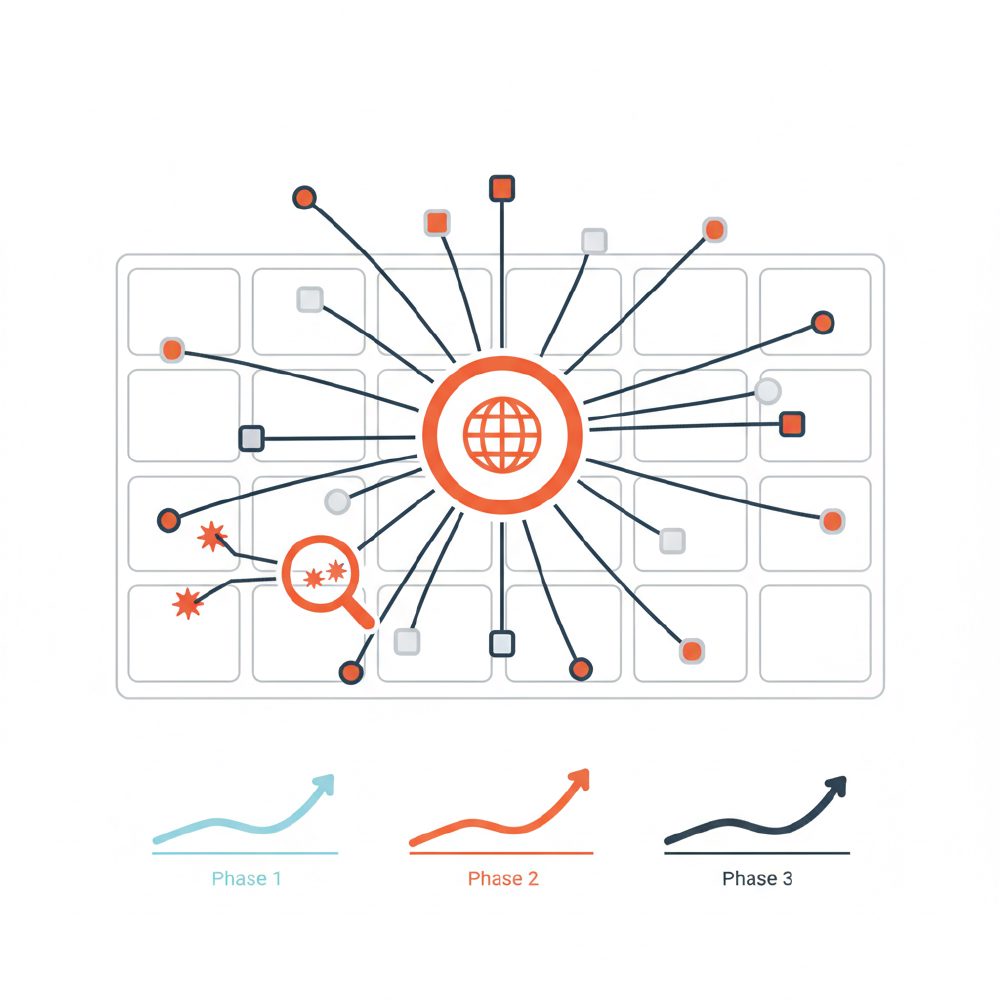
A quarterly casino link building strategy splits 90 days into diagnostic, scaling and consolidation phases instead of buying links at a constant rate. It matches link velocity to domain history, sequences anchor text deliberately, and builds a tiered structure so money pages never take a direct hit from risky link sources.
I almost never see a penalized casino site that lacked links. I see sites that bought the right volume of links in the wrong order. A client came to me in Q3 2025 with 340 referring domains built in six weeks, mostly PBN and expired-domain placements pointed straight at the deposit-bonus page, and a manual action for "unnatural links to your site" within 11 weeks of the burst. The links weren't all bad individually. The sequencing and concentration were the crime.
A quarterly plan fixes that by treating link building as three distinct phases, each with its own risk tolerance. Weeks 1-4 are diagnostic: audit existing referring domains in Ahrefs, flag toxic patterns, fix technical debt that would waste the authority you're about to build (orphaned pages, redirect chains, thin affiliate-style content Google already discounts). Weeks 5-9 are scaling: this is where you actually acquire links, at a rate tied to your current domain's referring-domain count, not an arbitrary target. Weeks 10-13 are consolidation: you stop acquiring, let Google crawl and recrawl (checking GSC's crawl stats and link reports), and measure which placements actually moved rankings versus which just added DR noise.
The reason this works where flat monthly retainers don't: Google's spam systems, including the link spam update rolled into the broader SpamBrain framework, weight velocity and timing heavily for YMYL-adjacent verticals like gambling. A steady drip looks like organic earned growth. A quarter split into a quiet audit month, an aggressive build month, and a cooldown month looks, paradoxically, more natural than a perfectly even monthly cadence, because real link earning is never perfectly even.
How should you sequence link types across a 90-day cycle?
Sequence foundational, low-risk links first (branded directories, digital PR, niche edits on relevant sites), then layer in scaled tactics (expired domains, crowd marketing, tiered PBN support) once the foundation holds 60-70% of total link volume. Never front-load aggressive tactics before you have editorial cover.
The order matters almost as much as the links themselves. I build every casino client's quarter on a simple rule: editorial-first, aggressive-second. If a reviewer at Google or a manual actions analyst pulls your backlink profile at any point mid-quarter, the first links they see chronologically should look like something a real brand earned, a mention in an iGaming trade publication, a niche edit on a sports betting content site, a cited data point from your own responsible-gambling research page.
Once that editorial base is in place, I target at least 15-20 genuinely earned or niche-edit placements before touching anything scaled, you layer in the higher-velocity tactics: expired-domain acquisitions rebuilt with relevant content, crowd marketing drops on forums and Reddit-adjacent communities (used sparingly, these still move needle on brand-anchor diversity), and tiered links that point at your tier-1 placements rather than your money pages.
Running this in the wrong order, scaled tactics in week 1, editorial cleanup in week 10, is exactly the pattern I find in post-penalty audits. The casino operators who recover fastest are the ones who, even after a hit, keep this sequencing discipline rather than panicking into another link-buying spree.
| Weeks | Phase | Link Types | Target Volume |
|---|---|---|---|
| 1-4 | Diagnostic & foundation | Audit + disavow cleanup, 5-8 niche edits, 2-3 digital PR pitches | Low, editorial only |
| 5-9 | Scaling | Expired domain builds, crowd marketing, tier-2 support links, continued niche edits | 60-70% of quarterly total |
| 10-13 | Consolidation & measurement | Pause new acquisition, monitor GSC/Ahrefs, selective top-up on underperforming pages | 10-15% top-up only |
What link building priorities differ between a new casino domain and an established one?
New casino domains (under 12 months, DR0-15) should prioritize trust and indexation signals, directories, brand mentions, a handful of niche edits, before chasing volume. Established domains (DR30+) should prioritize anchor diversification and topical relevance over raw link count, since they already have enough authority but often lopsided profiles.
A brand-new sportsbook or casino domain has almost no trust signal for Google to anchor a ranking decision to, so the first quarter isn't about link volume at all, it's about proving the domain is a real business. That means Trustpilot and BBB-style profile claims, licensing body citations (MGA, Curaçao, UKGC registries where applicable), a handful of genuine niche edits on gambling news sites, and patience. I tell new-domain clients not to expect ranking movement from link building alone inside the first two quarters; the content and technical foundation has to carry weight first.
Established domains, the ones I usually get called in to audit after a drop, almost always have the opposite problem: plenty of raw authority, DR40-60, thousands of referring domains, but a profile skewed 70%+ toward exact-match or money-adjacent anchors pointed at three pages. For these sites the quarterly priority flips to diversification: spreading link equity across informational pages (responsible gambling content, payment method guides, game-specific hubs) instead of only the "best online casino [state]" money page, and actively diluting anchor concentration rather than adding more volume.
| Domain Stage | DR Range | Primary Goal | Avoid |
|---|---|---|---|
| New (0-12 months) | DR0-15 | Trust signals, indexation, brand citations | Any PBN or expired-domain links before 10+ editorial placements exist |
| Growth (12-30 months) | DR15-35 | Steady editorial velocity, topical relevance clusters | Buying DR purely for the number |
| Established (30+ months) | DR35+ | Anchor diversification, link equity to informational pages | Concentrating new links on 2-3 money pages |
| Post-penalty recovery | Any | Disavow cleanup, rebuilding E-E-A-T, slow re-entry | Resuming acquisition before reconsideration or 2 core update cycles pass |
How many links per month is safe for a gambling site without triggering a spam update?
There's no published Google threshold, but patterns across 50+ gambling audits suggest growth beyond 25-30% of your current referring-domain count in a single month correlates with manual action exposure. A DR25 site with 80 referring domains should stay near 15-20 new ones monthly; a DR50 site with 2,000 can absorb more in absolute terms but less proportionally.
I want to be direct about the uncertainty here: Google has never published a velocity cap, and anyone quoting you an exact number as gospel is guessing too. What I can tell you is what I've measured across client Ahrefs/SEMrush histories before and after algorithmic or manual hits, the common thread isn't a fixed number, it's a sudden proportional jump. Sites that went from adding 10 referring domains a month to 150 in one month, sustained for 2-3 months, triggered either a link spam detection or a manual review far more often than sites that scaled velocity gradually over a quarter.
Practically, I set velocity caps as a percentage of trailing 90-day average, not a flat number: no single month should add more than 1.5-2x the trailing average referring-domain growth. If a site averaged 12 new referring domains a month for the prior quarter, I won't push past 24 in the scaling month even if budget allows more, I'd rather extend the campaign into next quarter than spike it.
This also interacts with content publishing velocity. A casino site adding 20 new referring domains a month but publishing no new pages looks like pure link manipulation. One adding the same 20 links while also shipping 4-6 new informational pages a month looks like a site that's genuinely growing and earning attention as a byproduct. Pair link velocity with content velocity or the pattern reads as manufactured no matter how careful the link sources are.
Where should tier-1 vs tier-2 links fit in the quarterly plan?
Tier-1 links are direct, editorially earned placements pointing at your site, niche edits, digital PR, guest contributions. Tier-2 links point at those tier-1 placements to boost their authority, never at your money pages directly. This structure isolates risk: if a tier-2 source gets deindexed, your core domain is untouched.
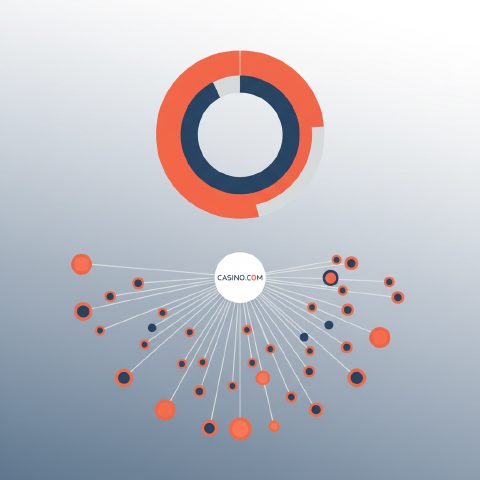
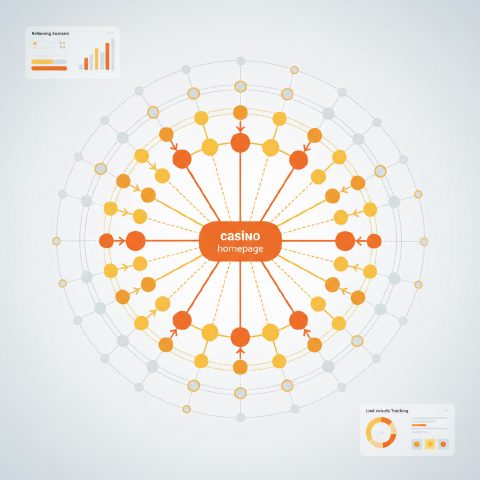
Tiered link structures get a bad reputation because people associate "tier-2" with spam, but the structure itself is just risk isolation, it's how you use lower-trust link sources (expired domains, PBN nodes, bookmarking/web 2.0 properties) without exposing your actual casino domain to them. The rule I enforce with every client: tier-2 links never touch your root domain or money pages. They point exclusively at tier-1 pages, the niche edit you got on a legitimate sports content site, the digital PR placement that already ranks and gets real traffic.
This matters because tier-2 sources decay. PBN networks get deindexed in batches when Google's web spam team identifies a footprint (shared hosting IPs, template similarity, WHOIS patterns). Expired domains sometimes get reclaimed or flagged after reactivation. If any of that happens to a link pointing directly at your casino.com, you've lost real equity and possibly drawn unwanted attention. If it happens to a tier-2 link supporting a tier-1 placement, you lose a small boost to one asset and nothing touches your core domain's link profile.
In the quarterly plan, tier-1 acquisition runs continuously across all three phases at a controlled pace. Tier-2 support only starts in the scaling phase (weeks 5-9), after tier-1 placements exist to receive it, and I cap tier-2 volume at roughly 2-3x tier-1 volume, beyond that ratio the structure starts looking artificial even to a competitor running Ahrefs on your domain, let alone to Google.
What's the right anchor text ratio for casino link building in 2026?
Keep branded anchors (your site name, URL variations) at 50-60% of the total profile, naked URLs at 15-20%, partial-match/topical anchors at 15-20%, and exact-match commercial anchors ('best online casino,' '[state] sportsbook bonus') under 5-8%. Exceeding 10% exact-match is the pattern I most consistently find in penalized casino sites.
Anchor text ratio is the most actionable, most ignored lever in casino link building. I've pulled the anchor text report in Ahrefs on probably 200+ gambling domains at this point, and the ones sitting on manual actions or that lost 70%+ traffic in a core update almost always cluster the same way: 25-40% exact or near-exact commercial anchors like "best crypto casino" or "[state] online sportsbook promo code," built over a short window.
Healthy profiles, including plenty of casino sites that rank well and have never been touched, look boring by comparison: the brand name and brand name plus modifier ("BetXYZ review," "BetXYZ bonus code") dominate, naked URLs show up constantly because that's how people actually link to things in forums and news articles, and exact-match commercial phrases are a small minority earned incidentally, not engineered. When I rebuild a profile post-penalty, the anchor text plan is usually the first deliverable, before a single new link goes out, because adding more volume on top of a skewed ratio just digs deeper.
Within the quarterly plan, I assign anchor text per batch, not per link. Each month's batch of 15-25 links gets a target mix (say, 12 branded, 4 naked URL, 6 partial match, 1-2 exact match) decided in advance, then tracked against the live Ahrefs anchor report at month close. If a batch drifts over 8% exact-match, the next batch corrects it down rather than letting it compound.
How do you budget a quarterly casino link building plan?
A realistic mid-market casino link building budget runs $8,000-$25,000 per quarter depending on market and competitiveness, US state-regulated and UK markets sit at the top end, offshore crypto casinos often run leaner. Allocate roughly 50% to niche edits/digital PR, 25% to content-for-links, 15% to expired domain acquisition, 10% to measurement and tooling.
Costs vary enormously by market, and anyone giving you a single flat number for "casino link building" is oversimplifying. In the regulated US and UK markets, where competitors are often well-funded affiliates and the legal advertising restrictions push more budget into organic and PR channels, I've seen quarterly link budgets from $15,000 up to $60,000+ for top-tier operators chasing head terms like "best online casino [state]." Offshore and crypto-casino clients, where the competitive set is thinner but domain trust is harder to establish, often run effective campaigns at $8,000-$15,000 a quarter by leaning more on content-for-links and crowd marketing and less on expensive digital PR placements.
Tooling isn't optional overhead, I treat an Ahrefs or SEMrush subscription plus Screaming Frog as fixed costs baked into every quarter because without live anchor text and referring-domain monitoring you're flying blind on exactly the metrics that predict penalty risk. Budget $400-$600/month combined for a mid-tier Ahrefs plan and crawling tools if you don't already have enterprise access.
| Category | % of Budget | What It Buys |
|---|---|---|
| Niche edits & digital PR | 50% | 15-30 editorial placements on relevant gambling/sports/finance sites |
| Content-for-links | 25% | Linkable assets: data studies, state-by-state guides, responsible gambling research |
| Expired domain acquisition & rebuild | 15% | 3-6 relevant expired domains, hosting diversification, content rebuild |
| Measurement & tooling | 10% | Ahrefs/SEMrush, Screaming Frog, GSC monitoring, quarterly audit time |
Which link acquisition channels should operators prioritize this quarter?
Prioritize niche edits on relevant gambling, sports and finance sites, digital PR around data/surveys, and content-for-links first, these carry the lowest risk and highest durability. Use expired-domain rebuilds and crowd marketing as scaled supplements, never as the primary channel, and treat parasite SEO as a separate, short-term visibility play, not a link source.
Niche edits, getting a contextual link added into an existing, already-indexed article on a relevant site, remain the single best risk-to-reward channel for casino link building in 2026. They're editorial by nature, the host page already has trust and sometimes traffic, and because you're not publishing new content the footprint is smaller than guest posting. I budget these at $150-$400 per placement depending on DR and niche relevance; gambling-specific sites with real traffic command the top of that range.
Digital PR, pitching a data study, a survey of player behavior, a responsible-gambling statistic, earns links from sites that would never accept a direct gambling guest post, including mainstream news and finance outlets, which is exactly the kind of topical diversity that makes a link profile look earned rather than manufactured. It's slower (expect a 20-40% pitch acceptance rate at best) and costs more per placement, $500-$1,500 depending on the journalist outreach required, but one genuine placement on a recognized outlet can be worth more for E-E-A-T than ten niche edits.
Expired domain acquisition and crowd marketing are scaled supplements, not primaries. Buying an expired domain with real historical relevance (a defunct poker or sports betting blog, verified clean in Ahrefs' historical backlink and anchor data before purchase) and rebuilding it as a tier-1 asset works, but the due diligence matters, I reject roughly a third of domains clients want to buy because the historical anchor profile or past penalty history makes them liabilities rather than assets. Parasite SEO, publishing on high-authority platforms like Medium, Sites.Google, or sub-pages of established news domains to rank directly, is a separate tactic entirely; it earns visibility, not links, and I keep its budget and reporting fully separate from the link building plan so clients don't conflate short-term parasite rankings with durable domain authority.
How do you measure whether your quarterly link plan is working?
Track referring-domain growth against ranking movement on target pages, not DR alone, DR can rise while rankings stall if links aren't topically relevant. Pull a GSC and Ahrefs comparison at the close of each month: new referring domains, anchor text distribution shift, and keyword position changes on the specific pages that received links.
Domain Rating is the metric clients fixate on and the one I trust least as a standalone success signal. I've watched casino sites climb from DR30 to DR45 in a quarter through aggressive link buying and see zero ranking movement, because the links were topically irrelevant, or concentrated on pages that weren't the actual ranking target, or both. DR measures link authority in Ahrefs' model; it says nothing about relevance or whether Google's own systems are crediting the link at all.
My monthly reporting for every casino client pulls three things side by side: referring domain count and anchor distribution from Ahrefs, indexation and link data from Google Search Console's Links report (which shows what Google has actually crawled and counted, sometimes meaningfully less than what Ahrefs has indexed), and keyword position tracking specifically on the pages that received links that month, not site-wide rankings. If a page received 8 new links in month 2 and its target keywords haven't moved by the end of month 3, that's a signal the links weren't relevant or weren't passing equity, and I'll reallocate that budget rather than keep feeding the same page.
I also watch Search Console's manual actions report and the crawl stats report every single week during the scaling phase, not just at quarter close, a spike in crawl requests to low-value new pages, or a message in the manual actions panel, needs same-week response, not a note for the quarterly review.
What are the biggest risks that derail a casino link building roadmap?
The biggest risks are velocity spikes disconnected from content growth, anchor text concentration over 10% exact-match, PBN footprint detection (shared hosting/templates), and treating link building as separate from technical health, building authority onto pages with crawl errors, thin content or duplicate issues wastes the investment entirely.
Velocity spikes are the most common derailment and the easiest to avoid once you're watching for it, I covered the mechanics above, but the practical failure mode is almost always a client or agency trying to compress a quarter's worth of links into six weeks because a competitor outranked them and someone wants fast movement. Resist this. A compressed timeline doesn't just risk detection; it also wastes money because Google needs time between crawls to credit new links incrementally, so a burst doesn't even move rankings faster than a steady drip would.
PBN footprint detection is the second major risk, and it's almost always a hosting and template problem, not a content problem. Sites on the same C-class IP range, the same WordPress theme with the same plugin fingerprint, or registered through the same privacy-shielded WHOIS pattern get swept in batches when Google's spam systems or manual reviewers identify the network. If you're running or buying into PBN infrastructure, insist on diversified hosting providers (not just different IPs from the same host), different CMS templates, and staggered registration dates, cutting corners here is the single fastest way to lose an entire tier-2 layer overnight.
The third risk is less discussed: building links onto a technically broken foundation. I've audited casino sites pouring $20,000 a quarter into link building while Screaming Frog turns up thousands of 404s, redirect chains three hops deep, and duplicate state-landing pages competing against each other. Links pointed at pages Google can't crawl efficiently or won't index confidently don't compound, they just evaporate. Fix the technical foundation in the diagnostic phase before scaling spend, every time.
How do you adjust the quarterly plan after a core update or manual action?
Pause all new link acquisition immediately, run a full backlink audit in Ahrefs/SEMrush to separate toxic from neutral links, file a disavow for clearly manipulative patterns, and don't resume building until you've either received reconsideration confirmation or watched two consecutive core update cycles pass without further decline.
The first move after any manual action or a core-update traffic drop that correlates with link patterns is to stop, no new acquisition, full stop, even if contracts or retainers are already committed. Continuing to build while Google is actively reassessing your link profile just adds more data for the next evaluation to penalize. I've taken over recoveries where the previous team kept building through a manual action because the client didn't want to "lose momentum," and it extended the recovery timeline by months.
Next is the audit: export the full backlink profile, cross-reference against historical acquisition records if you have them (this is where keeping a link log per quarter pays off enormously, if you don't know which links you built on purpose, you can't tell your own paid pattern from genuinely toxic third-party spam). I categorize every referring domain into keep, monitor, or disavow, and I'm conservative with disavow, over-disavowing legitimate links has its own cost, and Google has stated disavow is rarely necessary for algorithmic (non-manual) issues. For manual actions specifically, a disavow file plus a reconsideration request detailing what was removed and why is required; expect a 2-6 week response window, sometimes longer.
For algorithmic hits without a manual action, the more common and more frustrating scenario, there's no reconsideration process, just time and improved signals. I tell clients to treat the next two quarters as E-E-A-T rebuilding, not link building: author credentials, licensing transparency, responsible gambling resources, genuine expert review content. Resume outbound link acquisition only in quarter three, at half the previous velocity, and watch the next core update cycle closely before scaling back up.



Comments
No comments yet, be the first.