Casino Homepage SEO in 2026: The Keyword Autopsy Every Operator Needs
What should a casino homepage actually rank for in 2026?
Your homepage should rank for brand terms, brand+geo terms, and at most one broad head term tied to your core offer, 'online casino [state/country]' or brand plus 'review' or 'login'. Everything more specific, game types, bonus codes, payment methods, belongs on dedicated category and landing pages, not the homepage.
I've pulled Ahrefs Site Explorer data on more than fifty operator domains during penalty audits, and the homepage keyword list is almost always a mess. The average homepage in my audit sample ranks for somewhere between 150 and 300 distinct keyword variants, but over 90% of real click volume sits inside fewer than ten of them, the brand name, brand plus a handful of modifiers, and one or two broad head terms. The remaining mass of rankings is noise: cannibalization artifacts, orphaned anchor text left over from old link campaigns, or thin relevance signals Google is weighing against a category page that actually does the job.
That noise isn't harmless. Every keyword your homepage ranks for without earning real intent-match content dilutes the page's topical focus. Google's systems, from the original Penguin anchor-text penalty through to the 2024 scaled content abuse policy, treat a page trying to be everything to everyone as a weaker signal than a page that answers one query type deeply. A homepage targeting 'slots,' 'poker,' 'sports betting,' 'crypto casino,' and 'live dealer' simultaneously in its title tag is a 2013-era pattern that still shows up on roughly a third of the sites I'm brought in to fix.
The fix isn't deletion, it's reassignment. I run a keyword-mapping pass using Ahrefs' Organic Keywords report filtered by URL, cross-reference it against Google Search Console's Performance tab segmented by page, and then draw a hard line: if a keyword's intent requires a game list, a bonus table, a payment matrix, or jurisdiction-specific licensing detail, it moves off the homepage permanently. What's left is usually five to twelve terms, that's the homepage's real job.
Why do most casino homepages chase the wrong keywords?
Legacy SEO habits stuffed homepage title tags and H1s with every vertical the brand offers, slots, poker, sports, bingo, because that's how 2012-era link building worked. That pattern now triggers keyword cannibalization against category pages and reads as thin, unfocused content to Google's helpful content and spam detection systems.
I still see the same fingerprint on audit after audit: an H1 reading something like 'Best Online Casino, Slots, Poker, Sports Betting, Live Dealer, Crypto Casino' sitting on top of 300 words of filler copy. That structure made sense a decade ago when ranking was mostly a function of exact-match on-page signals plus exact-match anchor text pointed at the homepage from a PBN or tiered link network. Google's ranking systems have moved past that, but a lot of operator sites, especially ones built or relaunched by the same agency team years apart, never rewrote the template.
The deeper problem is what this does to internal link equity. When the homepage's own on-page signals claim ownership of 'online slots,' 'online poker,' and 'live dealer blackjack' all at once, the category pages built specifically for those terms are now competing with their own homepage. I've seen this cause rank-flipping in Search Console, the same query alternating between the homepage URL and the category URL week over week, which is a textbook cannibalization signature and a clear sign Google hasn't decided which page actually deserves to rank.
This gets worse when it's reinforced externally. A lot of the toxic link profiles I clean up during disavow work show heavy exact-match anchor text, 'best online casino,' 'online slots real money', pointed directly at the root domain instead of the relevant category page, usually from legacy niche-edit or PBN campaigns built before 2019. That external signal keeps telling Google the homepage is the authority for terms the site structure says belong three clicks deep.
Homepage vs category pages: which casino keywords belong where?
Brand and brand+geo terms belong on the homepage. Vertical head terms belong on top-level category pages. Game-specific, bonus-specific, and payment-specific long-tail terms belong on dedicated subpages. The rule: the more specific the query, the further from the homepage the ranking page should sit in your architecture.
I map this with a simple test during audits: does satisfying this query's intent require content the homepage structurally can't hold without becoming a 2,000-word scroll-fest? If a query needs a table of 40 slot providers, a bonus terms breakdown, or a state-by-state licensing list, it's a category-page keyword by definition, not a homepage keyword, no matter how much volume it carries.
Where operators get this wrong most often is with generic head terms like 'online casino' or 'real money casino.' Unless that phrase genuinely is the brand's entire identity, an aggregator or comparison site rather than a single licensed operator, trying to rank the homepage for it pulls resources away from terms you can actually win: your brand, your brand plus your state, your brand plus 'app' or 'login.' A single-license operator homepage competing against affiliate roundups and multi-state aggregators for 'best online casino' is fighting a battle it structurally can't win without becoming a content hub itself.
| Keyword type | Example query | Best-fit page | Why it belongs there |
|---|---|---|---|
| Brand | bet365 casino | Homepage | Navigational intent, highest conversion, must be defended |
| Brand + geo | betmgm new jersey login | Homepage or state landing page | Regulated markets need jurisdiction-specific trust signals |
| Vertical head term | online casino real money | Homepage only if it IS the brand's core identity; otherwise top category page | Too broad for a single homepage to satisfy search intent depth |
| Game vertical | online blackjack real money | Game category page | Needs game variants, RTP data, software providers, homepage can't hold that depth |
| Bonus/offer | no deposit bonus codes 2026 | Promotions page | Bonus terms change weekly; stale homepage content gets flagged fast |
| Payment method | casino that accepts crypto | Banking/payments page | Needs processor list, KYC detail, withdrawal time data |
| Comparison/review | best online casino 2026 | Dedicated hub page or blog, not brand homepage | Comparison intent conflicts with single-brand navigational intent |
Should branded keywords casino searches generate be a homepage priority?
Yes, always, without exception. Branded keywords are the one keyword set a homepage must fully own and defend, brand name, brand plus 'login,' 'review,' 'app,' or 'bonus.' Losing any of these SERP positions to affiliates, app store listings, or complaint sites is a trust and E-E-A-T problem, not just a traffic problem.
Branded searches convert at a dramatically higher rate than generic head terms because the searcher already knows who you are, this is frequently a returning depositor checking a login page or a bonus update, not someone comparison shopping. If your homepage isn't the dominant result for your own brand name, something structural is wrong: thin homepage content, a slow load time losing out to a faster third-party page, or a reputation issue surfacing negative or outdated third-party content above you.
I treat brand SERP ownership as a monitoring metric, not a one-time fix. Every audit includes a brand-term SERP capture: is the homepage ranking #1, are sitelinks showing, is anything negative in positions 2-5? Structured data matters here, Organization and WebSite schema with a defined SiteNavigationElement set increases the odds Google generates sitelinks under your homepage, which pushes competing or negative results further down the page. I've seen this alone recover visible brand real estate within two to four weeks of implementation, well inside a normal re-crawl cycle for an established domain.
The flip side: don't let the homepage's brand-defense job bleed into claiming unrelated generic terms. I've audited sites where the brand-protection instinct got overextended into stuffing the homepage title tag with ten unrelated verticals 'just in case.' Defend the brand surface aggressively; don't use it as an excuse to re-introduce the stuffing problem described earlier.
What casino home page keywords actually move revenue?
Brand and brand-modifier terms convert highest because they capture returning depositors. Geo+vertical terms matter in regulated single-state or single-country markets. Generic head terms carry volume but convert poorly for a single-brand homepage, and long-tail vertical terms almost never belong on the homepage at all.
Volume and value aren't the same thing, and casino operators confuse the two constantly. A head term like 'online casino' might show six-figure monthly search volume in a market report, but a single operator's homepage capturing position three or four on it converts a fraction of that traffic, most of that demand is comparison intent, and it's being absorbed by affiliate hubs and multi-brand aggregators built specifically to serve that intent with twenty operator listings side by side.
What I actually track in attribution data across operator accounts is conversion rate by keyword tier. Brand and brand-modifier terms consistently show the highest deposit conversion of anything in the account, these searchers already decided. Geo+vertical terms in regulated markets (think 'online casino michigan' for a licensed MI operator) convert well above generic head terms because the searcher has already filtered by jurisdiction, which usually means they're closer to a deposit decision. Generic head terms and long-tail vertical terms belong further down the funnel, on pages built to match that specific intent, not forced onto a homepage that can't hold the depth they require.
| Tier | Example | Search intent | Typical conversion pattern | Recommended owner page |
|---|---|---|---|---|
| 1, Brand | pokerstars casino | Navigational | Highest, returning depositor | Homepage |
| 2, Brand modifier | pokerstars casino login / app / review | Navigational-informational mix | High | Homepage, or a dedicated login/app page linked from it |
| 3, Geo + vertical | online casino pennsylvania | Commercial, filtered | Medium-high in regulated single-state/country markets | State/geo landing page, linked prominently from homepage |
| 4, Generic head term | online casino | Commercial, broad, very competitive | Low per-visit for a single brand; high volume | Rarely winnable for a single-operator homepage |
| 5, Long-tail vertical | live dealer baccarat minimum bet | Transactional, niche | High relevance, lower volume | Game/category page, never the homepage |
What keywords should you deliberately skip on the casino homepage?
Skip long-tail vertical terms, every individual bonus code, payment-method specifics, and duplicate geo pages crammed onto one URL. Skip 'free' modifiers entirely on real-money brand homepages, they create an intent mismatch that drags down conversion rate and confuses Google about what the page is actually for.
The 'free' modifier is the single most common mistake I see on real-money operator homepages. Targeting 'free online slots' or 'free casino games' on a brand homepage that's licensed for real-money play pulls in a searcher cohort with fundamentally different intent than your actual product, tanks on-page engagement metrics, and muddies the page's topical signal for the real-money terms you actually need to rank for. If you run a social-casino or sweepstakes product alongside a real-money brand, that's a separate domain or at minimum a separate subdirectory, never the same homepage.
Geo-stuffing is the second repeat offender. I've audited homepages trying to simultaneously rank for ten state-level variants ('online casino new jersey,' 'online casino pennsylvania,' 'online casino michigan') by cramming all ten into one page's copy and schema. That's a near-doorway-page pattern, and it's exactly the kind of structure the 2024 scaled content abuse update was built to catch when it's done at volume across dozens of near-identical pages. Build one geo landing page per regulated market, link them from the homepage with clear, descriptive anchors, and let the homepage stay focused on brand.
Bonus codes and payment-method long-tail are the third category to skip. These terms change constantly, a bonus code expires, a payment processor gets added or dropped, and a homepage trying to stay current on all of it either goes stale fast or gets edited so often it loses stable ranking signals. Move this to promotions and banking pages that are built to be updated on a weekly cadence without touching the homepage's core template.
How does casino homepage over-optimization trigger a penalty or core-update hit?
Over-optimized homepages combine exact-match anchor stacking, near-duplicate geo variants, and thin content relative to competing category pages, a pattern that both manual spam reviewers and algorithmic systems like core updates and the scaled content abuse policy are specifically tuned to catch. I've seen this exact combination cost sites 70%+ of organic traffic in a single update cycle.
One recovery case that illustrates this cleanly: an offshore casino brand lost 72% of organic sessions after a March core update. The crime scene, once I crawled it with Screaming Frog and pulled the backlink profile in Ahrefs, was a homepage plus forty near-duplicate state-variant pages, all targeting the same head term with maybe 15% unique content between them, reinforced by a tiered link network with exact-match anchors sitting above a 30% ratio against the root domain. That's not a borderline case, that's a textbook scaled content and over-optimization signature, and the update treated it accordingly.
The recovery path in cases like this is never a quick fix. Step one is always a full anchor text audit using Ahrefs' Backlinks report, segmented by exact-match, partial-match, branded, and naked-URL categories, if exact-match sits meaningfully above roughly 15%, that's a red flag worth disavowing the worst offenders and diluting the rest with new, naturally-anchored links. Step two is consolidating the near-duplicate pages: merge or 301 the thin geo variants into fewer, genuinely differentiated pages, and let the homepage drop back to targeting only what it can legitimately support with unique content.
What I tell operators going through this: there's no shortcut that avoids a temporary dip. Removing stuffed terms from a homepage title tag or H1 can cost you some of the long-tail ranking noise you were never converting on anyway, but it's the only path to a stable recovery. Sites that try to patch symptoms, rewriting the title tag without fixing the link profile, or disavowing links without fixing on-page cannibalization, tend to plateau below their pre-penalty traffic and stay there.
How should internal links flow from the casino homepage without diluting category pages?
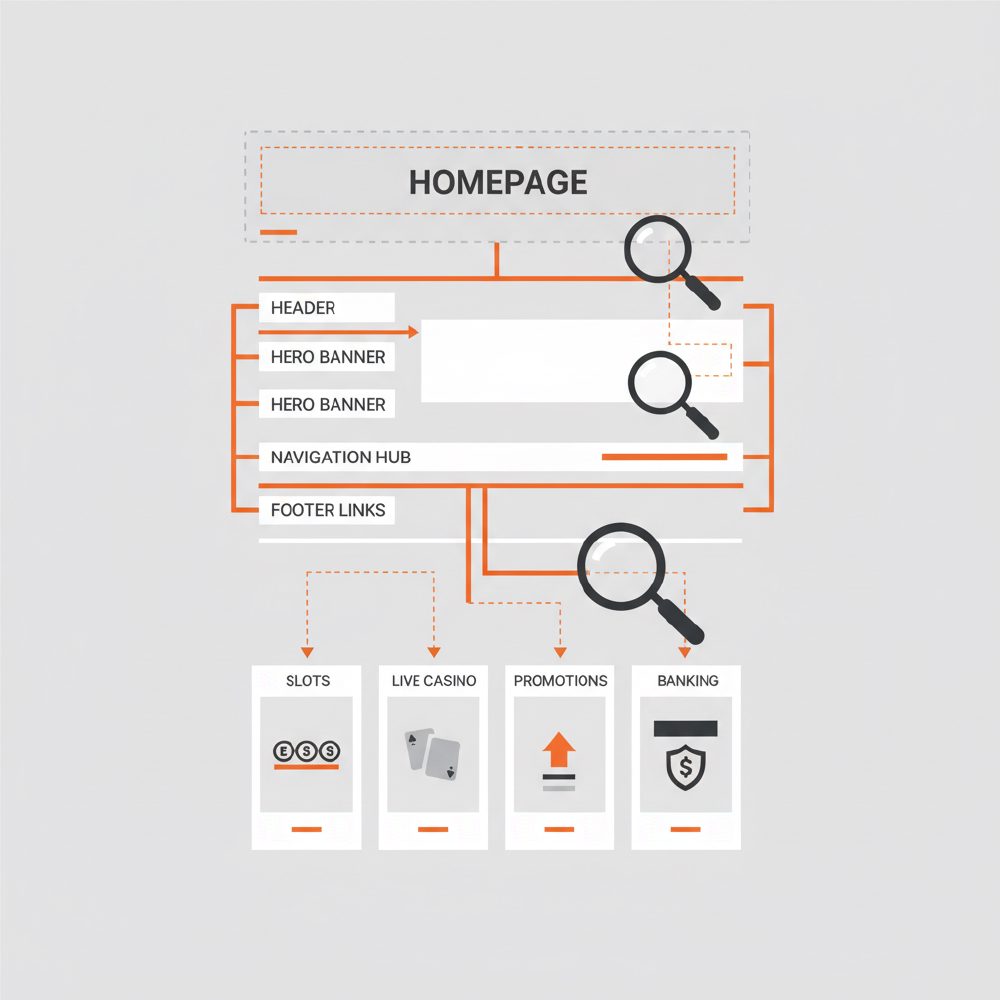
Use a hub-and-spoke model: the homepage links directly to five to eight top-level category hubs with descriptive, varied anchor text, and those hubs link down to subcategory and game pages. Avoid footer link farms linking every page from the homepage, that flattens your architecture and tells Google nothing is more important than anything else.
I check crawl depth on every audit using Screaming Frog's site structure visualization, and the recurring failure mode is a footer stuffed with 60-100 links, every game page, every state page, every promo, all one click from the homepage. That structure feels thorough, but it does the opposite of what the operator intends: it spreads link equity so thin that no category page gets a meaningful boost, and it signals a flat, undifferentiated site rather than one with a clear topical hierarchy Google can use to understand what matters most.
The fix is a genuine hub-and-spoke model. The homepage links to a small number of primary hubs, Slots, Live Casino, Sports (if applicable), Promotions, Banking, using descriptive anchors that vary naturally ('browse our slots library' rather than repeating 'online slots' verbatim on every link). Those hubs then link down to individual game or payment pages. This keeps every important category page within two or three clicks of the homepage while letting the internal anchor text do semantic work instead of over-optimized keyword stacking.
I validate this with Google Search Console's internal links report after implementation, category pages that were previously buried should show a meaningful jump in internal link count within the first full crawl cycle, and that typically shows up as improved impressions for the targeted terms within four to eight weeks, assuming no other technical issues are suppressing the pages.
What technical and E-E-A-T signals does a casino homepage need to rank in 2026?
A compliant casino homepage needs Organization and WebSite schema, visible licensing and regulator badges (UKGC, MGA, state gaming commissions), responsible gambling links, fast Core Web Vitals, and real editorial ownership signals, author bios, last-updated dates, and a transparent About/Licensing page. These are trust signals Google's systems weight heavily on YMYL gambling content.
Gambling falls squarely under Google's Your Money or Your Life classification, which means trust and authoritativeness signals carry more ranking weight than they would on a low-stakes topic. On every audit I run, the first thing I check after the keyword map is whether the homepage actually surfaces its licensing information above the fold or buried three scrolls down in a tiny footer line. Regulators like the UKGC, MGA, and individual US state gaming commissions expect visible compliance, and Google's systems increasingly reward pages that make that information easy to find and verify rather than treating it as legal boilerplate.
Schema markup matters more here than on most verticals I work in. Organization schema with sameAs links to verified social profiles and regulator listing pages, WebSite schema with a SearchAction for sitelinks search box eligibility, and a clearly defined SiteNavigationElement set all contribute to how confidently Google's systems can parse the page's authority and structure. I don't recommend Review or AggregateRating schema on a single-operator homepage unless you have genuinely compliant, verifiable review data, misused review schema on gambling sites is a recurring manual action trigger I've had to clean up more than once.
Core Web Vitals and mobile performance round out the technical side. Casino homepages are notoriously heavy, hero video, live jackpot counters, promotional carousels, and I regularly find LCP scores above 4 seconds on mobile during audits, which is well into the range where Google's page experience signals start working against you. Lazy-loading non-critical carousel assets and deferring third-party scripts (affiliate tracking pixels are frequent offenders) typically brings this back under 2.5 seconds without touching the design.
How do you audit a casino homepage that's ranking for the wrong terms?
Pull the full keyword list from Ahrefs Site Explorer, cross-reference with Search Console to find cannibalized queries, crawl internal and external anchor text distribution, and compare homepage content depth against the category pages it's competing with. The pattern that emerges tells you exactly what to reassign and what to cut.
This is the exact five-step sequence I run on every penalty or stagnation case before touching a single line of code. It's deliberately ordered: you need the full picture of what's actually happening before you start reassigning keywords or rewriting templates, because fixing on-page signals without addressing the external anchor profile, or vice versa, tends to produce a partial, unstable recovery.
Step one establishes scope: what is the homepage currently ranking for, in full, not just the top ten terms you already know about. Step two finds the conflict: which of those queries are also being served by a category page, and is Google flip-flopping between the two URLs week to week in Search Console. Steps three and four look outward, is the site's own internal link structure or its external backlink profile reinforcing the wrong page for a given term. Step five is the gut check: does the homepage actually have the content depth to justify ranking for what it's claiming, compared to what's currently outranking it.
Once that data is in hand, the reassignment work is mechanical: strip the homepage's title tag and H1 down to brand and the one or two terms it earns, 301 or consolidate any duplicate geo pages found, update internal anchors pointing at the homepage to use brand-oriented language instead of exact-match head terms, and submit a disavow file for any external links still hammering the homepage with commercial exact-match anchors from legacy campaigns.
| Step | Tool | What you're checking | Red flag |
|---|---|---|---|
| 1. Pull the homepage keyword list | Ahrefs Site Explorer, URL filter | Every keyword the homepage ranks for in the top 50 | Homepage ranking for 100+ unrelated terms |
| 2. Map cannibalization | Google Search Console, filtered by page | Overlap between homepage and category page rankings for the same query | Same query alternating between two URLs week to week |
| 3. Crawl internal anchors | Screaming Frog, custom extraction | Anchor text pointing to the homepage site-wide | Exact-match head-term anchors above roughly 15% of total internal anchors |
| 4. Check external anchor profile | Ahrefs Backlinks report | Anchor text distribution across all links pointing to the homepage | Heavy exact-match footprint consistent with old PBN or tiered-link campaigns |
| 5. Compare content depth | Manual review + Screaming Frog word count | Homepage depth versus the category pages and competitors it's actually competing against | Homepage thinner than the pages outranking it for the same terms |




Comments
No comments yet, be the first.